
ARIvidya | International Relations | UPSC GS Paper II
Thank you for reading this post, don't forget to subscribe!
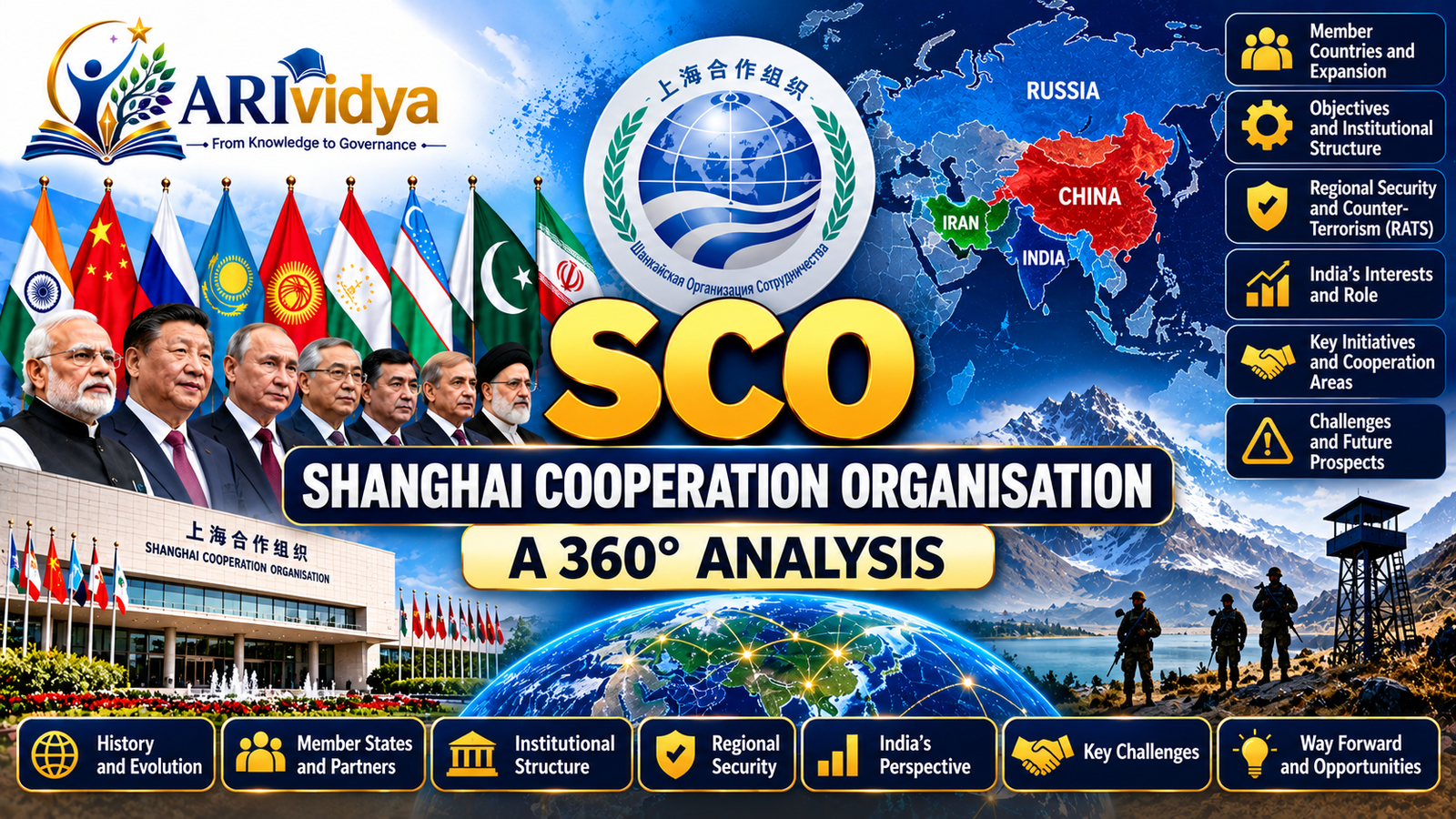
The Shanghai Cooperation Organisation (SCO) is a Eurasian regional organisation focused on security, political cooperation and economic and cultural engagement. It provides India with a platform to engage China, Russia, Central Asian states and other regional partners, even as bilateral tensions and differing strategic priorities limit consensus.
1. Origin and evolution
The SCO was established in 2001 by China, Russia, Kazakhstan, Kyrgyzstan, Tajikistan and Uzbekistan. It grew out of the earlier “Shanghai Five” process, which had focused on confidence-building and border-related issues. India and Pakistan became full members in 2017. Iran became a full member in 2023, and Belarus joined in 2024. The organisation’s membership and institutional role have therefore expanded considerably since its founding.
2. Main objectives
- Build mutual trust and good-neighbourly relations.
- Cooperate against terrorism, separatism and extremism—the organisation’s “three evils”.
- Strengthen regional stability and border-related confidence.
- Promote cooperation in trade, transport, energy, culture, education and people-to-people contact.
- Facilitate dialogue on regional and international issues.
3. Institutions and working mechanisms
The Council of Heads of State is the highest decision-making body and meets periodically. The Council of Heads of Government focuses on multilateral cooperation and economic priorities. The Secretariat is based in Beijing, while the Regional Anti-Terrorist Structure (RATS) is based in Tashkent and coordinates cooperation against terrorism and related threats. The SCO also works through ministerial meetings and specialised mechanisms.
4. Why the SCO matters to India
- Continental engagement: It offers a forum to engage Central Asia, a region important for energy, connectivity and security.
- Counterterrorism: It provides scope for information-sharing and coordinated action against terrorist networks, though implementation depends on member-state cooperation.
- Afghanistan: Regional dialogue can address terrorism, instability, humanitarian needs and spillovers from Afghanistan.
- Multipolar diplomacy: India can participate in a Eurasian forum while retaining strategic autonomy and its independent relationships with other partners.
- Economic links: Cooperation in transport, energy and trade can help diversify India’s regional engagement.
5. Key challenges
- India–China tensions: unresolved border issues and strategic competition constrain trust.
- India–Pakistan hostility: terrorism concerns and bilateral disputes often complicate regional cooperation.
- Unequal priorities: members differ on security threats, sanctions, connectivity and the preferred regional order.
- Connectivity barriers: limited direct land access to Central Asia and regional political constraints restrict trade routes.
- Consensus and implementation: broad declarations do not automatically translate into coordinated action.
6. SCO and other groupings
The SCO is not a collective-defence alliance like NATO. Its mandate combines security cooperation with political and economic dialogue. It also differs from BRICS, which focuses more broadly on economic and political coordination among emerging and other major economies. Membership overlaps in places, but their mandates and operating structures are distinct.
7. Way forward for India
India should use the SCO selectively and pragmatically: support verifiable counterterrorism cooperation, promote connectivity that respects sovereignty, engage Central Asian states bilaterally and multilaterally, strengthen cultural and educational links, and avoid assuming that every member shares the same strategic outlook. Progress should be judged by concrete outcomes rather than summit declarations alone.
Quick revision
| Feature | Fact |
|---|---|
| Established | 2001 |
| Predecessor | Shanghai Five process |
| India became full member | 2017 |
| Secretariat | Beijing |
| RATS | Tashkent |
| Core security phrase | Terrorism, separatism and extremism |
Prelims practice
Q1. The SCO was established in:
(A) 1991 (B) 1996 (C) 2001 (D) 2010
Answer: (C) 2001.
Q2. The headquarters of the SCO Secretariat is in:
(A) Moscow (B) Beijing (C) Tashkent (D) Astana
Answer: (B) Beijing.
Q3. Which SCO body is associated with counterterrorism coordination?
(A) RATS (B) WTO (C) APEC Secretariat (D) IMF
Answer: (A) Regional Anti-Terrorist Structure.
Q4. India became a full member of the SCO in:
(A) 2001 (B) 2010 (C) 2015 (D) 2017
Answer: (D) 2017.
Q5. Which statement is most accurate?
(A) SCO is a collective-defence alliance like NATO (B) SCO only deals with trade (C) SCO combines security cooperation with wider regional dialogue (D) SCO is a UN specialised agency
Answer: (C).
Mains practice | GS Paper II
- Evaluate the SCO’s importance for India’s Eurasian policy in the context of India–China and India–Pakistan tensions. (250 words)
- “Regional organisations are only as effective as the political willingness of their members.” Discuss with reference to the SCO. (150 words)
- How can India use the SCO to advance counterterrorism cooperation and Central Asian connectivity while preserving strategic autonomy? (150 words)
ARIvidya | ज्ञान से प्रशासन तक