
ARIvidya | Science and Technology | UPSC GS Paper III
Thank you for reading this post, don't forget to subscribe!
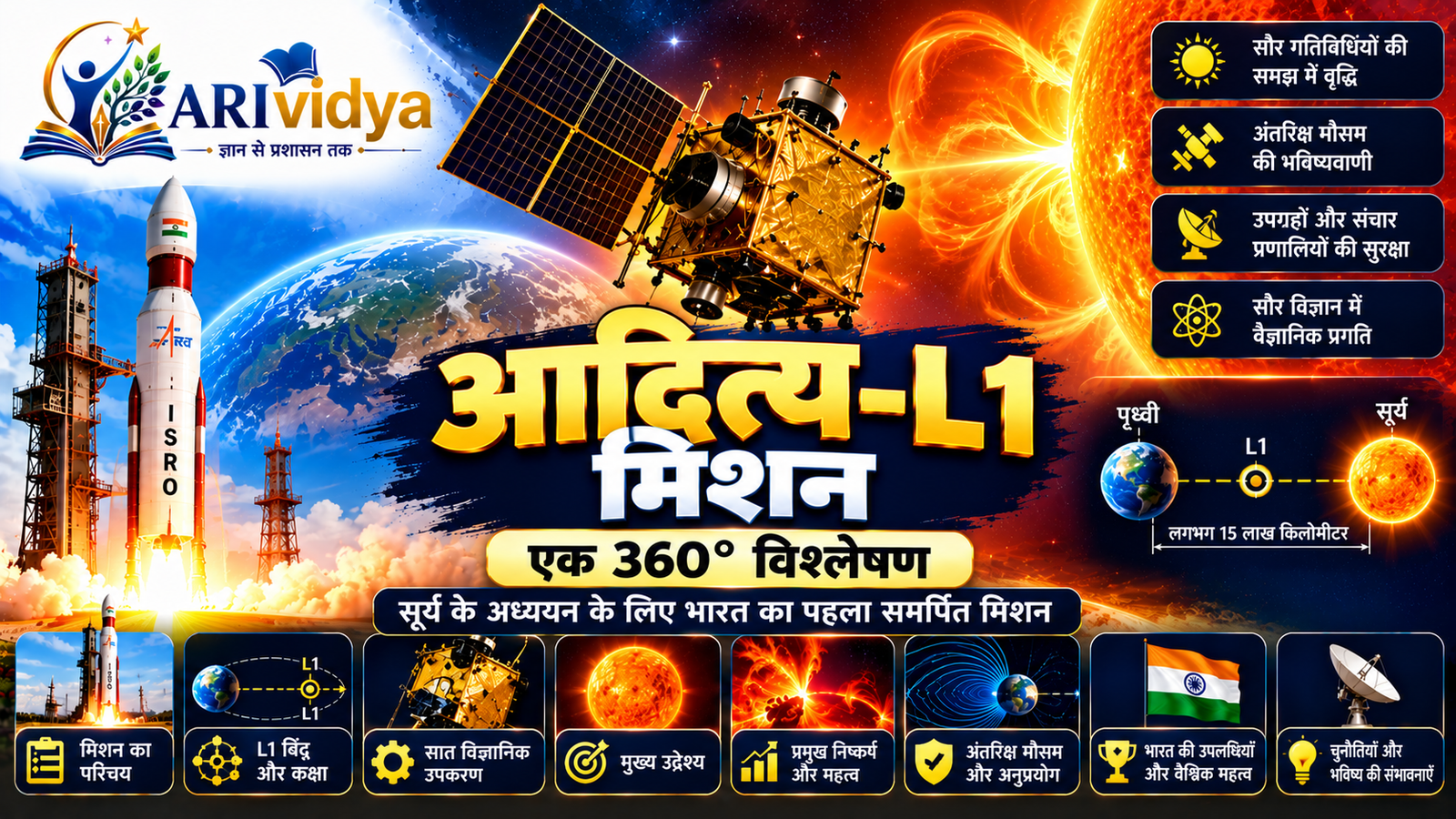
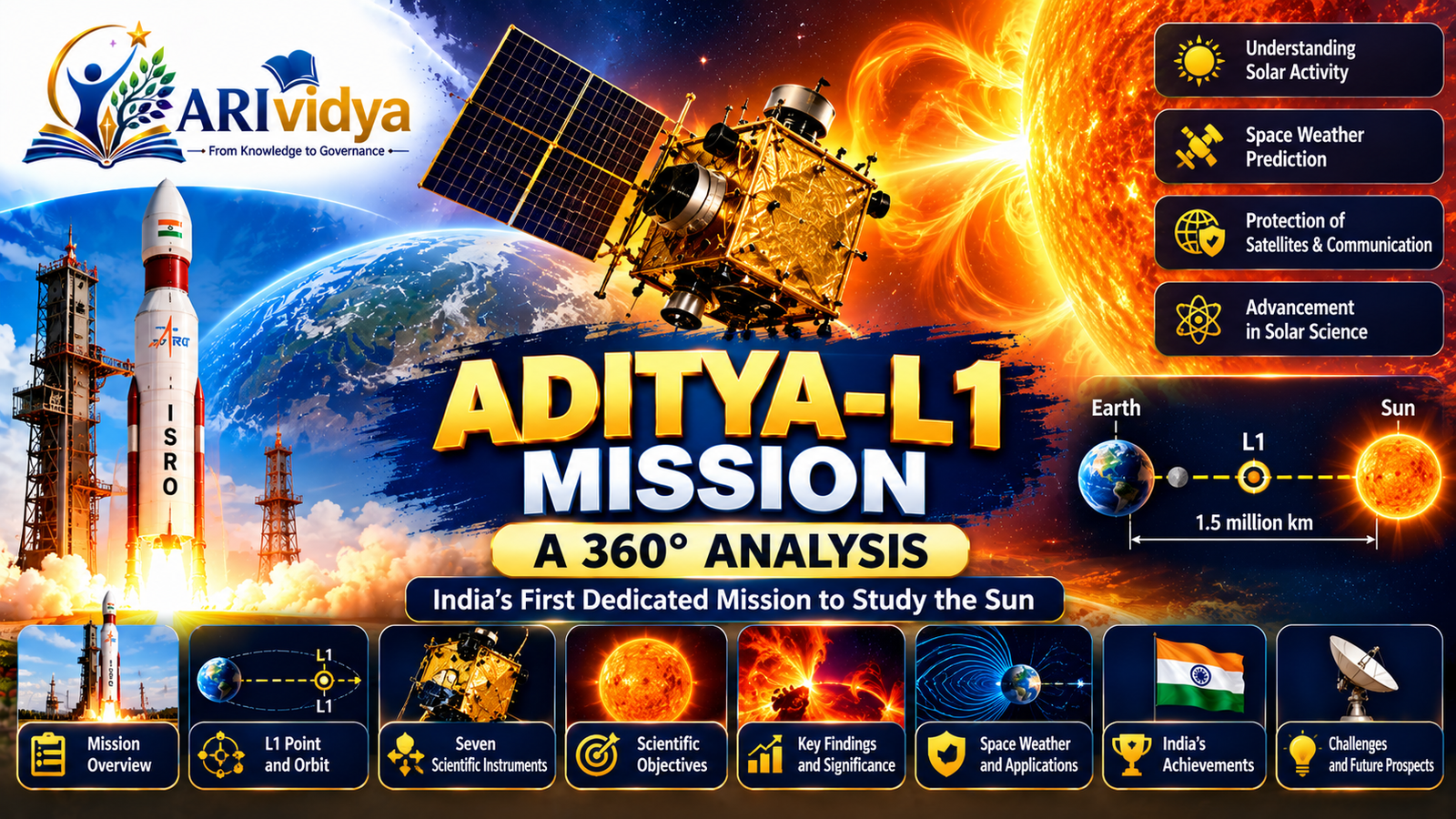
Aditya-L1 is India’s first dedicated space-based solar observatory mission, developed by ISRO to study the Sun and its influence on the space environment. It helps scientists investigate the solar atmosphere, magnetic activity and processes that can affect satellites, communication systems, navigation and power infrastructure on Earth.
1. Why study the Sun?
The Sun is a dynamic star. Solar flares, coronal mass ejections (CMEs) and variations in the solar wind can disturb Earth’s magnetosphere and produce space-weather events. Better observations improve scientific understanding and can support early warning and risk assessment for technology-dependent systems.
2. What is L1?
L1 is the first Sun–Earth Lagrange point, roughly 1.5 million kilometres from Earth towards the Sun. At this location, the gravitational influences of the Sun and Earth, together with orbital motion, allow a spacecraft to follow a useful orbit with a relatively stable view of the Sun. Aditya-L1 operates in a halo orbit around L1; it is not sitting motionless at a single point.
3. Mission objectives
- Study the upper solar atmosphere, including the photosphere, chromosphere and corona through different instruments.
- Investigate coronal heating and the physical processes behind solar eruptions.
- Observe solar flares and coronal mass ejections.
- Measure particles and plasma in the space environment.
- Study magnetic fields and improve understanding of space-weather drivers.
4. Seven scientific payloads
| Payload | Broad purpose |
|---|---|
| VELC | Visible emission-line coronagraph; studies the solar corona and its dynamics. |
| SUIT | Solar Ultraviolet Imaging Telescope; images the photosphere and chromosphere in ultraviolet wavelengths. |
| SoLEXS | Solar Low Energy X-ray Spectrometer; observes soft X-ray emission from the Sun. |
| HEL1OS | High Energy L1 Orbiting X-ray Spectrometer; studies high-energy X-ray emission from solar events. |
| ASPEX | Aditya Solar wind Particle Experiment; measures solar-wind and energetic particles. |
| PAPA | Plasma Analyser Package for Aditya; analyses solar-wind electrons and ions. |
| Magnetometer | Measures the interplanetary magnetic field near L1. |
5. Why is the mission important?
- Space weather: helps investigate events that may disrupt satellites, radio communication and navigation.
- Scientific capability: expands India’s capacity for long-duration solar observation and space-based research.
- Technology and data: builds expertise in instruments, spacecraft operations and analysis of solar observations.
- Global research: contributes observations that can complement data from other solar missions.
6. Challenges and limitations
Solar activity is complex and difficult to predict precisely. Instruments must operate reliably in a demanding radiation and thermal environment; observations require calibration and careful interpretation. A mission can improve monitoring and models, but it cannot eliminate space-weather risk or guarantee exact prediction of every solar eruption.
7. Aditya-L1 and other solar missions
NASA’s Parker Solar Probe makes close approaches to the Sun to study its outer atmosphere and solar wind, while the Solar and Heliospheric Observatory (SOHO) has long provided solar observations from the Sun–Earth L1 region. Aditya-L1 adds India’s own coordinated suite of instruments and scientific data to the global effort. The missions have different trajectories, instruments and primary objectives, so they are complementary rather than interchangeable.
8. Way forward
India should strengthen open scientific collaboration, develop robust space-weather models, connect solar observations with operational warning systems, train researchers in heliophysics and ensure long-term support for data analysis. The practical value lies in converting observations into better scientific knowledge and more resilient technological infrastructure.
Quick revision
| Feature | Remember |
|---|---|
| Agency | ISRO |
| Mission type | Space-based solar observatory |
| Location | Halo orbit around Sun–Earth L1 |
| Approximate Earth distance to L1 | 1.5 million km |
| Scientific payloads | Seven |
| Core application | Solar science and space-weather research |
Prelims practice
Q1. Aditya-L1 is primarily designed to study:
(A) Mars (B) The Sun (C) Venus (D) Earth’s oceans
Answer: (B) The Sun.
Q2. The Sun–Earth L1 point lies approximately:
(A) 1,500 km from Earth (B) 150,000 km from Earth (C) 1.5 million km from Earth towards the Sun (D) on the lunar surface
Answer: (C).
Q3. Which Aditya-L1 payload is a visible emission-line coronagraph?
(A) VELC (B) PAPA (C) ASPEX (D) SUIT
Answer: (A) VELC.
Q4. Coronal mass ejections are most directly relevant to the study of:
(A) Ocean salinity (B) Space weather (C) Plate tectonics (D) Monsoon onset alone
Answer: (B) Space weather.
Q5. Which statement about L1 is correct?
(A) It is a point on Earth’s surface (B) A spacecraft at L1 is permanently stationary (C) It is a Sun–Earth Lagrange point useful for solar observation (D) It lies beyond the Moon’s far side
Answer: (C).
Mains practice | GS Paper III
- Explain the scientific objectives of Aditya-L1. How can solar observation contribute to understanding and managing space-weather risks? (250 words)
- What are Lagrange points? Discuss why the Sun–Earth L1 region is useful for a solar observatory. (150 words)
- “Space missions create public value when scientific observations are translated into resilient systems and usable knowledge.” Discuss with reference to Aditya-L1. (150 words)
ARIvidya | ज्ञान से प्रशासन तक