
ARIvidya | International Relations | UPSC GS Paper II
Thank you for reading this post, don't forget to subscribe!
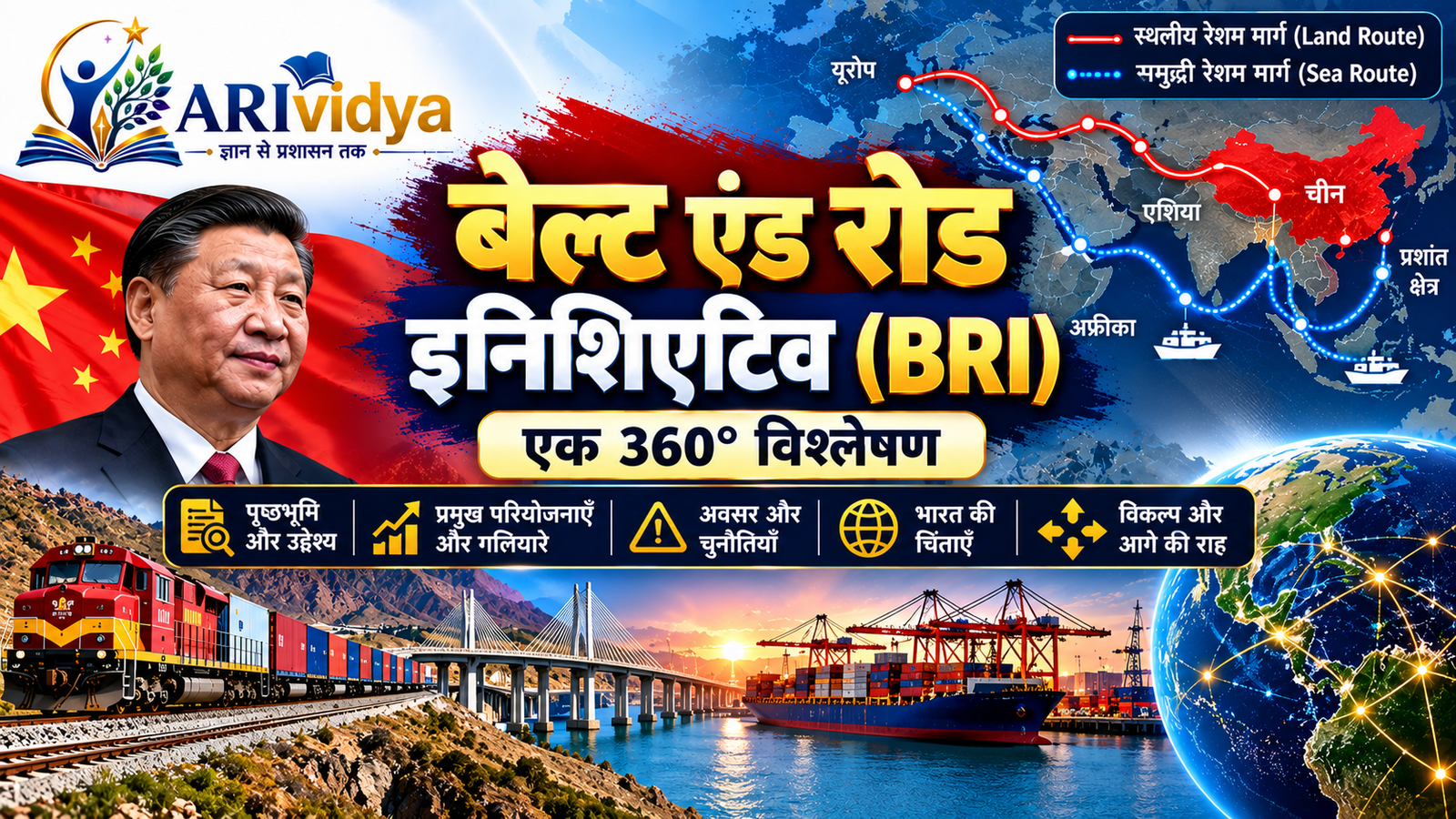
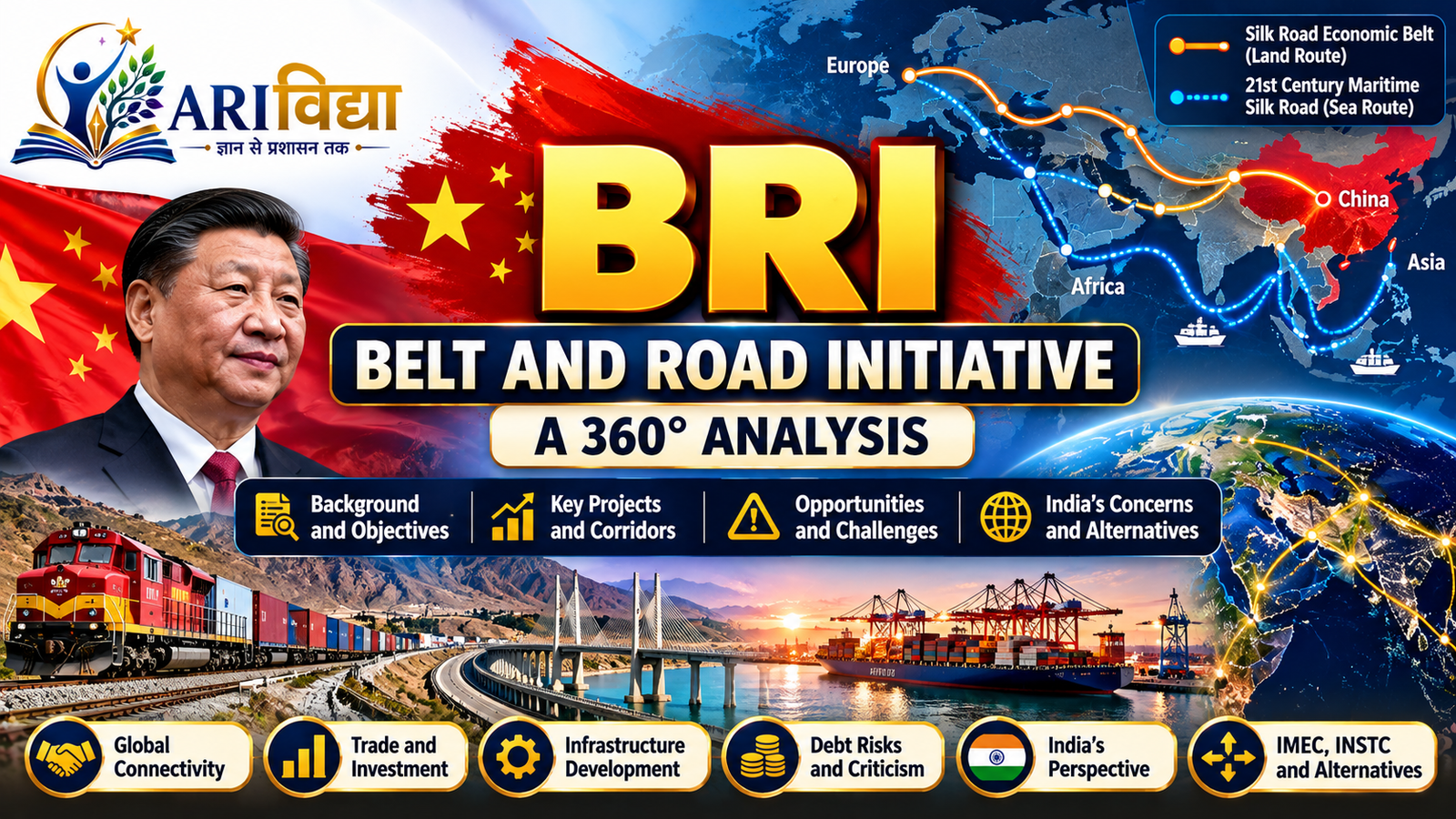
The Belt and Road Initiative (BRI) is China’s major international connectivity and infrastructure programme. Announced by President Xi Jinping in 2013, it aims to improve trade, transport, energy and people-to-people links across Asia, Europe, Africa and beyond. For India, BRI is not merely an infrastructure proposal: it raises questions of sovereignty, strategic influence, financial sustainability and regional connectivity.
1. What is the BRI?
The initiative has two broad components: the Silk Road Economic Belt, focused on overland links, and the 21st-Century Maritime Silk Road, focused on maritime connectivity. Projects may include ports, railways, roads, energy pipelines, industrial parks, logistics facilities and digital infrastructure.
2. China’s objectives
- Improve trade routes and reduce transport bottlenecks.
- Support Chinese firms, construction capacity and overseas investment.
- Diversify access to energy and raw materials.
- Build diplomatic influence and shape regional economic networks.
- Develop western Chinese regions through stronger external links.
3. Major corridors and examples
Examples associated with BRI include the China–Pakistan Economic Corridor (CPEC), China–Europe rail links, port-related projects such as Gwadar and Piraeus, and infrastructure investments across Central Asia, Africa and Southeast Asia. The scale, financing model and strategic significance differ from project to project; every project should be assessed on its own terms.
4. Why does India object?
- Sovereignty: CPEC passes through territories of Jammu and Kashmir claimed by India and under Pakistan’s control.
- Transparency and debt: India seeks clear procurement, lending and repayment terms, with credible debt-sustainability assessments.
- Strategic concerns: Certain ports and transport links may have implications beyond commerce, depending on their ownership, access and use.
- Consultation: India argues that connectivity should respect sovereignty, territorial integrity and the priorities of participating countries.
5. The debt-trap debate: a balanced view
Some BRI projects have faced debt distress, renegotiation, delays or weak commercial returns. However, the claim that every project is designed to trap borrowers is too broad. Outcomes depend on project selection, domestic governance, contract terms, revenue projections and the borrower’s overall debt position. A sound analysis distinguishes documented financial risks from sweeping political claims.
6. Opportunities and challenges
Potential benefits include infrastructure investment, lower logistics costs, market access and regional integration. Risks include opaque contracts, environmental and social impacts, cost overruns, dependence on a single financier, unequal benefits and strategic leverage. Host-country capacity and public accountability are therefore essential.
7. India’s alternatives and approach
- International North–South Transport Corridor (INSTC): a multimodal route intended to connect India with Iran, Russia and markets further north.
- Chabahar Port: offers a potential route to Afghanistan and Central Asia that bypasses Pakistan.
- India–Middle East–Europe Economic Corridor (IMEC): announced in 2023, it envisages links among India, the Gulf and Europe through shipping and rail connections; implementation depends on financing, coordination and regional conditions.
- Neighbourhood-first connectivity: improve cross-border trade, power, roads and digital links through consultation and transparent agreements.
8. Way forward
India should combine strategic caution with practical regional engagement: publish transparent project appraisals, strengthen multilateral financing, improve customs and logistics, consult local communities, and evaluate connectivity by economic viability, environmental safeguards and respect for sovereignty. Connectivity should create shared prosperity rather than unsustainable obligations.
Quick revision
| Aspect | Key point |
|---|---|
| Announced | 2013 |
| Overland component | Silk Road Economic Belt |
| Maritime component | 21st-Century Maritime Silk Road |
| India’s central concern | Sovereignty, transparency and strategic implications |
| Alternative connectivity | INSTC, Chabahar, IMEC and neighbourhood links |
Prelims practice
Q1. The Belt and Road Initiative was launched by which country?
(A) India (B) China (C) Japan (D) Indonesia
Answer: (B) China.
Q2. CPEC is controversial for India primarily because it passes through:
(A) Arunachal Pradesh (B) Nepal (C) territory in Jammu and Kashmir under Pakistan’s control (D) Sri Lanka
Answer: (C). The issue relates to India’s sovereignty and territorial-integrity concerns.
Q3. IMEC was announced on the sidelines of which event in 2023?
(A) G20 Summit in New Delhi (B) COP28 (C) BRICS Summit in Johannesburg (D) SCO Summit in Samarkand
Answer: (A) G20 Summit in New Delhi.
Mains practice | GS Paper II
- “Connectivity initiatives are instruments of both economic integration and geopolitical influence.” Discuss with reference to the BRI and India’s concerns. (250 words)
- Compare BRI with India-supported connectivity initiatives such as INSTC and IMEC. What principles should guide sustainable regional connectivity? (150 words)
ARIvidya | ज्ञान से प्रशासन तक