
(GS Paper II | Indian Polity & Governance | Parliament & Federalism | UPSC Notes)
Introduction
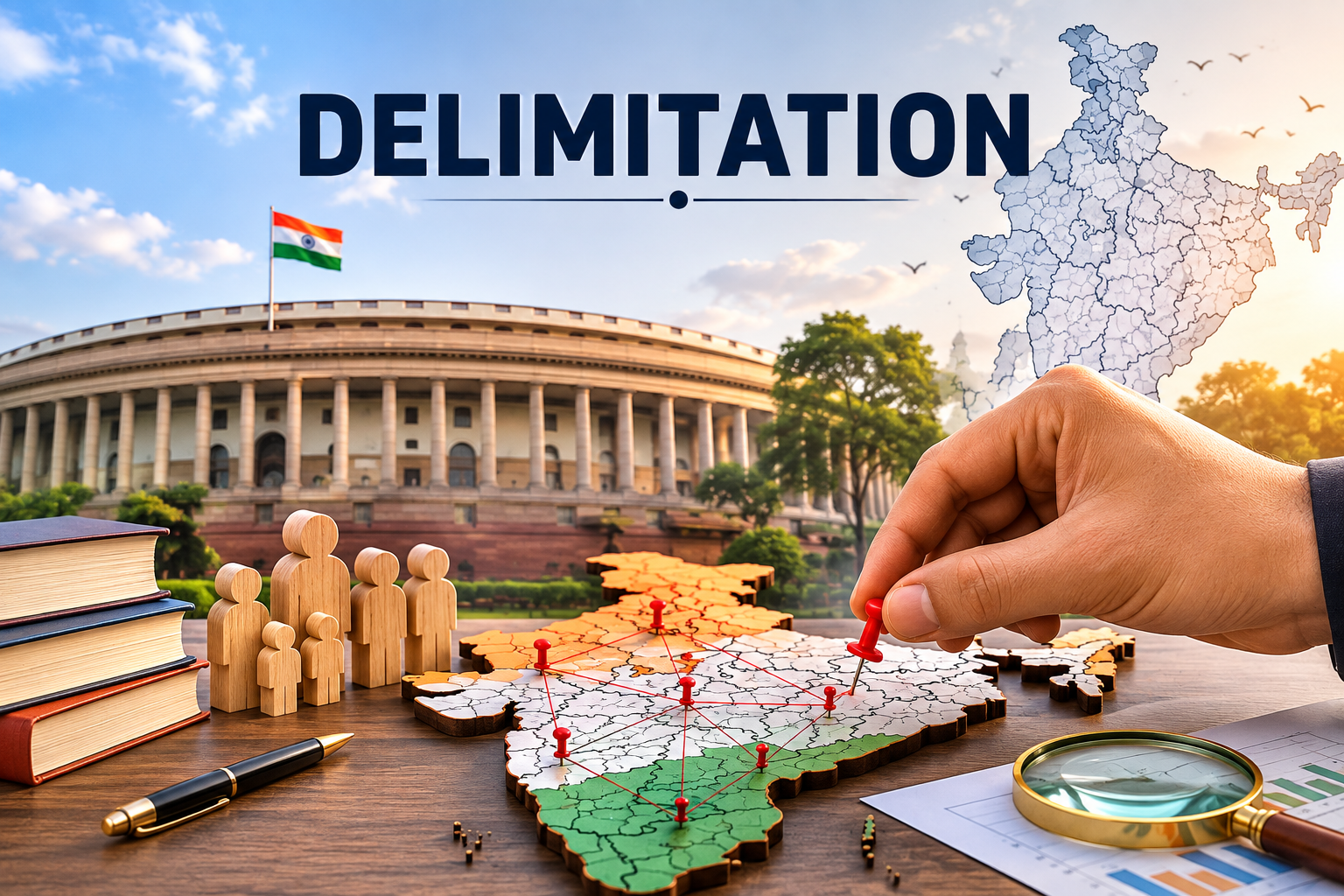
India is the world’s largest democracy, and the strength of any democracy lies in ensuring equal political representation for every citizen. Over time, population distribution changes due to migration, urbanization, and demographic growth. To maintain equality in representation, the boundaries and number of parliamentary and assembly constituencies need to be periodically revised. This constitutional process is known as Delimitation.
Delimitation has once again become a major political and constitutional issue as the Union Government is considering a fresh delimitation exercise, while the Dravida Munnetra Kazhagam (DMK) has proposed certain conditions regarding the proposed exercise.
What is Delimitation?
Delimitation is the process of:
• Redrawing the boundaries of Lok Sabha and State Legislative Assembly constituencies.
• Determining the number of seats allocated to each State in the Lok Sabha.
• Identifying constituencies reserved for Scheduled Castes (SCs) and Scheduled Tribes (STs).
The primary objective of delimitation is to ensure equal representation so that each elected representative represents nearly the same number of people.
Why is Delimitation Necessary?
Population is not static. Some regions witness rapid population growth, while others experience slower growth.
Without periodic delimitation:
One Member of Parliament may represent 30 lakh people.
Another may represent only 10 lakh people.
Such disparities violate the democratic principle of equal representation. Delimitation corrects this imbalance and strengthens representative democracy.
Delimitation Commission
The delimitation exercise in India is carried out by the Delimitation Commission, an independent high-powered body constituted under an Act of Parliament.
Key Features
Constituted through a Parliamentary Act.
Its decisions are final and legally binding.
The orders of the Commission are generally not subject to judicial review.
History of Delimitation in India
The Delimitation Commission has been constituted four times:
1952
1963
1973
2002
The first delimitation exercise was conducted during 1950–51 with the assistance of the Election Commission of India.
Why is Delimitation Controversial Today?
The proposed delimitation exercise has generated concerns, particularly among southern States.
The DMK has argued that States which successfully controlled population growth should not lose political representation because of their success.
The party has suggested three major changes:
Extend the constitutional freeze on Lok Sabha seat allocation for another 25 years.
Increase Lok Sabha seats of all States uniformly by 50%.
Clearly specify the number of seats allocated to each State before implementing delimitation.
Constitutional Background
42nd Constitutional Amendment Act, 1976
Froze the allocation of Lok Sabha seats based on the 1971 Census.
84th Constitutional Amendment Act, 2001
Allowed readjustment of constituency boundaries.
87th Constitutional Amendment Act, 2003
Permitted delimitation using the 2001 Census, without changing the total number of seats allotted to each State.
Importance of Delimitation
Ensures equal political representation.
Upholds the democratic principle of “One Person, One Vote.”
Provides fair reservation for SC and ST communities.
Adjusts constituencies according to changing population patterns.
Strengthens representative democracy.
Challenges
Concerns over reduced political representation for southern States.
Potential imbalance between northern and southern States.
Impact on India’s federal structure.
Political disagreements and regional sensitivities.
UPSC Prelims Quick Facts
Delimitation Commission
Constituted under an Act of Parliament
First Delimitation
1950–51
Delimitation Commissions
1952, 1963, 1973, 2002
42nd Amendment
1976
84th Amendment
2001
87th Amendment
2003
UPSC Mains Perspective
This topic is important under:
Parliament
Federalism
Electoral Reforms
Representation
Population Policy
Governance
UPSC Previous Year Question (Mains)
UPSC Civil Services Examination 2012 (GS Paper II)
“Discuss the role of the Delimitation Commission in ensuring free and fair elections in India.”
(10 Marks)
UPSC-Style Prelims MCQ
Q. Consider the following statements regarding the Delimitation Commission:
It is constituted under an Act of Parliament.
It redraws the boundaries of Parliamentary and Assembly constituencies.
It also determines constituencies reserved for Scheduled Castes and Scheduled Tribes.
Which of the statements given above is/are correct?
A. 1 only
B. 1 and 2 only
C. 2 and 3 only
D. 1, 2 and 3
Answer: D
UPSC Mains Practice Question
Q. “The proposed delimitation exercise has the potential to reshape India’s federal political structure.” Discuss the constitutional basis of delimitation and critically examine the concerns raised by the southern States. Suggest a balanced way forward.
(250 Words | 15 Marks)
Conclusion
Delimitation is not merely a technical exercise of redrawing constituency boundaries; it is a vital constitutional mechanism that ensures equal representation, strengthens democratic governance, and promotes social justice. As India prepares for the next phase of delimitation after the forthcoming Census, the issue is likely to remain highly significant for UPSC Prelims, Mains, and interviews, making it an essential topic for every civil services aspirant.