

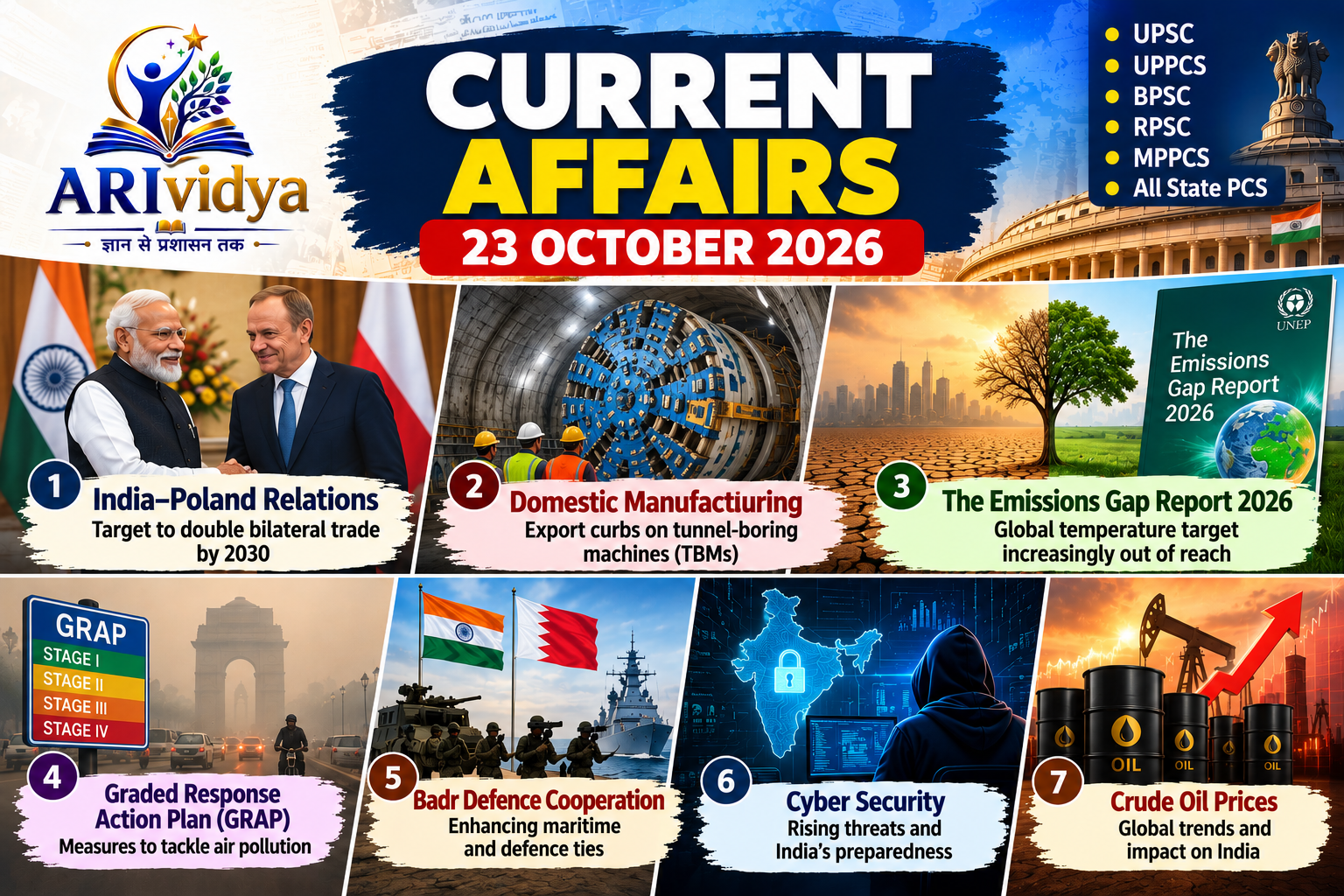
Date: Friday, 23 October 2026 | Exam focus: UPSC, UPPCS, BPSC and other State PCS examinations
Thank you for reading this post, don't forget to subscribe!
Today’s current affairs cover international relations, manufacturing, climate change, air pollution, defence cooperation, cybersecurity and the Indian economy. Each news item is immediately followed by a Prelims MCQ with its answer and a Mains practice question.
1. India–Poland: Target to Double Bilateral Trade by 2030
India and Poland have set a target to double bilateral trade by 2030. The current trade base was reported at around US$6 billion. Discussions covered cooperation in space, transport, renewable energy and technology. The proposed India–European Union Free Trade Agreement is also expected to support trade growth.
Prelims MCQ: Consider the following statements about India–Poland cooperation:
- The two countries have targeted doubling bilateral trade by 2030.
- Space and renewable energy are areas of potential cooperation.
- Poland is located in South Asia.
(A) 1 and 2 only (B) 2 and 3 only (C) 1 and 3 only (D) 1, 2 and 3
Answer: (A) — Poland is located in Europe.
Mains Practice (GS-2): Analyse the role of countries such as Poland in India’s economic diplomacy with Europe.
2. Tunnel-Boring Machines and Domestic Manufacturing
China has placed tunnel-boring machines (TBMs), walking excavators and high-altitude wet shotcrete machines under export controls. China accounts for around 70% of the global TBM market, according to the supplied material. TBMs are important for major infrastructure projects, including the Mumbai–Ahmedabad high-speed rail corridor. India must balance domestic manufacturing ambitions with international technology partnerships and reliable access to specialised components.
Prelims MCQ: What is the primary use of a tunnel-boring machine?
(A) Desalination of seawater (B) Excavation of underground tunnels (C) Satellite launch (D) Harvesting crops
Answer: (B) — TBMs excavate tunnels in a controlled manner.
Mains Practice (GS-3): How does dependence on foreign suppliers for critical machinery affect India’s strategic autonomy? Suggest measures combining domestic manufacturing with technology partnerships.
3. Emissions Gap Report 2026
The United Nations Environment Programme (UNEP) released the Emissions Gap Report 2026, titled “The Point of Return”. It warns that inadequate global emissions reductions have made an overshoot of the 1.5°C warming threshold virtually unavoidable. Under existing policies, warming could reach about 2.8°C by 2100; full implementation of climate pledges could limit it to around 2.1°C. Relative to 2025 levels, the report calls for global emissions reductions of 18% by 2030, 45% by 2035 and 69% by 2040.
Prelims MCQ: Which organisation publishes the Emissions Gap Report?
(A) World Trade Organization (B) United Nations Environment Programme (C) International Monetary Fund (D) World Bank
Answer: (B) — The report is an annual UNEP assessment.
Mains Practice (GS-3): Discuss why a gap persists between global climate goals and current emissions trajectories, and suggest ways to narrow it.
4. Stage I of GRAP Invoked in Delhi-NCR
The Commission for Air Quality Management (CAQM) invoked Stage I of the Graded Response Action Plan (GRAP) across Delhi-NCR after the Air Quality Index moved into the ‘Poor’ category. GRAP provides a graded response, with progressively stricter measures as air pollution worsens. It was developed following Supreme Court directions in 2016 and formally notified on 12 January 2017. CAQM is a statutory body established under the 2021 law on air-quality management in the National Capital Region and adjoining areas.
Prelims MCQ: What is the primary purpose of GRAP?
(A) Control water pollution (B) Apply graded measures as air quality worsens (C) Conduct wildlife censuses (D) Increase industrial exports
Answer: (B) — GRAP tightens pollution-control measures in stages.
Mains Practice (GS-3): Evaluate the usefulness of GRAP in tackling air pollution in Delhi-NCR and discuss its implementation challenges.
5. Badr Defence Cooperation MoU
Qatar, Türkiye, Pakistan and Indonesia signed the Badr Memorandum of Understanding in Doha. The initiative aims to promote joint defence production, technology transfer, research and development, and technical military training. It seeks to combine the complementary industrial capabilities of participating countries. The supplied material clarifies that the MoU does not create a binding collective-defence obligation.
Prelims MCQ: Which of the following is an objective of the Badr defence cooperation initiative?
(A) Joint defence production and technical training (B) Issuing a common currency (C) Establishing a customs union (D) Expanding the UN Security Council
Answer: (A) — The initiative focuses on defence-industry and technical cooperation.
Mains Practice (GS-2): How might emerging defence partnerships in West and South Asia affect the regional security balance?
6. SBI Customer Data and Cybersecurity
A report stated that 3,897 records containing personal information of State Bank of India (SBI) customers were found among approximately 375,000 records on the dark web. The exposed information reportedly included mobile numbers, addresses, dates of birth and loan-related details. Such information can be misused for identity-based fraud. Artificial-intelligence tools may also make cyberattacks faster and easier to scale. The Digital Personal Data Protection Act, 2023, is an important part of India’s legal framework for protecting digital personal data.
Prelims MCQ: In which year was India’s Digital Personal Data Protection Act enacted?
(A) 2019 (B) 2021 (C) 2023 (D) 2025
Answer: (C) — The Digital Personal Data Protection Act was enacted in 2023.
Mains Practice (GS-3): With the expansion of digital banking, discuss the institutional and technological measures needed to strengthen cybersecurity and protect citizens’ personal data.
7. Crude Oil Prices and the Indian Economy
Amid the conflict in West Asia, crude oil prices were reported to remain above US$110 per barrel. For India, which depends on imported oil, this can increase the import bill and put pressure on inflation and the rupee. Concerns were also raised about weakness in Indian equity markets and a decline in foreign-exchange reserves during the period discussed. Higher energy prices can affect the wider economy through transport and production costs.
Prelims MCQ: What is a likely consequence for India of a sharp rise in crude oil prices?
(A) Higher import costs and inflationary pressure (B) Automatic elimination of oil imports (C) Transport costs necessarily falling to zero (D) Guaranteed appreciation of the rupee
Answer: (A) — Costlier imported oil can put pressure on the current account, costs and inflation.
Mains Practice (GS-3): Explain how geopolitical crises and volatile energy prices affect the Indian economy. Suggest measures to strengthen India’s energy security.
Quick Revision
- India–Poland: Target to double bilateral trade by 2030.
- TBMs: Critical infrastructure equipment and supply-chain resilience.
- Emissions Gap Report 2026: Published by UNEP.
- GRAP: Graded action as air pollution worsens.
- Badr MoU: Defence-industrial cooperation among four countries.
- SBI data case: Cybersecurity and personal-data protection.
- Crude oil: Implications for the import bill, inflation and economic stability.
Practice tip: Write one Mains answer in 150–250 words and record key facts in your revision notes.