
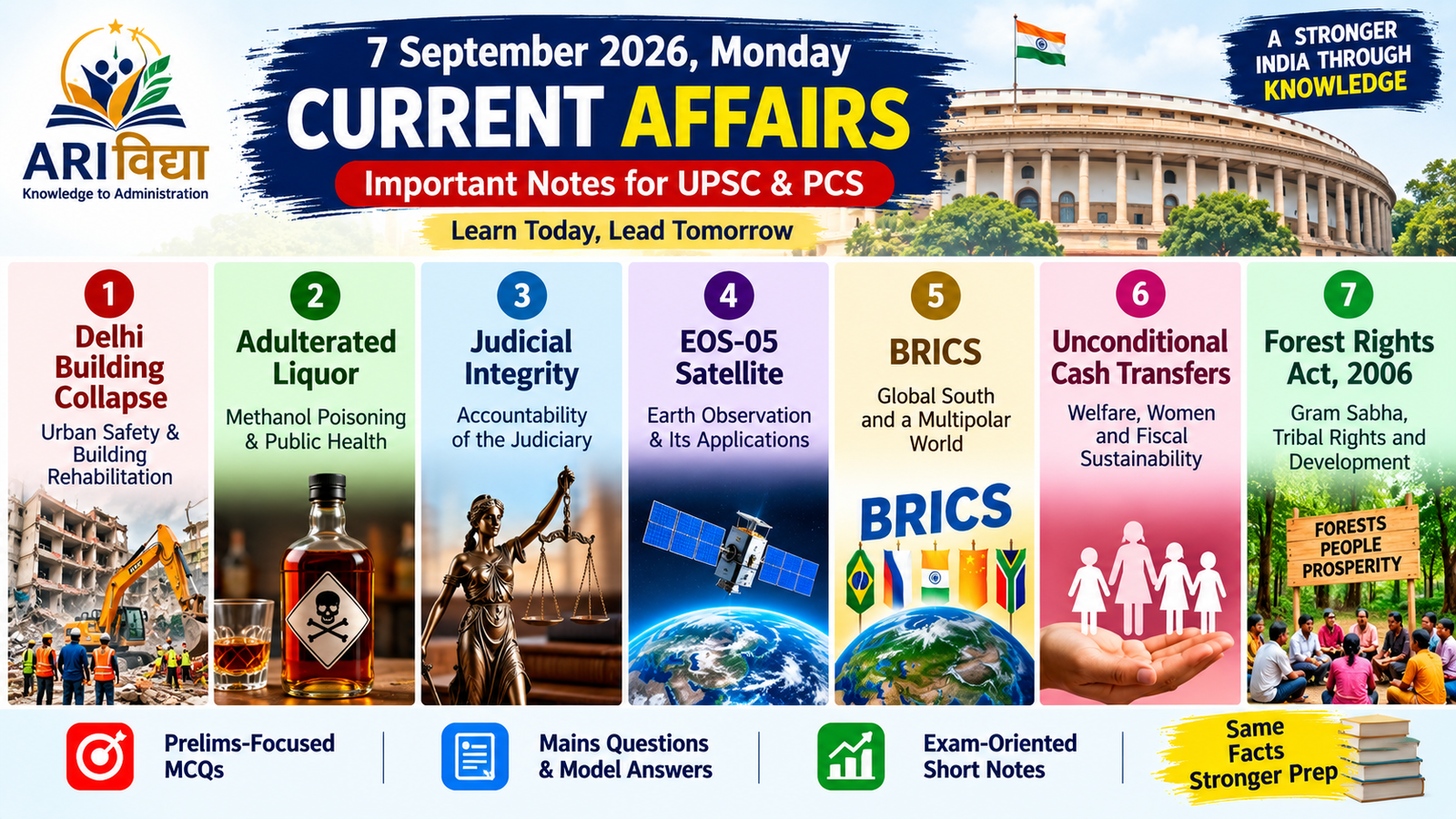
7 September 2026 — Monday
Current Affairs
Thank you for reading this post, don't forget to subscribe!
1. Delhi Building Collapse: Urban Safety & Building Rehabilitation
A five-storey building collapsed in the Satya Niketan area of Delhi, near the South Campus of Delhi University. The area has a dense concentration of rented accommodation for students. Five people died in the incident.
The building was around 50 years old and had a basement below the ground floor. Repair work was reportedly underway in the basement.
Major Causes
- Ageing and deteriorating infrastructure
- Weak enforcement by urban local bodies
- Illegal construction and unauthorised extensions
- Lack of regular structural inspection and maintenance
- Climate-related stresses such as intense rainfall and urban flooding
- Weak implementation of evacuation orders for unsafe buildings
Building Rehabilitation
Building rehabilitation includes repair, strengthening, structural retrofitting, renovation and redevelopment. Its objective is to improve structural safety and extend the useful life of buildings wherever technically feasible.
Way Forward
- Periodic structural safety audits of old buildings
- Identification and timely action against unsafe structures
- Effective implementation of the National Building Code, 2016
- Use of drones, artificial intelligence, sensors and Geographic Information Systems
- Better financial and technical capacity of urban local bodies
Prelims MCQ
The National Building Code, 2016 primarily deals with:
- Only building ownership rights
- Building design, construction, fire safety and maintenance standards
- Only urban land acquisition
- Only post-disaster relief
Answer: B
Mains Question
“India’s rapid urbanisation has outpaced the structural safety mechanisms for existing buildings.” Analyse the causes of building collapse incidents and suggest measures to improve urban building safety.
2. Adulterated Liquor & Methanol Poisoning
Adulterated liquor can cause severe public-health emergencies, particularly when toxic substances such as methanol are present.
Methanol and Its Danger
Ethanol is the principal alcohol used in alcoholic beverages intended for human consumption. Methanol can be metabolised in the body into highly toxic substances such as formaldehyde and formic acid.
Health Effects
- Permanent visual impairment and blindness
- Liver and kidney damage
- Nervous-system damage
- Confusion and dizziness
- Seizures
- Unconsciousness
- Death in severe cases
Constitutional Dimension
Regulation of alcoholic beverages is primarily a State subject. Article 47 directs the State to improve nutrition, standard of living and public health and to endeavour to prohibit the consumption of intoxicating drinks injurious to health, except for medicinal purposes.
Key Challenges
- Weak enforcement of prohibition policies
- Illegal liquor production
- Poor monitoring
- Different State-level policies
- Expansion of illegal markets
Prelims MCQ
Article 47 of the Indian Constitution is associated with:
- Free legal aid
- Improvement of nutrition, standard of living and public health, including endeavour towards prohibition of intoxicating drinks
- Environmental protection
- Right to education
Answer: B
Mains Question
Adulterated liquor is not merely a law-and-order issue but also a public-health and governance challenge. Examine its causes and suggest measures to address the problem in India.
3. Judicial Integrity & Accountability of the Judiciary
The issue of judicial integrity has gained attention in the context of allegations concerning the Acting Chief Justice of the Rajasthan High Court. The allegations reportedly involve issues such as harassment of judges, administrative mismanagement, transfer of cases to particular benches, alleged nepotism in appointments and alleged favouritism towards certain advocates.
Important: Allegations should not be treated as judicial findings. They need to be examined through established institutional procedures.
Major Institutional Challenges
- Limited mechanisms for effective judicial accountability
- Complex procedures for complaints against higher judiciary
- Balancing judicial independence with accountability
- Administrative transparency
- Public confidence regarding appointments and allocation of cases
Important References
The Judges (Inquiry) Act, 1968 is relevant to the institutional framework of judicial accountability. In K. Veeraswami v. Union of India (1991), the issue of criminal proceedings against higher judiciary was considered, including the requirement relating to the Chief Justice of India’s permission.
The Judicial Standards and Accountability Bill, 2012 was introduced as an attempt to strengthen accountability, but it lapsed with the dissolution of the 15th Lok Sabha.
Prelims MCQ
Which of the following best reflects the balance between judicial independence and accountability?
- Keeping the judiciary completely free from accountability
- Giving the executive direct control over judicial decisions
- Developing transparent and institutional mechanisms of accountability while preserving judicial independence
- Placing judicial appointments entirely under Parliament
Answer: C
Mains Question
“Judicial integrity is the foundation of public confidence in the justice system.” Examine the major challenges to judicial integrity in India and suggest institutional measures to strengthen accountability without compromising judicial independence.
4. EOS-05 Satellite & Earth Observation Technology
EOS-05 is an Earth-observation satellite launched by the Indian Space Research Organisation. It is intended to be placed in a geosynchronous orbit, enabling continuous observation of a particular region. The final orbital altitude is around 36,000 km.
Applications
- Flood monitoring
- Cyclone monitoring
- Forest-fire monitoring
- Agriculture and crop assessment
- Forest monitoring
- Water-body monitoring
- Land-use change detection
Remote Sensing
Sensors study signals reflected from the Earth’s surface across different wavelengths. This helps distinguish vegetation, water and different types of land cover.
Disaster Management
Earth-observation technology can support monitoring of landslides, geomorphological changes, possible glacial-break events, avalanches and stubble burning.
Prelims MCQ
Earth-observation satellites can be used for which of the following?
1. Monitoring forest fires
2. Crop assessment
3. Monitoring land-use changes
4. Flood monitoring
- 1 and 2 only
- 2 and 3 only
- 1, 2 and 3 only
- 1, 2, 3 and 4
Answer: D
Mains Question
Analyse the role of Earth-observation satellites in disaster management, agriculture and environmental monitoring in India.
5. BRICS & the Global South
According to the source, the 18th BRICS Summit is scheduled to be held in New Delhi on 12–13 September 2026. BRICS is an important platform for economic cooperation, multilateralism, development and strengthening the voice of the Global South.
Major Priorities
- Respect for the UN Charter
- Sovereign equality
- Non-interference in internal affairs
- Peaceful settlement of disputes
- Stronger multilateral trading arrangements
- A central role for the World Trade Organization
- Opposition to protectionism
- Openness and inclusiveness
- Mutually beneficial cooperation
Global Significance
According to the source, BRICS countries represent approximately half of the world’s population, 30% of global economic output and one-fifth of global trade.
Prelims MCQ
Which of the following statements about BRICS is correct?
- It is exclusively a military cooperation organisation.
- It aims only to increase trade among developed countries.
- It is a platform for economic cooperation and strengthening the role of the Global South.
- It is an organ of the United Nations.
Answer: C
Mains Question
Analyse the significance and limitations of BRICS in strengthening the role of the Global South in global governance.
6. Unconditional Cash Transfer Schemes
Since 2020, unconditional cash transfer schemes have emerged as important welfare measures in India, particularly those targeting women beneficiaries.
Potential Benefits
- Provide direct financial assistance to women
- Support recognition of unpaid domestic and care work
- Improve income security among vulnerable groups
According to the source, States were expected to spend around $18 billion on such schemes in 2025–26.
Major Concerns
- Pressure on fiscal resources
- Possible reduction in resources available for productive investment
- Potential impact on employment and self-employment programmes
- Difficulty in withdrawing schemes because of political competition
- Identification of genuine beneficiaries
Inclusion and Exclusion Errors
Identifying the actual income of informal-sector workers is difficult. Governments may therefore use indirect indicators such as land ownership, electricity consumption and household assets. This can result in exclusion error, where an eligible person is left out, or inclusion error, where an ineligible person receives the benefit.
Alternative Approach
Conditional cash transfers can link benefits with desirable outcomes such as education, health and other socially desirable behaviour.
Prelims MCQ
Which of the following are major challenges associated with unconditional cash-transfer schemes?
1. Difficulty in identifying beneficiaries
2. Pressure on fiscal resources
3. Inclusion and exclusion errors
- 1 only
- 1 and 2 only
- 2 and 3 only
- 1, 2 and 3
Answer: D
Mains Question
“Unconditional cash transfers present a challenge of balancing social protection with fiscal sustainability.” Critically examine the statement in the Indian context.
7. Forest Rights Act, 2006 & Role of Gram Sabha
The issue concerns the implementation of the Forest Rights Act, 2006 and the role of Gram Sabhas in the diversion of forest land for non-forest purposes.
According to the source, during discussions with the Ministry of Power, the Ministry of Tribal Affairs stated that the Forest Rights Act does not explicitly provide for obtaining 100% consent of Gram Sabhas for forest clearance.
Important Procedures
- Identification of potential forest-rights claimants
- Recognition of their rights
- Vesting of recognised rights
- Obtaining relevant clearances or certificates from Gram Sabhas as required under the applicable framework
Nodal Ministry
The Ministry of Tribal Affairs is the nodal ministry for implementation of the Forest Rights Act, while States and Union Territories also have an important role.
Core Issue
The central challenge is to balance Forest Conservation ↔ Tribal Rights ↔ Development Projects.
Prelims MCQ
With reference to the Forest Rights Act, 2006, which of the following statements is correct?
- The Ministry of Tribal Affairs is the nodal ministry for its implementation.
- It applies only to urban areas.
- It deals only with property belonging to forest departments.
- It does not recognise the rights of forest-dwelling communities.
Answer: A
Mains Question
Examine the role of Gram Sabhas in the effective implementation of the Forest Rights Act, 2006. How can India balance development projects, forest conservation and the rights of forest-dwelling communities?