
Current Affairs Study Notes
28–29 August 2026 | For UPSC & PCS Examination Preparation
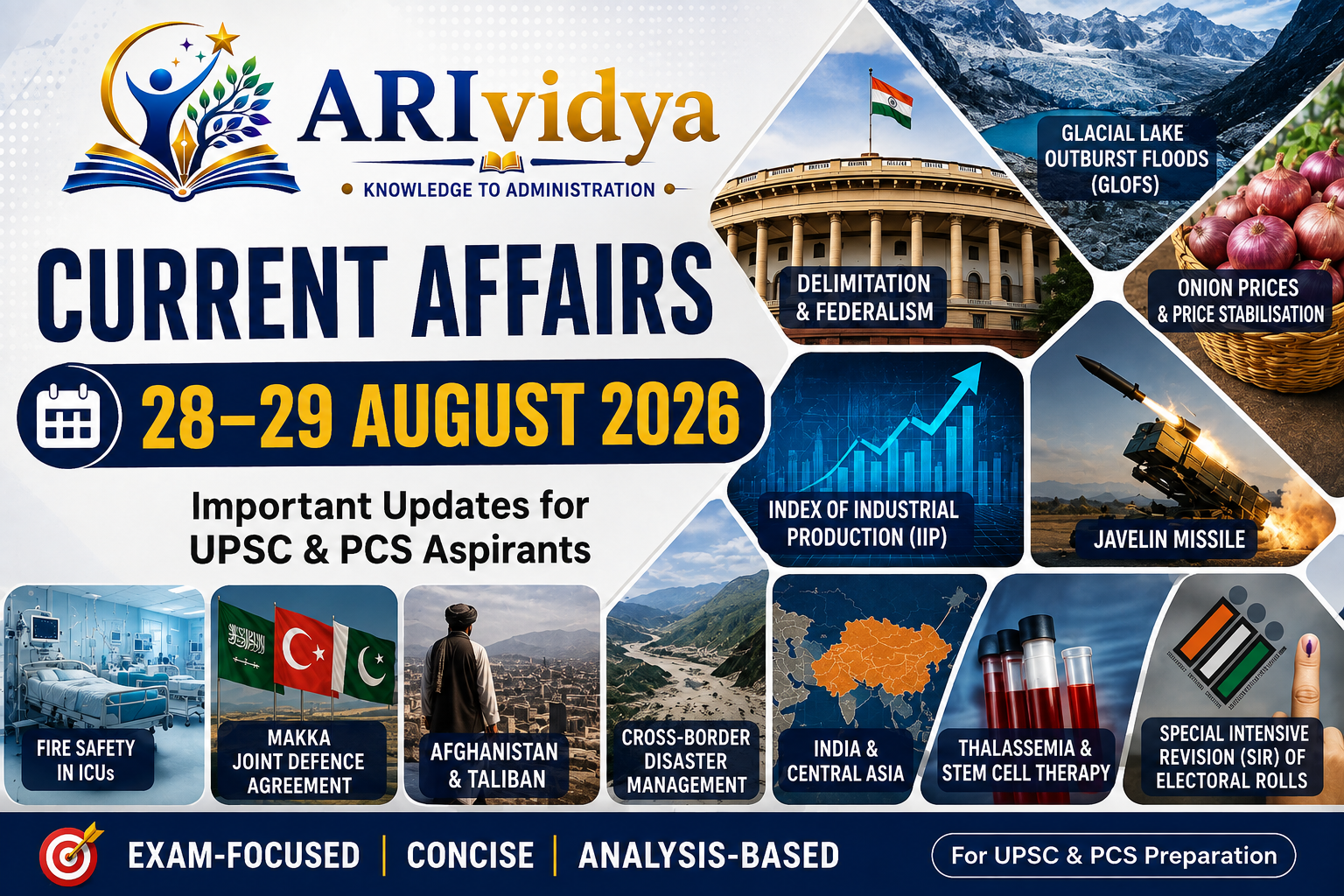
Important Current Affairs: 28–29 August 2026
This study material consolidates the examination-relevant issues covered in the source material for 28 and 29 August 2026. Promotional pages and repetitive content have been removed, while the important facts, background, significance and examination angles have been retained.
The issue of delimitation of Lok Sabha constituencies has again become significant. Changes in population distribution among States raise questions about political representation, federal balance and the future redistribution of seats.
Constitutional Basis
- Article 81 provides the constitutional basis for representation in the Lok Sabha broadly in accordance with population, “so far as practicable”.
- Article 82 provides for readjustment after every Census.
- The 42nd Constitutional Amendment, 1976 froze inter-State allocation of Lok Sabha seats on the basis of the 1971 Census.
- The 84th Constitutional Amendment extended the freeze until the publication of figures from the first Census conducted after 2026.
Illustration
The source material gives the example of Uttar Pradesh potentially rising from 80 to 120 seats and Tamil Nadu from 39 to about 59. Even if their proportional relationship remains broadly similar, the absolute difference in voting strength would increase.
The Union Government attributed the rise in onion prices to black marketing, hoarding and profiteering. The source material reported a Delhi market price of ₹62 per kg, while onions were to be sold at a subsidised rate of ₹35 per kg through designated channels.
Government Measures
- Sale through NAFED and NCCF.
- Availability through retail stores and Kendriya Bhandars.
- Use of price stabilisation measures to protect consumers.
NAFED
- Founded in 1958.
- An apex cooperative organisation for marketing agricultural produce.
- Registered under the Multi-State Co-operative Societies Act, 2002.
NCCF
- Apex organisation of consumer cooperatives.
- Works under the Ministry of Consumer Affairs, Food and Public Distribution.
- Registered under the Multi-State Co-operative Societies Act, 2002.
Climate change and increasing human intervention are making Glacial Lake Outburst Floods (GLOFs) an important disaster risk in the Himalayan region. The source material links the Nepal floods to a possible glacier collapse or ice-rock avalanche, followed by temporary river blockage and sudden failure.
What is a GLOF?
A GLOF occurs when a glacial lake’s natural barrier suddenly fails, releasing a large volume of water, ice, rocks and debris downstream.
Major Causes
- Climate-induced glacier melting.
- Expansion of glacial lakes.
- Glacier collapse and ice-rock avalanches.
- Temporary blockage of river channels by debris.
- Increasing infrastructure and human intervention in fragile Himalayan terrain.
Himalayan Vulnerability
The source material notes nearly 7,500 glacial lakes and around 15,000 glaciers in the Indian Himalayas. The October 2023 South Lhonak Lake disaster in Sikkim is an important reference point.
Preparedness Measures
- Satellite and remote-sensing based monitoring.
- Risk mapping of vulnerable glacial lakes.
- Early-warning systems.
- Community-based disaster preparedness.
- Cross-border sharing of hydrological and disaster information.
Central Asia is important for India because of its historical links, strategic location and relevance to energy, connectivity and regional security. The region lies between Russia and China and forms an important part of the wider Eurasian geopolitical space.
Five Central Asian Republics
Importance for India
- Energy security.
- Counter-terrorism cooperation.
- Trade and connectivity across Eurasia.
- Strategic engagement relating to Afghanistan.
- Managing the wider regional balance amid growing Chinese influence.
Shanghai Cooperation Organisation
The SCO began with the “Shanghai Five” in 1996. Uzbekistan joined in 2001, leading to the formation of the SCO in its present broader framework. India and Pakistan joined in 2017. The source material lists 10 members, 15 dialogue partners and 2 observers.
Fire safety concerns are increasingly extending beyond industrial facilities to residential buildings, hotels and hospitals, especially Intensive Care Units and Neonatal Intensive Care Units.
Why are ICUs Vulnerable?
- Oxygen-rich environment.
- Large number of electrical and electronic devices.
- Patients often cannot evacuate independently.
- Smoke can fill enclosed spaces rapidly.
- Overloaded or poorly maintained electrical systems.
Required Safety Measures
- Multiple independent exits and horizontal evacuation facilities.
- Automatic sprinklers.
- Independent power lines for critical equipment.
- Regular fire drills.
- Mandatory fire-safety certification and power audits.
- Clear evacuation protocols.
RACE principle: Rescue → Alarm → Confine → Extinguish/Evacuate.
The status of English in India has come into focus during the discussion around the three-language formula. The issue involves education, governance, cultural identity and the protection of linguistic diversity.
Key Points
- The three-language formula requires two of the three languages to be Indian languages; English is not included in that category.
- The interaction between English and Indian languages began centuries before the 1835 Macaulay’s Minute.
- The source material traces the interaction to the 17th century, with greater development during the 18th and 19th centuries.
- According to the 2011 Census, around 10% of India’s population speaks English.
Linguistic Diversity Challenge
The source material raises concerns that several smaller languages may be classified as subsets of larger languages, potentially understating India’s actual linguistic diversity.
Saudi Arabia, Türkiye and Pakistan have signed the Mecca Joint Defence Agreement. Under the mutual-defence clause, an attack on one signatory would be treated as an attack on all three.
Bangladesh’s Possible Role
The source material states that Bangladesh may positively consider joining the framework if the existing signatories propose its inclusion. However, accession was not under formal discussion at the time covered by the source.
Strategic Considerations
- Long-term national interest.
- National security and strategic capabilities.
- Regional balance of power.
- Advantages and risks of collective defence arrangements.
India’s industrial growth stood at 6.7% in July 2026, compared with 8.8% in June. The source material describes July’s performance as the second-best growth recorded since December of the previous year.
What is IIP?
The Index of Industrial Production is a major macroeconomic indicator that measures short-term changes in the volume of industrial production. It is released by the National Statistical Office under the Ministry of Statistics and Programme Implementation.
Major Sectors
- Mining and quarrying.
- Manufacturing.
- Electricity.
- The revised series also incorporates gas supply, water supply, sewerage and waste-management activities.
Base Year Revision
The IIP base year has been revised from 2011–12 to 2022–23. Electricity generation is also separated into renewable and non-renewable sources.
India has signed a Letter of Offer and Acceptance with the United States for procurement of Javelin anti-tank guided missile systems through the U.S. Foreign Military Sales route.
Key Features
- Medium-range anti-tank guided missile.
- Designed to engage armoured vehicles and fortified positions.
- Fire-and-forget capability allows the operator to move after launch without continuously guiding the missile.
Manufacturer
The Javelin system is produced by the Javelin Joint Venture comprising RTX and Lockheed Martin.
Importance for India
- Strengthening anti-armour capabilities.
- Enhancing critical operational capabilities.
- Deepening the India–U.S. defence partnership.
- Creating possibilities for defence-industrial cooperation and co-production.
Thalassemia is a genetic blood disorder in which the body cannot produce sufficient normal haemoglobin, resulting in fewer healthy red blood cells and anaemia.
Symptoms
- Growth delays and delayed puberty.
- Bone abnormalities.
- Poor appetite, jaundice and dark urine.
- Facial bone deformities in severe cases.
India’s Burden
The source material estimates that around 100,000–150,000 children in India live with the disease and approximately 42 million Indians carry the Beta-Thalassemia trait.
Treatment
- Regular blood transfusions.
- Iron chelation therapy to prevent iron overload.
- Bone marrow or stem cell transplantation can provide a potential cure in severe cases.
Since the Taliban returned to power in 2021, Afghanistan has experienced relative stability in some respects, but serious social, economic and humanitarian challenges remain.
Positive Developments Mentioned in the Source
- Relative stability and security.
- Return of millions of refugees from Pakistan and Iran.
Major Concerns
- Restrictions on girls’ education.
- Gender segregation.
- Limited participation of women in public and political life.
- Exclusion of ethnic minorities from a broad political base.
- Poverty, food insecurity and limited external assistance.
The source material states that nearly half of Afghanistan’s population lives below the national poverty line and gives an HDI value of 0.496.
Floods affecting Nepal, India and China demonstrate that natural disasters do not respect political boundaries. Effective disaster management therefore requires regional cooperation, data sharing and coordinated preparedness.
Impact on India
The source material reports that floodwaters reached the Gandak, Kosi and Ganga river systems in Bihar. Authorities increased alert levels and monitored the Valmikinagar Barrage and vulnerable embankments.
Need for Regional Cooperation
- Real-time sharing of hydrological and disaster data.
- Cross-border early-warning systems.
- River-basin cooperation.
- Joint monitoring of GLOF risks.
- Satellite-based disaster monitoring.
- Coordinated rescue and relief mechanisms.
The Special Intensive Revision (SIR) of electoral rolls has raised questions about voter deletions, transparency and democratic participation. The issue is significant because electoral-roll accuracy must be balanced with the protection of eligible voters’ rights.
Key Figures Mentioned in the Source
- About 22% deletions in Telangana.
- About 19.5% deletions in Karnataka.
- Some constituencies in Bengaluru and Hyderabad reportedly experienced even higher levels of deletion.
Major Concerns
- Burden placed on electors to establish their eligibility.
- Transparency of Election Commission data.
- Availability of elector-to-population ratios.
- Availability of gender-wise deletion data.
- Accessible grievance-redressal mechanisms for wrongly deleted voters.