

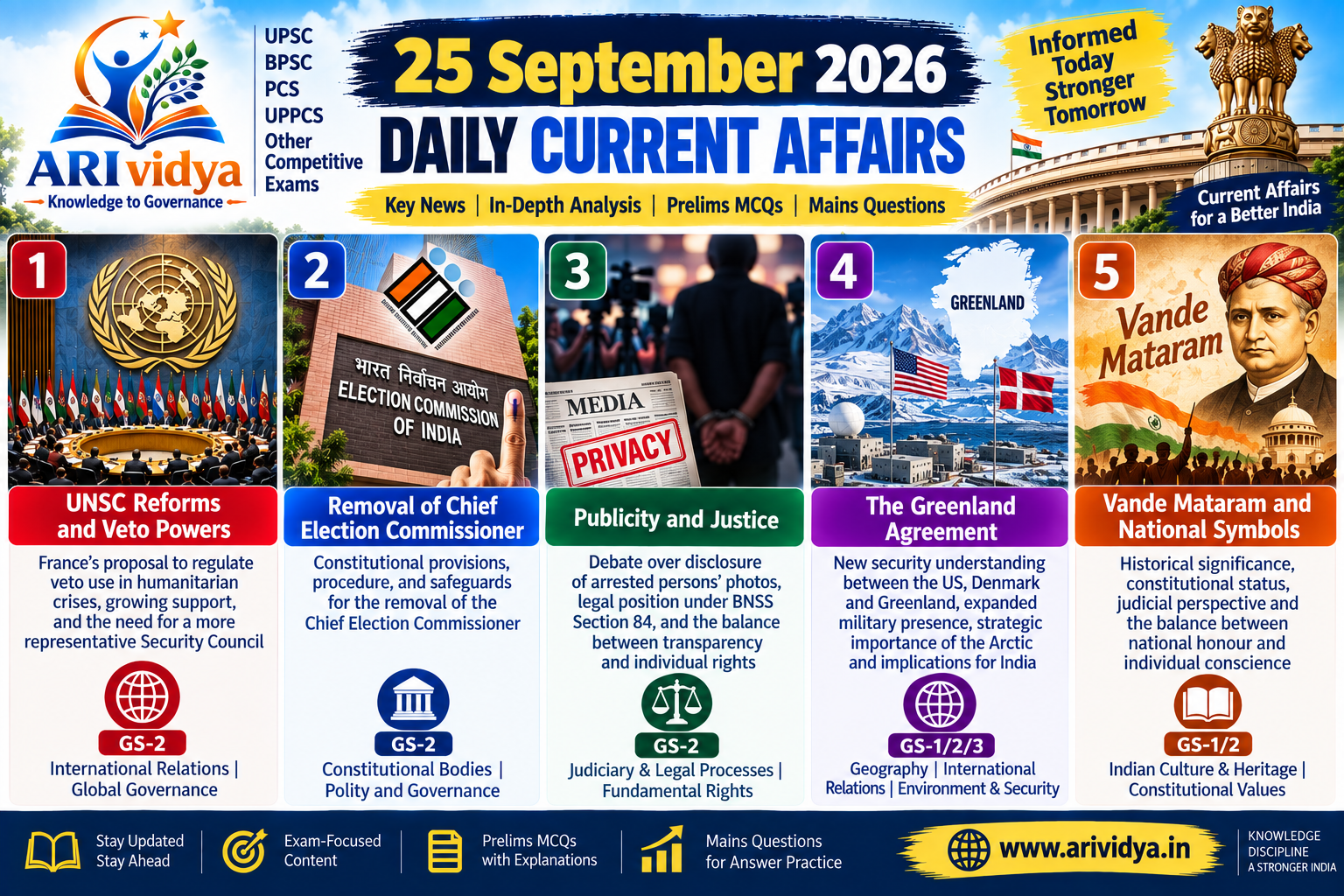
25 September 2026 Current Affairs
UPSC & PCS | Facts • Analysis • Prelims MCQs • Mains Questions
Thank you for reading this post, don't forget to subscribe!
1. UNSC Veto Power and Reform
What happened?
During the current United Nations General Assembly session, France has pushed for a more accountable approach to the use of the veto in the UN Security Council, particularly in situations involving humanitarian crises and genocide.
Key facts
- The UN Security Council was established in 1945 under the UN Charter.
- It has 15 members: 5 permanent and 10 non-permanent members.
- The five permanent members are the United States, United Kingdom, France, China and Russia.
- The five permanent members possess veto power.
- Non-permanent members serve two-year terms.
- India is a member of the G4 along with Brazil, Germany and Japan, which supports expansion of permanent and non-permanent membership of the Security Council.
- India has served as an elected member of the Security Council in several terms, including 2021–22.
Consider the following statements about the UN Security Council:
1. It has 15 members.
2. The five permanent members possess veto power.
3. The ten non-permanent members have two-year terms.
4. India is a member of the G4.
How many of the statements given above are correct?
A. Only one B. Only two C. Only three D. All four
Answer: D. All four
Explanation: All four statements are correct.
Mains Question — GS II: Discuss the need for reform of the UN Security Council and examine the major grounds of India’s claim for permanent membership. (250 words | 15 marks)
2. Constitutional Procedure for Removing the Chief Election Commissioner
What happened?
The constitutional procedure for removing the Chief Election Commissioner has come into focus. The Constitution provides special safeguards to protect the independence of the Election Commission.
Key facts
- Article 324(5) deals with conditions of service and tenure-related safeguards for Election Commissioners.
- The Chief Election Commissioner can be removed through a procedure similar to that applicable to a Supreme Court judge.
- The grounds are proved misbehaviour or incapacity.
- Other Election Commissioners can be removed on the recommendation of the Chief Election Commissioner.
- A removal motion can be introduced in either the Lok Sabha or the Rajya Sabha.
- The source material specifies 100 signatures for initiating the process in the Lok Sabha and 50 in the Rajya Sabha.
- A three-member inquiry committee is constituted during the process.
- The motion requires a special majority in both Houses before the formal address is sent to the President.
Which one of the following statements regarding the removal of the Chief Election Commissioner is not correct?
A. The Chief Election Commissioner can be removed through a procedure similar to that for a Supreme Court judge.
B. Proved misbehaviour or incapacity are the grounds for removal.
C. The removal motion can be introduced only in the Lok Sabha.
D. A special majority is required in both Houses.
Answer: C
Explanation: The motion can be introduced in either House of Parliament.
Mains Question — GS II: Why is security of tenure important for the independence of the Election Commission? Discuss with reference to the constitutional framework. (150 words)
3. Public Circulation of Photographs of Arrested Persons
What happened?
The public circulation of photographs and information about arrested persons, especially soon after arrest, has raised questions concerning legal authority, privacy, dignity and the presumption of innocence.
Key facts
- Section 84 of the Bharatiya Nagarik Suraksha Sanhita, 2023 deals with proclamation and publication relating to persons absconding.
- The provision does not by itself create a general basis for publicly circulating photographs of every arrested person during the early stage of investigation.
- The Criminal Procedure (Identification) Act, 2022 concerns the collection, storage and use of measurements and identification-related information.
- It should not be treated as a general authorisation for public circulation of an arrested person’s photograph.
- Article 21 protects personal liberty and dignity.
- Presenting an accused person as a criminal before conviction can have lasting reputational consequences, especially in the digital environment.
Section 84 of the Bharatiya Nagarik Suraksha Sanhita, 2023 primarily relates to:
A. Publication of photographs of every arrested person
B. Publication relating to proclaimed/absconding persons
C. Media regulation during criminal trials
D. Sentencing of convicted persons
Answer: B
Explanation: Section 84 concerns proclamation and publication relating to persons absconding; it is not a general provision authorising publication of photographs of every arrested person.
Mains Question — GS II: “Transparency in criminal justice must be balanced with individual dignity and the presumption of innocence.” Discuss in the context of public identification of arrested persons. (150 words)
4. Greenland and the New Security Agreement
What happened?
Information has emerged about a new security arrangement involving the United States, Denmark and Greenland. The development is linked to the growing strategic importance of Greenland and the wider Arctic region.
Key facts
- Greenland is an autonomous territory within the Kingdom of Denmark.
- The United States already operates the Pituffik Space Base in Greenland.
- The source material notes an existing US military presence of about 150 personnel there.
- The new arrangement includes plans concerning military facilities at Narsarsuaq in southern Greenland and Mestersvig in eastern Greenland.
- The 1951 US–Denmark defence agreement provides the historical framework for US military facilities in Greenland.
- Greenland’s strategic significance is linked to Arctic security, maritime routes, resources and the North Atlantic strategic environment.
Consider the following statements about Greenland:
1. Greenland is an autonomous territory within the Kingdom of Denmark.
2. The Pituffik Space Base is located in Greenland.
3. The 1951 US–Denmark defence agreement is connected with the US military presence in Greenland.
Which of the statements given above are correct?
A. 1 and 2 only B. 2 and 3 only C. 1 and 3 only D. 1, 2 and 3
Answer: D. 1, 2 and 3
Explanation: All three statements are supported by the source material.
Mains Question — GS II: Analyse the growing strategic significance of the Arctic region for global geopolitics and India’s interests. (150 words)
5. Vande Mataram and the Constitutional Debate on National Symbols
What happened?
The public singing of Vande Mataram, the use of its different stanzas and the constitutional questions surrounding respect for national symbols have been the subject of continuing debate.
Historical and constitutional facts
- Vande Mataram was composed by Bankim Chandra Chattopadhyay.
- In 1937, the Congress Working Committee decided on the use of its first two stanzas at national gatherings.
- On 24 January 1950, Rajendra Prasad stated that Vande Mataram should receive equal honour alongside the National Anthem.
- The Constitution does not contain a separate, explicit constitutional provision establishing the “National Song”.
- The 1986 Bijoe Emmanuel case is relevant to the balance between respect for national symbols and individual freedom of conscience.
- The issue connects fundamental rights, fundamental duties, freedom of conscience and respect for national symbols.
Consider the following statements regarding Vande Mataram:
1. It was composed by Bankim Chandra Chattopadhyay.
2. In 1937, its first two stanzas were selected for use at national gatherings.
3. The Constitution contains a separate explicit provision for the “National Song”.
4. On 24 January 1950, Rajendra Prasad referred to Vande Mataram as deserving equal honour.
Which of the statements given above are correct?
A. 1 and 2 only B. 1, 2 and 4 only C. 2, 3 and 4 only D. 1, 2, 3 and 4
Answer: B. 1, 2 and 4 only
Explanation: Statements 1, 2 and 4 are correct according to the source material; there is no separate explicit constitutional provision for the National Song.
Mains Question — GS I/II: Discuss the constitutional balance between respect for national symbols and an individual’s freedom of conscience. (150 words)
ARIvidya Exam Takeaway
For Prelims, focus on the factual anchors within each news item. For Mains, connect these issues with global governance, constitutional institutions, personal liberty, Arctic geopolitics and fundamental rights.
ARIvidya — Knowledge to Governance