
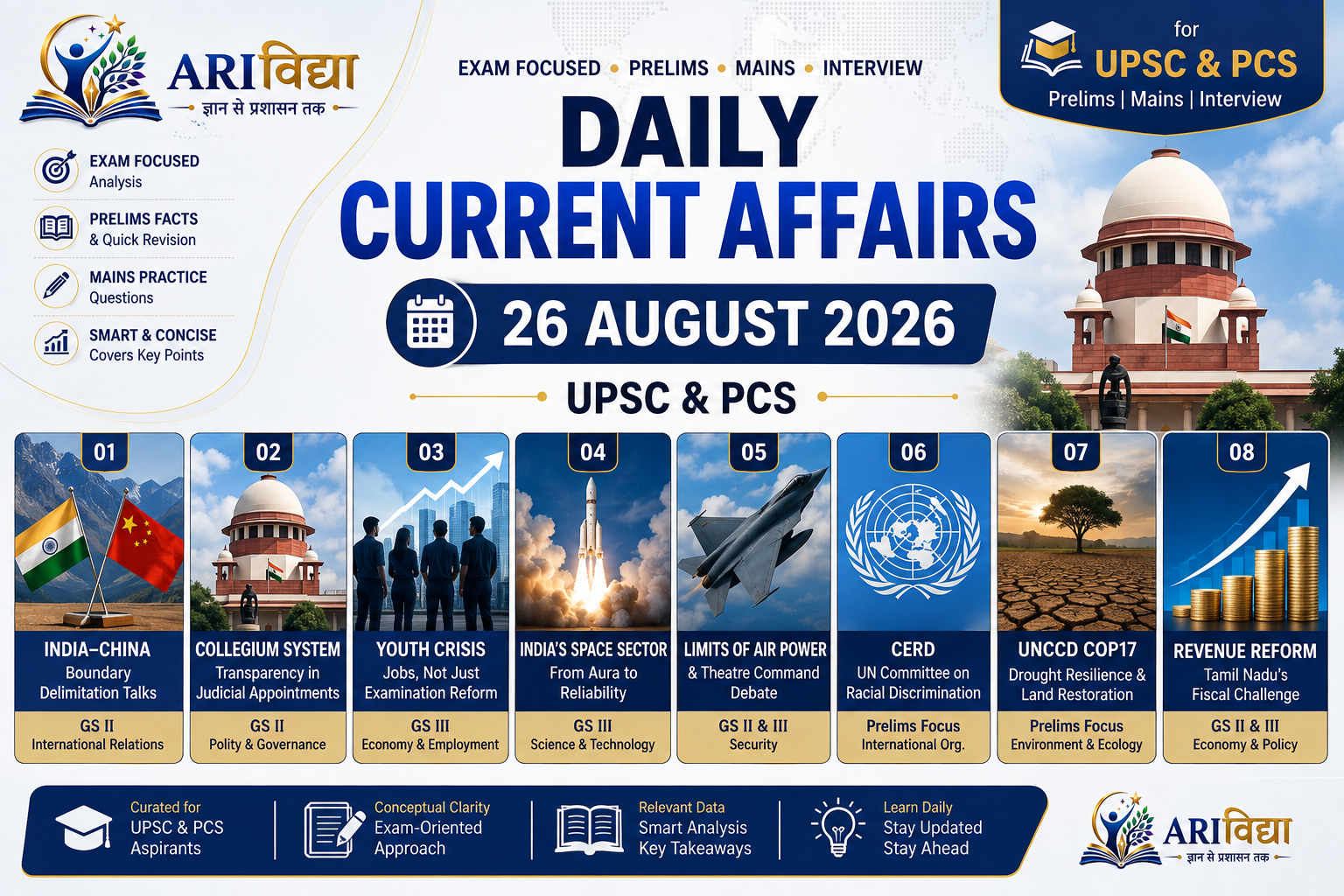
Daily Current Affairs 26 August 2026
Exam-oriented analysis of important national, international, governance, economy, environment, science & technology and security developments for UPSC & PCS preparation.
India–China: Boundary Delimitation Talks
Why in News?
India and China discussed ways to advance talks on delimiting parts of their disputed border. National Security Adviser Ajit Doval and Chinese Foreign Minister Wang Yi met in Beijing during the 25th round of talks between the Special Representatives on the boundary question.
Key Areas
- Line of Actual Control (LAC)
- Boundary delimitation
- Border management and control
- India–China bilateral cooperation
- Peace and tranquillity in border areas
Question
Despite continuing diplomatic engagement, permanent resolution of the India–China boundary dispute remains difficult. Discuss the major challenges.
Collegium System: Transparency in Judicial Appointments
Why in News?
The debate over transparency in judicial appointments has resurfaced following observations by Supreme Court Justice Ujjal Bhuyan that greater openness in the collegium process could strengthen public confidence and help ensure merit remains the governing principle.
Evolution of the Collegium
| Case | Significance |
|---|---|
| First Judges Case — 1981 | Executive primacy in judicial appointments |
| Second Judges Case — 1993 | Judicial primacy strengthened |
| Third Judges Case — 1998 | Expanded the system into the present five-member Supreme Court collegium |
Major Concerns
- No clear public notification of vacancies.
- No publicly known eligibility matrix.
- Limited transparency in candidate assessment.
- Questions regarding accountability and diversity.
- Need to balance judicial independence with constitutional accountability.
Mains Question
“The Collegium System seeks to safeguard judicial independence, but concerns regarding transparency, accountability and diversity continue to persist.” Critically examine.
India’s Youth Crisis: Jobs, Not Just Examination Reform
India’s youth challenge is increasingly connected with the shortage of quality employment opportunities. The issue cannot be addressed merely by reforming competitive examinations or making coaching cheaper.
Structural Problems
- Limited access to quality professional education.
- Manufacturing remains around one-sixth of GVA.
- Corporate investment declined from 17.3% of GDP in 2007–08 to 10.3% in 2024–25.
- Medium-sized enterprises need a more supportive regulatory environment.
Mains Question
“India’s youth challenge is fundamentally an employment challenge, not merely an examination challenge.” Discuss.
India’s Space Sector: From Aura to Reliability
India’s private space sector needs to focus not only on technological prestige but also on reliability, regular launches, cost competitiveness, jobs and long-term capital.
Why Reliability Matters
- Navigation and communication depend increasingly on space infrastructure.
- Regular launches help build commercial credibility.
- Lower launch costs are essential for global competitiveness.
- Heavy-lift launch capability can strengthen India’s position in the global space market.
Mains Question
India’s space economy must move beyond technological prestige towards reliability and cost competitiveness. Analyse.
The Limits of Air Power & India’s Theatre Command Debate
Recent wars have demonstrated that air superiority remains extremely important but is not necessarily sufficient to win a war on its own.
India’s Challenge
- The Indian Air Force has traditionally favoured operational flexibility.
- The China front presents different geographical and numerical challenges.
- Mountain terrain limits the number and flexibility of airbases.
- Joint-force generation and peacetime jointness remain important.
Theatre Command Debate
A Joint Coordination Centre relies heavily on consultation, whereas a theatre command provides a clearer chain of operational authority. Jointness, training, shared planning and institutional reform therefore remain important elements of modern military preparedness.
Mains Question
“Modern warfare requires joint military capability rather than dependence on any single service.” Examine in the context of India’s theatre command debate.
UN Committee on the Elimination of Racial Discrimination
The UN Committee on the Elimination of Racial Discrimination (CERD) expressed concern over reports of human rights violations involving Scheduled Tribes, Scheduled Castes, Rohingya refugees and other groups.
What is CERD?
CERD is a body of independent experts that monitors implementation of the International Convention on the Elimination of All Forms of Racial Discrimination.
UNCCD COP17: Drought Resilience & Land Restoration
Why in News?
Union Environment Minister Bhupender Yadav called for a fundamental shift from reactive drought relief towards proactive, technology-enabled resilience at the UNCCD conference in Mongolia.
UNCCD — Remember
- Adopted in 1994 after the 1992 Rio Earth Summit.
- One of the three major Rio Conventions.
- Other two: UNFCCC and CBD.
- Focuses on desertification, land degradation and drought.
Mains Question
“Drought is no longer merely a natural hazard but a development, food-security and water-security challenge.” Discuss.