
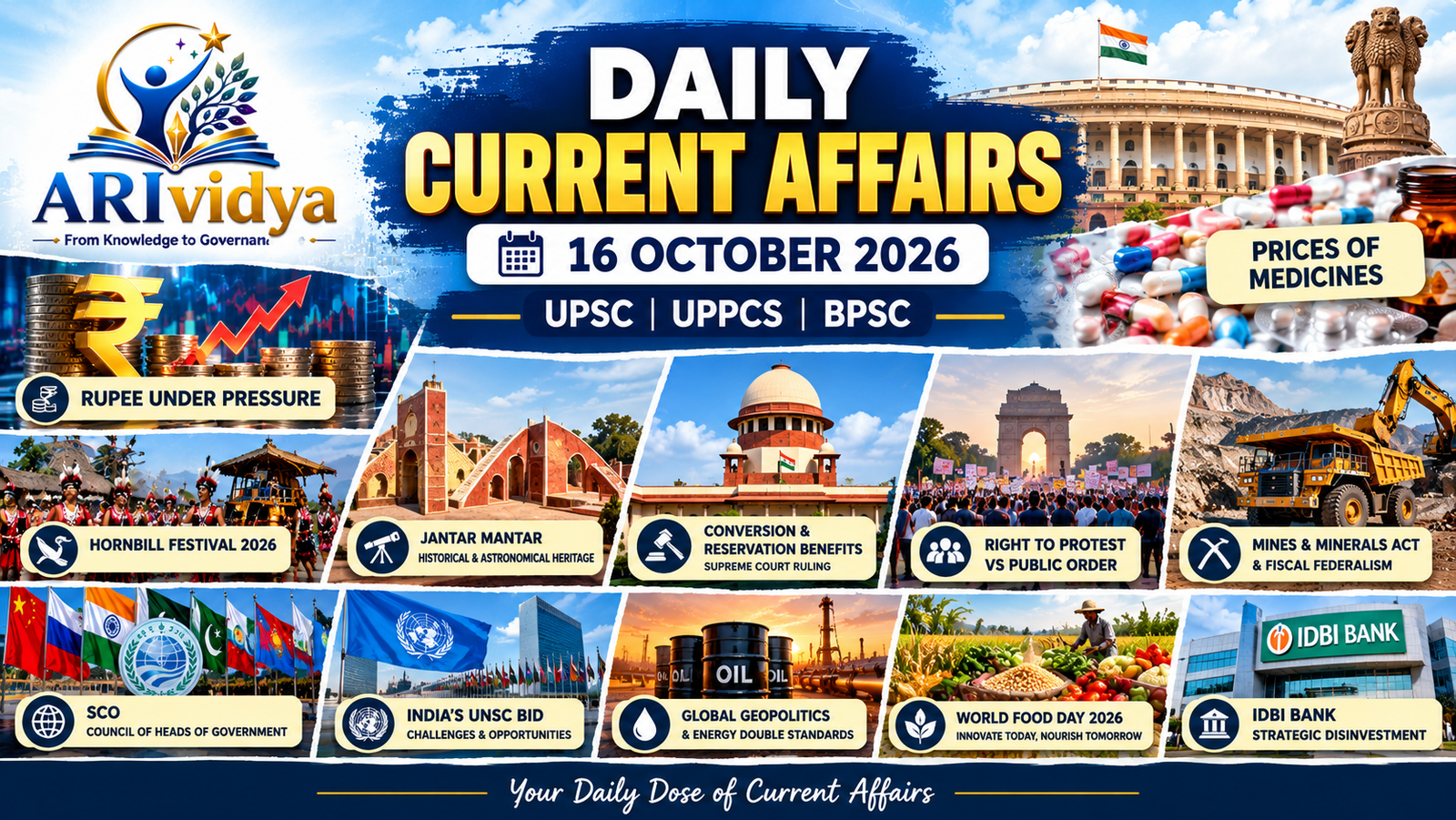
ARIvidya • Daily Current Affairs Notes
Thank you for reading this post, don't forget to subscribe!
16 October 2026
UPSC • UPPCS • BPSC | Prelims & Mains
Source material: Notes compiled from The Hindu, Dainik Bhaskar, Dainik Jagran and Business Standard. The material below is organised for examination preparation. Time-sensitive claims, figures and legal developments should be checked against the original reports or official notifications before being treated as final facts.
General Studies Paper 1 (GS-1)
01 • Indian Culture and Tribal Traditions
Hornbill Festival 2026
Nagaland has reportedly begun preparations for the 27th Hornbill Festival, scheduled in the supplied notes for 1–10 December 2026 at Kisama’s Naga Heritage Village. Often called the “Festival of Festivals”, it showcases the cultural traditions of Naga communities.
Prelims pointers: The Nagaland government launched the festival in 2000 to encourage inter-tribal harmony and tourism. It begins on 1 December, which coincides with Nagaland Statehood Day. The festival is named after the Great Indian Hornbill. Naga communities present traditional morungs, handicrafts, handloom, wood carving, folk dances and other cultural practices.
Significance: The festival supports the preservation of cultural heritage, local livelihoods and tourism. Development should also ensure meaningful community participation and respect for the authenticity of local traditions.
Mains Question (GS-1): How do cultural festivals in Northeast India contribute to the preservation of tribal heritage and local economic development?
MCQ 1: Choose the correct statement about the Hornbill Festival. (Tap to reveal the answer)
(A) It is held in Nagaland and began in 2000.
(B) It is dedicated exclusively to classical music.
(C) It is held every year in Rajasthan.
(D) It has no connection with Naga culture.
Reveal answer and explanation
Correct answer: (A). The festival was launched in Nagaland to promote tribal culture, crafts and tourism.
02 • Indian Architecture and Scientific Heritage
Jantar Mantar, Delhi: A Historic Astronomical Observatory
Jantar Mantar in Delhi is a historic observatory built for astronomical observations and time calculation. It was commissioned by Maharaja Sawai Jai Singh II in the eighteenth century. The site has also been discussed in connection with its role as a designated location for public protests.
Prelims pointers: Jai Singh II established observatories in Delhi, Jaipur, Ujjain, Varanasi and Mathura. Their instruments were designed to observe celestial positions, track time and study astronomical movements. The name “Jantar Mantar” is commonly associated with the Sanskrit terms yantra (instrument) and mantra (formula or calculation).
Significance: The site reflects the relationship between astronomy, mathematics and architecture in India’s knowledge traditions. Its conservation and public use also raise questions about urban heritage management.
Mains Question (GS-1): How do historic scientific monuments such as Jantar Mantar help us understand India’s knowledge traditions and architectural heritage?
MCQ 2: What was the principal purpose of Jantar Mantar? (Tap to reveal the answer)
(A) Maritime trade management
(B) Astronomical observation and time calculation
(C) Military training
(D) Hydroelectric power generation
Reveal answer and explanation
Correct answer: (B). Jantar Mantar’s structures were designed to observe celestial bodies and support astronomical calculations.
General Studies Paper 2 (GS-2)
03 • Constitution, Equality and Social Justice
Religious Conversion and Reservation Eligibility
The supplied notes refer to a Supreme Court decision concerning reservation eligibility after religious conversion. The broader constitutional question is whether reservation eligibility follows religious identity alone or depends on applicable laws, notified communities and statutory criteria concerning social backwardness.
Key constitutional provisions: Article 14 concerns equality before the law; Article 15 addresses discrimination and permits certain special provisions; Article 16 guarantees equality of opportunity in public employment. Article 16(4) enables reservation-related provisions for backward classes that, in the State’s opinion, are inadequately represented in public services. Eligibility must be assessed with reference to the applicable constitutional provisions, Central or State lists and relevant notifications. A certificate issued by a religious body does not, by itself, determine statutory reservation status.
Verification note: The specific judgment, parties and date mentioned in the news notes should be checked against the original court order before citation.
Mains Question (GS-2): Discuss how constitutional equality, social backwardness and statutory classification should be balanced while determining reservation eligibility.
MCQ 3: Which provision relates to reservation for backward classes in public employment? (Tap to reveal the answer)
(A) Article 16(4)
(B) Article 21A
(C) Article 32A
(D) Article 300A
Reveal answer and explanation
Correct answer: (A). Article 16(4) enables the State to provide for reservation in appointments or posts for backward classes that are, in the State’s opinion, inadequately represented in public services.
04 • Fundamental Rights and Public Order
Right to Protest versus Public Order
Debates over permission to protest at Jantar Mantar and the identification of alternative sites raise the question of balancing public order with democratic expression. Peaceful assembly and freedom of expression are essential to democracy, although they remain subject to constitutionally permitted restrictions relating to public order and other legitimate concerns.
Constitutional basis: Article 19(1)(a) protects freedom of speech and expression, while Article 19(1)(b) guarantees the right to assemble peacefully and without arms. These rights are subject to reasonable restrictions provided by the Constitution.
Policy balance: Protest locations should allow authorities to manage security and traffic while preserving opportunities for citizens to bring their concerns to decision-makers. Transparent permissions, consistent rules and judicial review are important safeguards.
Mains Question (GS-2): How can a democracy balance the right to peaceful protest with the need to maintain public order?
MCQ 4: Which Article guarantees the right to assemble peacefully and without arms? (Tap to reveal the answer)
(A) Article 14
(B) Article 19(1)(b)
(C) Article 20
(D) Article 25
Reveal answer and explanation
Correct answer: (B). Article 19(1)(b) protects peaceful assembly without arms, subject to constitutionally permitted reasonable restrictions.
05 • Federalism and Fiscal Relations
Mines and Minerals Amendment Act 2026: States’ Fiscal Autonomy
According to the supplied notes, some States are challenging changes to mining legislation over the expansion of the Union’s regulatory scope and the impact on taxation of mineral-bearing land. The central issue is how constitutional responsibilities for regulating mineral resources and collecting related revenue should be distributed between the Union and the States.
Federal dimensions: Royalties, lease payments and other mineral-related receipts can be significant sources of revenue for mineral-rich States. Restrictions on States’ ability to raise revenue may affect development spending and fiscal autonomy. Conversely, uniform national regulation can influence investment, transparency and resource management.
Points for analysis: constitutional distribution of legislative powers, fiscal federalism, cooperative federalism, benefits for local communities and environmental accountability. State-wise revenue percentages in the supplied notes should be checked against the original report.
Mains Question (GS-2): Critically examine how recent changes to mining law may affect the fiscal autonomy of States and the balance of India’s federal system.
MCQ 5: What is the key constitutional dimension of Union–State disputes over mineral resources? (Tap to reveal the answer)
(A) Distribution of fiscal and legislative powers
(B) Only local body elections
(C) The process of electing the President
(D) The process of acquiring citizenship
Reveal answer and explanation
Correct answer: (A). Regulation of minerals and the revenue derived from them raise questions about the distribution of legislative and fiscal powers between the Union and States.
06 • Regional Organisations and Diplomacy
Shanghai Cooperation Organisation (SCO): Council of Heads of Government
The supplied notes refer to a meeting of the SCO Council of Heads of Government in Dushanbe, Tajikistan, on 19–20 October. They mention India’s participation by Defence Minister Rajnath Singh and the Prime Minister joining virtually; the representation and schedule should be checked against official announcements.
Prelims pointers: The SCO traces its origins to the Shanghai Five of 1996 and was formally established on 15 June 2001. Its main bodies include the Council of Heads of State, the Council of Heads of Government and the Secretariat in Beijing. The Regional Anti-Terrorist Structure (RATS) is based in Tashkent. India and Pakistan became full members in 2017. The supplied notes list Iran as joining in 2023 and Belarus in 2024.
Significance for India: Eurasian connectivity, counter-terrorism cooperation, energy security and multilateral dialogue. Strategic differences among members can, however, make consensus difficult.
Mains Question (GS-2): Analyse the utility and limitations of the SCO in advancing India’s strategic and economic interests in Eurasia.
MCQ 6: Where is the SCO Regional Anti-Terrorist Structure (RATS) headquartered? (Tap to reveal the answer)
(A) Beijing
(B) Tashkent
(C) Dushanbe
(D) New Delhi
Reveal answer and explanation
Correct answer: (B). The SCO’s Regional Anti-Terrorist Structure is headquartered in Tashkent, Uzbekistan.
07 • United Nations and Global Governance
India’s Bid for a 2028–29 Non-Permanent UNSC Seat
The supplied notes state that India has announced its bid for a non-permanent seat on the UN Security Council for the 2028–29 term, with the election expected in June 2027. Non-permanent members are elected by the UN General Assembly and require a two-thirds majority of members present and voting. If all 193 members vote, that would amount to 129 votes.
Diplomatic challenges: competition within regional groups, calls for greater representation of smaller countries, priorities of the Global South and the need to secure support across regions. India’s previous membership and multilateral contributions may strengthen its case but cannot guarantee the outcome.
India’s priorities: articulate the concerns of developing countries, support UN reform, contribute constructively to peacekeeping and international law, and sustain engagement with regional groups.
Mains Question (GS-2): Analyse the opportunities and diplomatic challenges facing India in its bid for a non-permanent seat on the UN Security Council.
MCQ 7: Who elects the non-permanent members of the UN Security Council? (Tap to reveal the answer)
(A) UN General Assembly
(B) International Court of Justice
(C) World Bank
(D) UN Secretariat alone
Reveal answer and explanation
Correct answer: (A). Non-permanent Security Council members are elected by the UN General Assembly, with a two-thirds majority required.
08 • Foreign Policy and Energy Security
Global Geopolitics and Double Standards in Energy Trade
The supplied editorial notes describe criticism of India’s purchases of Russian energy followed by an alleged change in US policy involving Russian diesel purchases. Such developments raise questions about energy security, sanctions policy and the role of national interests in the decisions of major powers. Specific purchase volumes, waiver periods and sanctions details should be verified from original reporting and official documents.
Policy implications for India: diversify energy imports, maintain access to affordable supplies, protect against disruptions, assess sanctions and payment arrangements, and manage relations with major powers. Strategic autonomy means making decisions based on national interests while assessing their wider economic and diplomatic consequences.
Mains Question (GS-2): Examine India’s strategic autonomy in the context of sanctions on energy trade and the changing policies of major powers.
MCQ 8: What is the most appropriate meaning of strategic autonomy in energy diplomacy? (Tap to reveal the answer)
(A) Always following the foreign policy of one country
(B) Taking independent decisions based on national interests
(C) Ending trade with all countries
(D) Limiting energy security to domestic production alone
Reveal answer and explanation
Correct answer: (B). Strategic autonomy means making decisions according to national interests and circumstances while considering their broader consequences.
General Studies Paper 3 (GS-3)
09 • Food Security and Agricultural Innovation
World Food Day 2026: “Innovate Today, Nourish Tomorrow”
World Food Day is observed on 16 October. The supplied notes give the 2026 theme as “Innovate today, nourish tomorrow”. Food security is not limited to adequate production; it also involves nutrition, affordability, distribution, climate resilience and reducing food loss and waste.
India’s food security system: The Green Revolution helped raise foodgrain production. The National Food Security Act, 2013 provides eligible populations with a legal entitlement to subsidised foodgrains. Digitisation of the Public Distribution System (PDS), biometric authentication, One Nation One Ration Card and technology-assisted grain distribution are intended to improve delivery. These systems must also address authentication failures and the risk of excluding eligible beneficiaries.
UN agencies: FAO provides technical cooperation on agriculture and food systems; IFAD supports rural livelihoods and agricultural investment; WFP works on food assistance, nutrition and more efficient food distribution. Climate-resilient agriculture, millets, improved storage and cold-chain infrastructure are important components of food security.
Mains Question (GS-3): In the context of “Innovate today, nourish tomorrow”, discuss how technological progress, climate-resilient agriculture and inclusive policies can strengthen India’s food security. (250 words, 15 marks)
MCQ 9: Which initiative improves portability under India’s Public Distribution System? (Tap to reveal the answer)
(A) One Nation One Ration Card
(B) Minimum Support Price alone
(C) Pradhan Mantri Gram Sadak Yojana
(D) National Clean Air Programme
Reveal answer and explanation
Correct answer: (A). One Nation One Ration Card is intended to enable eligible beneficiaries to access ration at participating locations across India.
10 • Banking, Disinvestment and Economic Policy
Strategic Disinvestment of IDBI Bank
The supplied notes state that the Cabinet Committee on Economic Affairs approved the strategic sale of IDBI Bank. According to those notes, the proposed transaction involves Fairfax Financial Holdings acquiring a 60.72% stake, with the Union government and LIC selling their respective holdings. The final status, transaction value and regulatory conditions should be checked against official announcements.
Economic context: Strategic disinvestment involves the government reducing its stake or transferring control in a public-sector enterprise. Potential benefits include raising capital, improving management efficiency and redirecting public resources towards priority areas. Risks may include effects on competition, employees, financial inclusion and public accountability.
Banking indicator: Gross non-performing assets (Gross NPA) are one measure of a bank’s asset quality. A fuller assessment should also consider capital adequacy, profitability, provisioning and governance.
Mains Question (GS-3): Analyse the potential benefits and risks of strategic disinvestment in a public-sector bank. How might it affect the financial sector and the allocation of public resources?
MCQ 10: What does Gross NPA primarily indicate in banking? (Tap to reveal the answer)
(A) The quality of a bank’s assets and level of stressed loans
(B) Only the number of bank branches
(C) The country’s literacy rate
(D) Daily stock-market turnover
Reveal answer and explanation
Correct answer: (A). Gross NPA reflects loans where repayment has become overdue under the applicable norms and is a key indicator of asset quality.
11 • Inflation and Supply-Chain Management
Food Inflation: Why Can Prices Rise Despite Adequate Production?
The supplied notes report food inflation rising from 5.97% in August to 7.74% in September. The underlying index and measurement basis should be checked against the original report. Food prices depend not only on total production but also on crop-specific availability, storage, transport, seasonal fluctuations and access to markets.
Possible causes: inadequate cold-chain facilities for perishable produce, weather uncertainty, crop losses, delays in bringing supplies to market, and storage decisions by farmers and consumers. Buffer stocks can support cereal availability but do not directly stabilise the prices of every food item.
Policy measures: expand scientific storage, cold chains and food processing; strengthen market information; reduce transport bottlenecks; and use timely import-export measures where appropriate. Policy should improve farmers’ market access while also protecting consumers from sharp price volatility.
Mains Question (GS-3): Why can food inflation rise despite adequate foodgrain production and buffer stocks? Explain the role of supply-chain and storage reforms.
MCQ 11: Which measure most directly addresses supply-chain constraints for perishable produce? (Tap to reveal the answer)
(A) Expanding cold-chain and storage facilities
(B) Withholding market information
(C) Ignoring transportation costs
(D) Fixing the same harvest date for every crop
Reveal answer and explanation
Correct answer: (A). Better cold chains and storage can reduce spoilage and help keep market supplies more stable.
Additional Mains Practice
Question 1 (GS-3 | Food Security): “Innovate today, nourish tomorrow” highlights the role of innovation in ensuring sustainable food security. How can technological progress, climate-resilient agriculture and inclusive policies address India’s emerging food-security challenges? (250 words, 15 marks)
Question 2 (GS-2 | Fiscal Federalism): Critically examine how recent provisions in mining law may affect the fiscal autonomy of States and the balance of India’s federal system. (150 words, 10 marks)
ARIvidya Study Strategy
For each topic, prepare five points: background, constitutional or institutional basis, major challenges, government or international initiatives, and the way forward. Revise factual prelims pointers separately and use relevant examples in balanced mains answers.
Editorial note: This post organises the supplied notes for examination preparation. Verify time-sensitive claims—particularly court decisions, legislative changes, upcoming meetings, election bids, disinvestment details and current inflation figures—against original reporting and official sources.