
Thank you for reading this post, don't forget to subscribe!
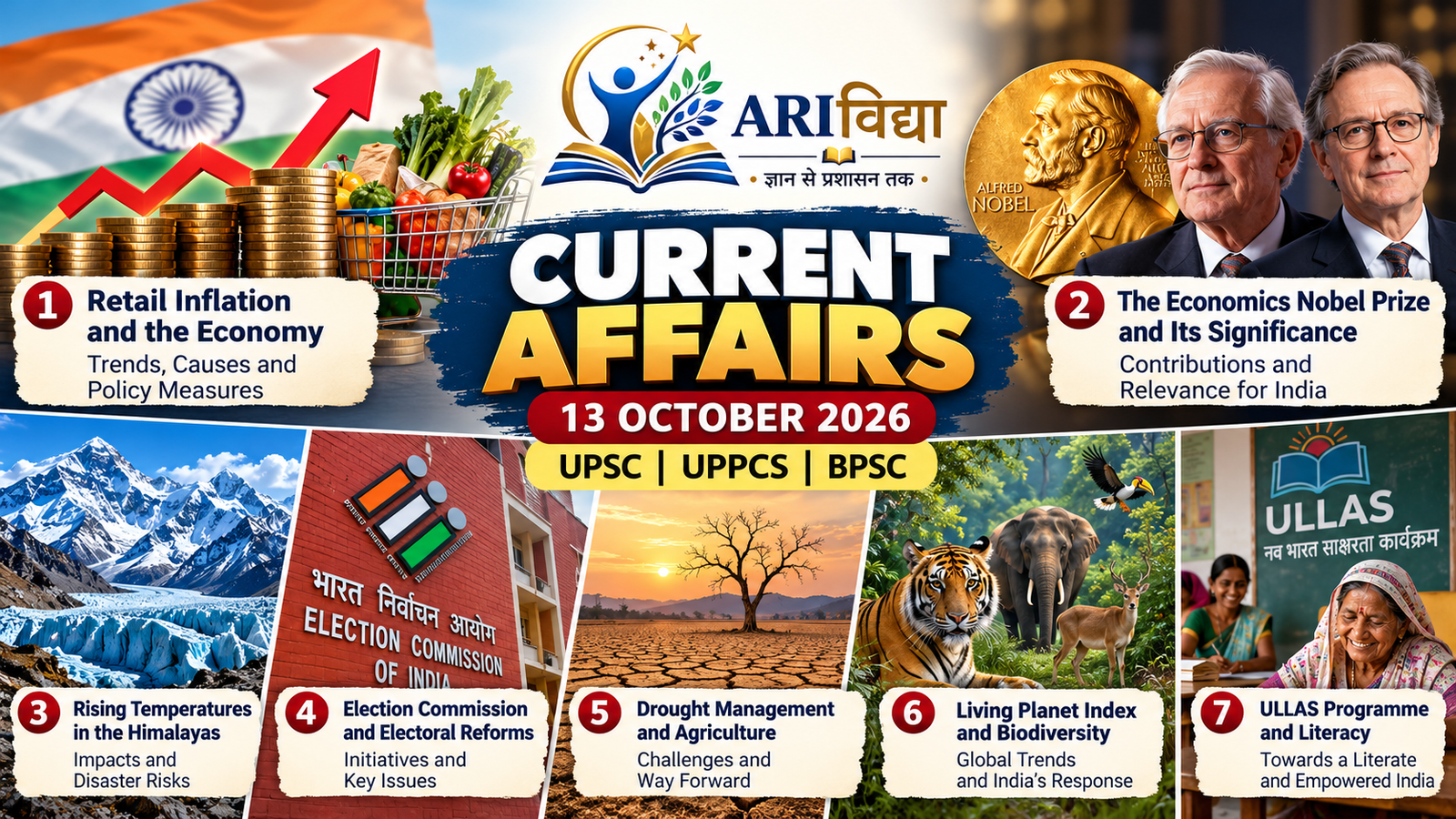
Today’s Current Affairs
13 October 2026 | Tuesday
UPSC • UPPCS • BPSC
Important issues for Prelims and Mains
1. Retail Inflation Rises to 5.54%
India’s retail inflation rose to 5.54% in September 2026, compared with 4.8% in August, according to the news material. Higher food and fuel prices contributed to the increase. The reported rate was the highest since October 2024.
Key points
- The Consumer Price Index (CPI) measures changes in the retail prices of a basket of goods and services.
- The Reserve Bank of India’s medium-term inflation target is 4%, with a tolerance band of 2% to 6%.
- The September reading moved closer to the upper tolerance limit of 6%.
- The CPI series has been revised to a new base year of 2024=100, as noted in the source material.
Prelims MCQ
Question: Which index is primarily used to measure retail inflation in India?
(A) Index of Industrial Production (IIP)
(B) Consumer Price Index (CPI)
(C) Human Development Index (HDI)
(D) Wholesale trade volume index
Answer and explanation
Correct answer: (B) Consumer Price Index. CPI tracks changes in the retail prices paid by consumers for a basket of goods and services.
Mains Question (GS-3)
Question: Discuss the major drivers of retail inflation in India and examine its implications for households and monetary policy. (150 words)
2. Economics Nobel and Macroeconomic Stabilisation
The news clippings discuss the contributions of American economists Robert E. Hall and Michael Woodford to New Keynesian economics and economic stabilisation. Their work connects macroeconomic outcomes with the decisions and expectations of households and individual businesses.
Why it matters
- Household expectations about future income can influence consumption and saving decisions.
- Business expectations affect investment, hiring and price-setting decisions.
- Central banks can influence expectations by communicating their likely policy direction, a practice known as forward guidance.
- Coordination among central banks and governments can help manage economic shocks that spread across borders.
Prelims MCQ
Question: In monetary policy, the term “forward guidance” refers to:
(A) A government guarantee against all investment losses
(B) A central bank communicating its likely future policy direction
(C) Fixing the exchange rate permanently
(D) Replacing monetary policy with fiscal policy
Answer and explanation
Correct answer: (B). Forward guidance communicates information about the likely future course of monetary policy to influence economic expectations and decisions.
Mains Question (GS-3)
Question: Explain how household expectations and central-bank communication influence macroeconomic stabilisation. (150 words)
3. Warming Himalayas and Rising Disaster Risks
Rising temperatures across the Hindu Kush–Himalayan region are affecting glaciers and permafrost. The source material cites warnings that high mountain regions of Asia are warming at around 0.3°C per decade—nearly twice the global average. These changes can destabilise mountain slopes and threaten infrastructure, water security and livelihoods.
Major concerns
- Retreating glaciers and accelerated ice loss.
- Thawing permafrost and weakening mountain slopes.
- Greater risks of landslides, rockfalls, debris flows and sudden floods.
- Pressure on water resources, ecosystems, livelihoods and mountain infrastructure.
Risk reduction requires monitoring of glacial lakes and unstable slopes, early-warning systems, satellite-based observation, climate-resilient construction and cooperation across the Himalayan region.
Prelims MCQ
Question: Thawing permafrost in mountainous regions can increase the risk of:
(A) Greater stability of all mountain slopes
(B) Landslides and rockfalls
(C) Permanent elimination of glacial floods
(D) Reduced exposure of mountain infrastructure to hazards
Answer and explanation
Correct answer: (B). Thawing permafrost can weaken the material that helps bind mountain slopes and rock, increasing slope-instability hazards.
Mains Question (GS-3)
Question: Examine how climate change is increasing disaster risks in the Indian Himalayan Region. Suggest measures to strengthen climate-resilient development. (150 words)
4. Election Commission and the Revision of Electoral Rolls
The news material raises questions about the Election Commission of India’s credibility and the process of Special Intensive Revision (SIR) of electoral rolls. The central challenge is to improve the accuracy of voter lists while protecting the voting rights of every eligible citizen.
Key issues
- Revision can help include eligible voters and correct inaccurate or duplicate entries.
- The process should be transparent, with appropriate notice, hearings and opportunities to appeal.
- Administrative efficiency must be balanced with inclusion, fairness and public trust.
- Indian citizens who meet the legal eligibility requirements must follow the prescribed process to register as voters; the voting age is 18 years.
Prelims MCQ
Question: Which principle should guide the revision of electoral rolls?
(A) Removing names without notice or review
(B) Restricting verification to urban voters
(C) Ensuring accuracy while protecting eligible voters through a transparent process
(D) Preventing citizens from raising objections
Answer and explanation
Correct answer: (C). Electoral-roll revision should improve accuracy while maintaining due process, transparency and safeguards for eligible voters.
Mains Question (GS-2)
Question: How can India balance the need for accurate electoral rolls with the protection of universal adult suffrage? Discuss. (150 words)
5. Drought in Southern India: Agriculture and Centre–State Coordination
According to the news material, parts of Karnataka and Andhra Pradesh are facing serious drought conditions following deficient monsoon rainfall. Drought assessment should consider not only rainfall but also agricultural and water-related indicators, supported by ground verification.
Major challenges
- Reduced crop output and pressure on farmers’ incomes.
- Stress on reservoirs, groundwater and drinking-water supplies.
- Shortages of fodder and pressure on rural livelihoods.
- The need for timely assessment and coordination for relief assistance.
Important responses include micro-irrigation, water conservation, drought-resilient crops, crop insurance and timely support to affected households. Effective coordination between the Centre and states is essential for assessment and relief.
Prelims MCQ
Question: Which approach is most suitable for assessing drought conditions?
(A) Considering only rainfall on a single day
(B) Relying exclusively on media reports
(C) Combining rainfall, agricultural and water indicators with field verification
(D) Using population size as the sole indicator
Answer and explanation
Correct answer: (C). A sound drought assessment combines rainfall data with indicators of crop stress, water availability and ground conditions.
Mains Question (GS-3)
Question: Analyse the effects of drought on Indian agriculture and rural livelihoods. Suggest measures for drought-resilient management. (150 words)
6. Living Planet Index and Declining Wildlife Populations
The Living Planet Index tracks changes over time in the population sizes of monitored wildlife populations. The news analysis refers to an average decline of 73% in the size of monitored wildlife populations between 1970 and 2022.
How should the figure be interpreted?
- It does not mean that 73% of all wildlife species have become extinct.
- The index tracks population trends across monitored mammals, birds, reptiles, amphibians and fish.
- Habitat loss, pollution, climate change and overexploitation are major pressures on biodiversity.
- The source material notes particularly severe average declines in Latin America and the Caribbean.
Conservation requires protecting habitats, curbing illegal wildlife trade, reducing pollution and restoring degraded ecosystems.
Prelims MCQ
Question: What does a 73% decline reported by the Living Planet Index represent?
(A) The extinction of 73% of all wildlife species
(B) An average decline in the size of monitored wildlife populations
(C) A 73% decline in the world’s total forest area
(D) An identical decline in every wildlife population everywhere
Answer and explanation
Correct answer: (B). The figure describes an average change in monitored population sizes; it is not the percentage of species that have gone extinct.
Mains Question (GS-3)
Question: Discuss the major drivers of biodiversity loss and their implications for ecosystem stability. Suggest effective conservation measures. (150 words)
7. ULLAS–Nav Bharat Saaksharta Karyakram and Lakshadweep
According to the news material, Lakshadweep was declared a fully literate Union Territory under the ULLAS–Nav Bharat Saaksharta Karyakram. The material reports that 1,113 adults who lacked literacy skills were identified and supported through learning and assessment activities, after which they passed the foundational literacy and numeracy assessment.
Key features
- ULLAS stands for Understanding of Lifelong Learning for All in Society; it is also known as the New India Literacy Programme.
- The programme focuses on non-literate people aged 15 years and above who missed out on formal schooling.
- It aims to develop foundational reading, writing and numeracy skills.
- Functional and digital literacy and skills useful in daily life are also important elements.
- The Department of School Education and Literacy under the Ministry of Education is associated with its implementation.
Prelims MCQ
Question: ULLAS–Nav Bharat Saaksharta Karyakram primarily focuses on:
(A) Only primary-school students
(B) Non-literate people aged 15 years and above
(C) Only university research scholars
(D) Only serving government employees
Answer and explanation
Correct answer: (B). The programme aims to provide foundational literacy and numeracy to non-literate people aged 15 years and above.
Mains Question (GS-2)
Question: How can adult literacy contribute to inclusive development and citizen empowerment? Discuss with reference to the ULLAS programme. (150 words)
Quick Revision: Key Themes
- Economy: Retail inflation, CPI and economic stabilisation.
- Economics Nobel: Expectations, household behaviour and monetary policy.
- Environment: Himalayan warming and the Living Planet Index.
- Polity: Election Commission and electoral-roll revision.
- Agriculture: Drought assessment, relief and water conservation.
- Social development: ULLAS and adult literacy.