
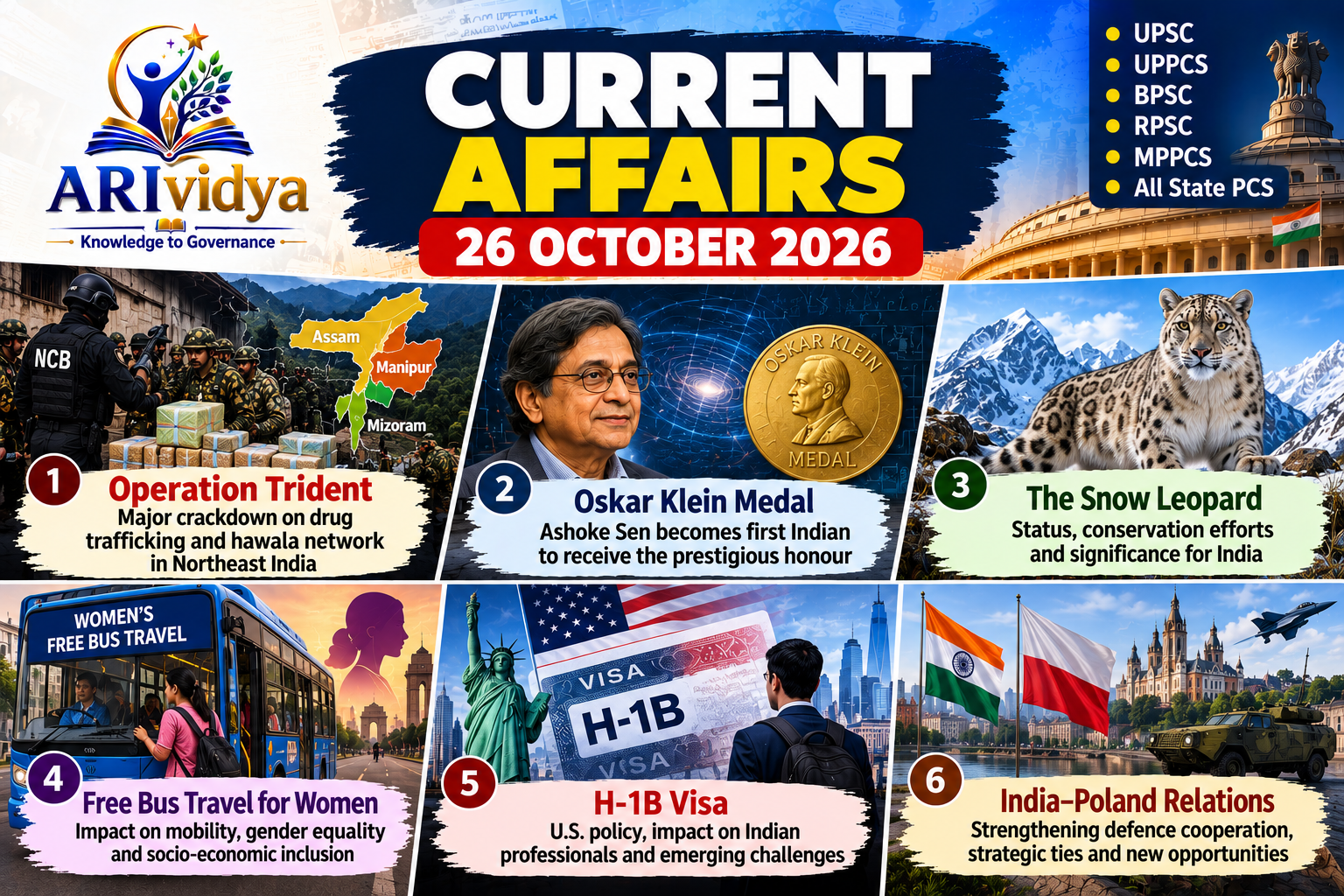
Date: Monday, 26 October 2026 | Exam focus: UPSC, UPPCS and other State PCS examinations
Thank you for reading this post, don't forget to subscribe!
Today’s material covers internal security, illicit financial flows, science and technology, biodiversity, gender equality, migration policy and India’s Europe policy. Each topic is developed through its background, significance, challenges and way forward, followed immediately by a Prelims MCQ with answer and a Mains practice question.
1. Operation Trident: Action Against a Northeast Narco-Hawala Network
According to the supplied material, coordinated raids were conducted at 38 locations across Assam, Mizoram and Manipur on 23 October. Eighteen accused persons were arrested, and suspected hawala transactions worth about ₹100 crore linked to an international “narco-hawala” network were detected. The material refers to drug trafficking from Myanmar, the use of local carriers and the settlement of proceeds through bank accounts in the Northeast. The operation was named “Operation Trident”.
What is hawala? Hawala is an informal, trust-based money-transfer arrangement. Intermediaries in different locations arrange equivalent payouts; the funds do not necessarily cross borders through the formal banking system at the time of the transaction. Although historically used in trade and remittances, an unregulated channel can be misused for money laundering, tax evasion, organised crime and terrorist financing.
360° analysis: International borders in the Northeast, drug supply chains and informal financial channels can reinforce one another. Arrests alone are not enough. Financial intelligence, border management, banking surveillance, information-sharing among States, cooperation with Myanmar, and drug treatment and rehabilitation all matter. Risk-based checks should target illicit networks without unnecessarily disrupting legitimate remittances and small businesses.
Prelims MCQ: Consider the following statements about hawala:
- It is generally an informal money-transfer arrangement based on intermediaries and trust.
- It can be misused for money laundering and illicit cross-border financial flows.
- Every hawala transaction necessarily involves an immediate formal bank transfer.
(A) 1 and 2 only (B) 2 and 3 only (C) 1 and 3 only (D) 1, 2 and 3
Answer: (A) — Settlement between intermediaries can take place later; an immediate formal bank transfer is not an essential feature.
Mains Practice (GS-3): How does the nexus between drug trafficking and illicit financial flows threaten India’s internal security? Suggest a multi-agency and regional-cooperation approach.
2. Oskar Klein Medal: Theoretical Physicist Ashoke Sen
According to the supplied material, theoretical physicist Ashoke Sen has received the Oskar Klein Medal. The material describes him as the first Indian to receive the honour. The medal has been awarded annually since 1988 through Stockholm University and the Nobel Committee for Physics of the Royal Swedish Academy of Sciences. Sen is known for his work on string theory and has previously received honours including the Dirac Medal and the Breakthrough Prize in Fundamental Physics.
What is string theory? It is a theoretical approach in which fundamental particles are modelled not as point-like objects but as extremely small, one-dimensional vibrating strings. One major aim is to find a mathematically consistent framework connecting quantum theory and gravitation. The supplied material highlights Sen’s work showing mathematical equivalences among apparently distinct string theories, S-duality, the Sen conjecture on unstable D-branes and the entropy function formalism for black holes.
360° analysis: The recognition underlines the value of fundamental science, long-term research and international scientific collaboration in India. Theoretical research may not immediately produce commercial products, but it strengthens mathematical methods, scientific training and the foundations for future discoveries. Stable research funding, academic freedom, international collaboration and opportunities for young researchers are important for India’s research ecosystem.
Prelims MCQ: Which statement best describes string theory?
(A) It studies only planetary orbits. (B) It models fundamental particles as tiny vibrating strings. (C) It classifies biological cells. (D) It is used only for weather forecasting.
Answer: (B) — String theory seeks a broader theoretical framework for understanding fundamental particles and forces.
Mains Practice (GS-3): How does investment in fundamental science strengthen India’s long-term scientific capability and innovation ecosystem?
3. Snow Leopard: Conservation and Population Assessment
On International Snow Leopard Day, 23 October, India’s Environment Ministry highlighted the country’s first Snow Leopard Population Assessment (SPAI). The supplied material estimates 718 snow leopards in India, including 477 in Ladakh. The species, Panthera uncia, is often called the “Ghost of the Mountains”. It inhabits cold, dry alpine and sub-alpine landscapes across high mountains of Central and South Asia. The material gives a typical elevation range of 3,000–5,400 metres.
Conservation status and range: The snow leopard is listed as Vulnerable on the IUCN Red List. Its 12 range states are Afghanistan, Bhutan, China, India, Kazakhstan, Kyrgyz Republic, Mongolia, Nepal, Pakistan, Russia, Tajikistan and Uzbekistan. The material says China contains roughly 60% of the global habitat. India’s Project Snow Leopard, launched in 2009, promotes landscape-level conservation of high-altitude wildlife and habitats, with community participation.
360° analysis: Major pressures can include habitat fragmentation, climate change, declining prey, poaching and conflict with livestock herders. Scientific population assessments help set conservation priorities, but long-term camera-trap monitoring, community participation, measures to address livestock losses and cross-border cooperation are also needed. As an apex predator, the snow leopard is an important indicator of high-mountain ecosystem health.
Prelims MCQ: Consider the following statements about the snow leopard:
- Its scientific name is Panthera uncia.
- It is listed as Vulnerable on the IUCN Red List.
- Project Snow Leopard was launched in India in 2009.
(A) 1 and 2 only (B) 2 and 3 only (C) 1, 2 and 3 (D) 1 and 3 only
Answer: (C) — All three statements are consistent with the supplied material.
Mains Practice (GS-3): Analyse the roles of scientific assessment, local communities and international cooperation in conserving high-altitude species such as the snow leopard.
4. Free Bus Travel for Women: Mobility and Empowerment
The supplied material says Punjab and Tamil Nadu introduced free travel on ordinary government buses for women in 2021, Karnataka followed in June 2023 and Telangana in December 2023. The schemes are intended to make it easier for women to reach jobs, colleges and hospitals. Data from the National Statistics Office’s 2019 and 2024 Time Use Surveys were compared to assess changes in women’s mobility.
What do the figures show? In these four States, the share of women aged 15–59 who made at least one trip on the survey day rose from 38.7% in 2019 to 45.3% in 2024, an increase of 6.6 percentage points. The corresponding increase for men was 3.7 points. In 12 other large States studied, women’s travel rose by 4.4 points and men’s by 7.6 points. In Telangana, the share increased from 43.7% in 2019 to 54.6% in 2024; in Andhra Pradesh it moved from 40.8% to 41.6%. The material notes that Andhra Pradesh’s scheme began after the 2024 survey.
360° analysis: Free bus travel can reduce direct travel costs and improve access to education, jobs, healthcare and public life. Its impact, however, depends on bus availability, routes, frequency, safety, last-mile connectivity, crowding, fiscal sustainability and working conditions for transport staff. A rise in the number of women travelling does not by itself prove a proportional rise in employment or income; outcomes should also be assessed by gender, rural–urban location and income group.
Prelims MCQ: What is a key purpose of the NSO’s Time Use Survey?
(A) Recording how people spend their time across activities (B) Measuring only industrial output (C) Conducting school examinations only (D) Covering only government employees
Answer: (A) — Time Use Surveys help understand how people allocate their time during the day.
Mains Practice (GS-2/3): “Free public bus transport for women is not merely a welfare measure but an instrument of economic empowerment and social inclusion.” Critically examine its role in mobility, safety and workforce participation.
5. The U.S. H-1B Visa and Indian Professionals
The supplied material describes a tightening of legal immigration by the U.S. administration. Measures discussed include a US$100,000 payment requirement for certain new H-1B petitions, changes to visa-renewal procedures, a wage-weighted selection system and suspension of the PERM process. According to the material, Indian nationals have accounted for more than 70% of H-1B beneficiaries, making the changes especially relevant to Indian professionals and Indian-origin firms.
What is the H-1B visa? It is an employer-sponsored, temporary non-immigrant work visa for foreign professionals in speciality occupations. The material identifies IT, engineering, finance and healthcare among the relevant fields. It describes the usual annual cap as 65,000 visas, with an additional 20,000 for eligible individuals with advanced degrees from U.S. institutions. Some workers at higher-education institutions, non-profits and government research organisations may be exempt from the cap. A visa is initially valid for three years and can generally be extended up to six years. H-1B holders may also apply for a Green Card.
H-1B versus PERM: H-1B is a temporary employment visa. PERM is the U.S. Department of Labor’s permanent labour-certification process and an important step for certain employment-based Green Card categories. Employers must demonstrate that qualified U.S. workers are not available for the role and that hiring a foreign worker will not adversely affect local wages and working conditions.
360° analysis: Restrictions may raise costs and uncertainty for Indian professionals, affect firms’ ability to recruit talent and become a sustained issue in India–U.S. relations. The U.S. administration argues that such policies protect domestic workers and wages. India can respond through skills development, stronger high-technology employment at home, guidance for affected professionals, dialogue on migrant rights and diversification of global job markets.
Prelims MCQ: Which statement about the H-1B visa is correct?
(A) It directly grants permanent citizenship. (B) It is an employer-sponsored temporary work visa. (C) It is exclusively for tourists. (D) It is only for seasonal agricultural work.
Answer: (B) — H-1B allows temporary employment in speciality occupations through employer sponsorship.
Mains Practice (GS-2): How could changes in U.S. employment-based immigration policy affect India–U.S. relations, Indian talent and global skilled-labour flows?
6. India–Poland Relations: Strategic Cooperation Beyond Trade
The supplied material suggests that India and Poland have few direct bilateral disputes, but strategic partnerships with third countries can complicate mutual trust. It highlights India’s defence relationship with Russia and Poland’s defence ties with Pakistan. The two sides agreed to establish a “Defence Industry Dialogue” and explore counter-terrorism cooperation. The war in Ukraine and European security also featured in discussions.
Economic and technological opportunities: Poland is one of the European Union’s major economies. The material identifies technology, artificial intelligence, defence hardware, critical minerals, renewable energy and nuclear energy as potential areas for cooperation. Poland’s machinery and components supply chains, combined with India’s manufacturing scale, could create opportunities for trilateral industrial collaboration.
360° analysis: Deeper economic and technology links with Europe can help India diversify strategic partnerships. However, India’s defence ties with Russia, Poland’s defence relationship with Pakistan and differing perspectives on the Ukraine war complicate trust-building. Regular political dialogue, transparent defence-industry cooperation, counter-terrorism information-sharing and practical projects in technology and energy can help manage these differences. This topic focuses on the strategic and defence dimensions, distinct from the trade-focused India–Poland item published on 23 October.
Prelims MCQ: Which set includes potential areas of India–Poland cooperation identified in the material?
(A) Artificial intelligence, defence industry and renewable energy (B) Polar fishing only (C) A common currency only (D) Space tourism only
Answer: (A) — The material identifies technology, defence equipment and energy as possible areas of cooperation.
Mains Practice (GS-2): Evaluate the opportunities for defence and technology cooperation in India–Poland relations and the strategic differences linked to Russia and Pakistan.
Quick Revision
- Operation Trident: Raids at 38 locations across Assam, Mizoram and Manipur; 18 arrests; suspected hawala transactions worth about ₹100 crore detected.
- Oskar Klein Medal: Theoretical physicist Ashoke Sen; contributions to string theory.
- Snow leopard: India’s assessment estimated 718 animals, including 477 in Ladakh; IUCN status Vulnerable.
- Free bus travel: Women’s travel rose in the four States studied between 2019 and 2024.
- H-1B: Employer-sponsored temporary work visa; PERM is linked to employment-based permanent residency.
- India–Poland: Defence industry, counter-terrorism, technology and energy, alongside strategic trust challenges.
Practice tip: Write one GS-2 and one GS-3 answer today, supporting your arguments with data and examples.