

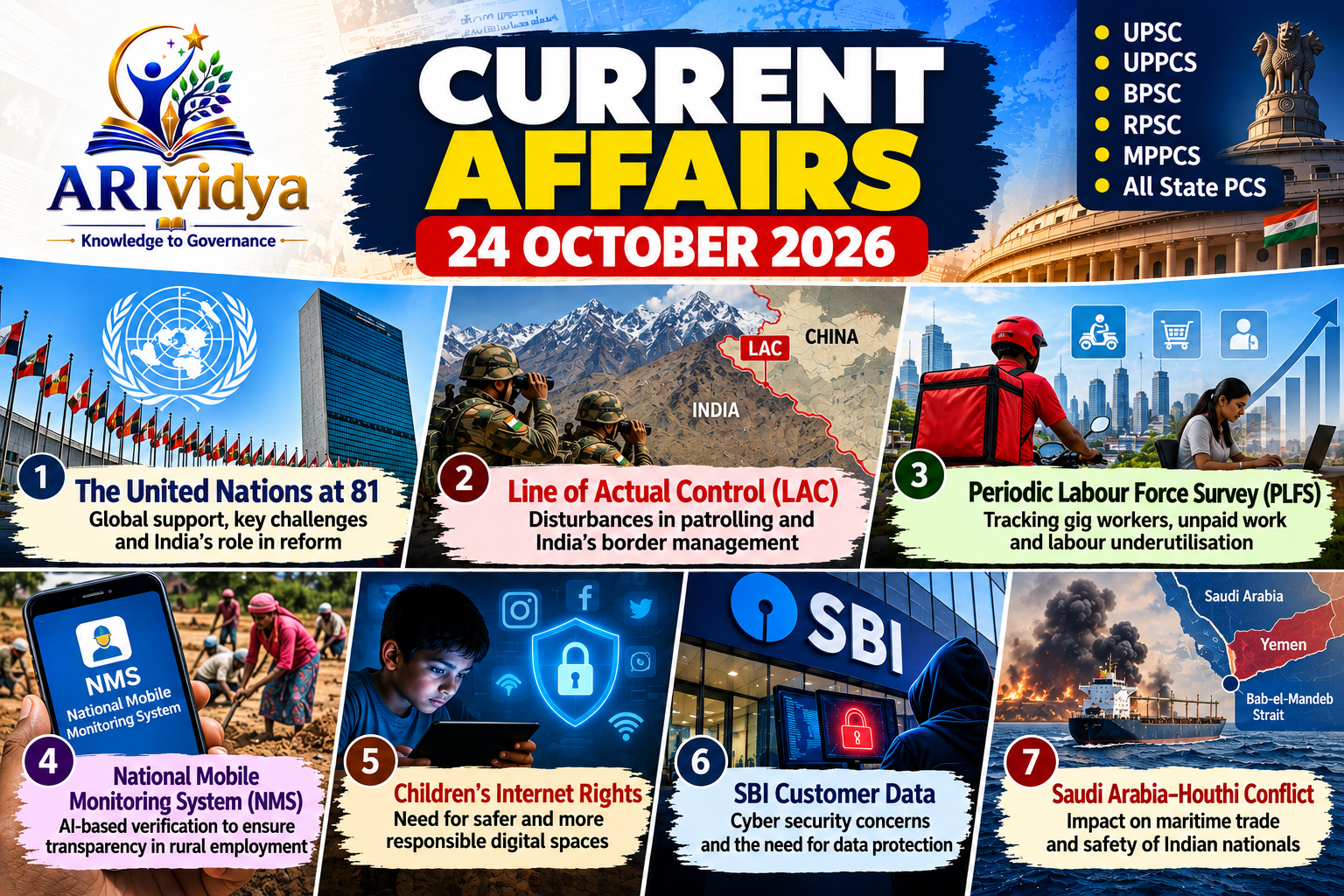
Date: Saturday, 24 October 2026 | Exam focus: UPSC, UPPCS, BPSC and other State PCS examinations
Thank you for reading this post, don't forget to subscribe!
Today’s current affairs cover UN reform, labour statistics, AI-based verification in rural employment, children’s digital safety, banking cybersecurity, air pollution and India–China border management. Each item is immediately followed by a Prelims MCQ with its answer and a Mains practice question.
1. UN Reform and India’s Role
As the United Nations marks its 81st anniversary, questions about its effectiveness and the need for reform remain important. Surveys cited in the material show that positive views of the UN exceed negative views in many countries, although support is not a majority everywhere. India seeks permanent membership of the UN Security Council and is also pursuing an elected seat for the 2028–29 term. Reform is not only about membership: it also concerns the voice of countries that contribute peacekeepers and those affected by Security Council decisions.
Prelims MCQ: Consider the following statements about the UN Security Council:
- India seeks permanent membership of the Council.
- UN reform concerns only the number of permanent members.
- The role of countries contributing peacekeepers can form part of reform discussions.
(A) 1 and 2 only (B) 1 and 3 only (C) 2 and 3 only (D) 1, 2 and 3
Answer: (B) — Reform also concerns representation, accountability and participation in decision-making.
Mains Practice (GS-2): Analyse the need for reform of the UN Security Council and India’s role in the context of contemporary global challenges.
2. Proposed Changes to the Periodic Labour Force Survey (PLFS)
The Union government has proposed changes to the design and questionnaire of the Periodic Labour Force Survey. The aim is to better capture digital platform work, unpaid household work, caregiving, volunteering and trainee work. Changes to the sampling design are proposed from January 2027. PLFS is India’s principal official framework for understanding employment, unemployment and labour-market conditions.
Prelims MCQ: What is the primary purpose of PLFS?
(A) Estimating agricultural output (B) Assessing employment and unemployment (C) Conducting the population census (D) Measuring industrial exports
Answer: (B) — PLFS assesses indicators such as labour force participation, worker population ratio and unemployment rate.
Mains Practice (GS-3): Why is it important to capture digital platform work and unpaid care work in labour surveys? How could this improve policymaking?
3. AI-Based Attendance Verification in Rural Employment
An upgraded version of the National Mobile Monitoring System is intended to use AI-based verification and enhanced safeguards to address fake or duplicate attendance in the rural employment programme. It includes a module to identify suspicious or repeated photographs. Wage lists and fund-transfer orders may be withheld until checks are completed. The material also notes that offline attendance can be recorded where connectivity is unavailable and that exception mechanisms exist for elderly workers, persons with disabilities and technical failures.
Prelims MCQ: What is one key use of the National Mobile Monitoring System?
(A) Recording time-stamped and geo-tagged attendance at worksites (B) Nationalising land records (C) Conducting school examinations (D) Determining food imports
Answer: (A) — The system supports attendance monitoring and transparency at rural employment worksites.
Mains Practice (GS-2/3): AI and digital monitoring can improve transparency in welfare schemes but may also create exclusion risks. Critically examine.
4. Internet for Children: Rights, Access and Safety
Children’s access to the internet is linked to education, information and learning opportunities. At the same time, online abuse, cyberbullying, harmful content, addiction, deepfakes and misuse of personal data pose risks. The supplied material refers to the National Education Policy 2020, the National Curriculum Framework and the Digital Personal Data Protection Act, 2023. The challenge is to protect children through age-appropriate safeguards, parental awareness and platform accountability without unnecessarily denying them digital opportunities.
Prelims MCQ: Which issue is especially relevant to children’s personal data under the Digital Personal Data Protection Act, 2023?
(A) Verifiable parental consent (B) A complete internet ban for all children (C) Privatisation of all digital services (D) Ending internet access in schools
Answer: (A) — Parental consent and safeguards are important in the processing of children’s personal data.
Mains Practice (GS-2): Explain the roles of government, schools, parents and digital platforms in balancing children’s digital rights with online safety.
5. Customer Data and Cybersecurity in Banking
Reports that personal information belonging to around 4,000 State Bank of India customers appeared on the dark web have raised concerns about trust and accountability in digital banking. Names, phone numbers, dates of birth, email addresses, residential addresses, customer identifiers and loan-related details can be misused for identity fraud or fake banking messages. The Digital Personal Data Protection Act, 2023, and rules notified in 2025 form important regulatory context. Banks need to strengthen customer notifications, independent security testing, restricted data access and breach-response procedures.
Prelims MCQ: What is India’s national helpline number for reporting suspected cyber financial fraud?
(A) 100 (B) 1098 (C) 1930 (D) 1962
Answer: (C) — The number 1930 can be used for prompt reporting of cyber financial fraud.
Mains Practice (GS-3): Analyse the responsibilities of banks, regulators and consumers in protecting customer data in digital banking.
6. Saudi Arabia–Houthi Conflict and the Safety of Indian Nationals
Escalating conflict between Saudi Arabia and Yemen’s Houthi movement has raised concerns about the safety of Indian nationals living in Saudi Arabia. According to the supplied material, a Houthi attack on Dammam airport killed an Indian national; since fighting intensified again, at least two Indians have reportedly been killed and 14 injured. The Houthis control parts of Yemen and sections of its Red Sea coast. Risks to Saudi oil facilities and airports could affect regional energy security and maritime connectivity.
Prelims MCQ: The Bab-el-Mandeb Strait is a key passage connecting which two water bodies?
(A) Red Sea and Gulf of Aden (B) Mediterranean Sea and Black Sea (C) Persian Gulf and Caspian Sea (D) Arabian Sea and Bay of Bengal
Answer: (A) — Bab-el-Mandeb connects the Red Sea with the Gulf of Aden and is important for global maritime trade.
Mains Practice (GS-2): In the context of conflicts in West Asia, what diplomatic and contingency measures should India adopt to protect its diaspora and maintain energy supplies?
7. Tensions Along the India–China Line of Actual Control
Concerns have been raised about patrolling and face-offs along the India–China border. The supplied material refers to reported incidents in parts of Arunachal Pradesh since July 2026, while noting that the claims had not been officially confirmed. The Indo-Tibetan Border Police (ITBP) was raised on 24 October 1962. In 2004, responsibility for guarding approximately 3,488 kilometres of the India–China border was assigned to the force. Vigilance, infrastructure, communications and diplomatic engagement remain important to border management.
Prelims MCQ: The ITBP functions under which ministry?
(A) Ministry of Defence (B) Ministry of Home Affairs (C) Ministry of External Affairs (D) Ministry of Finance
Answer: (B) — ITBP is a Central Armed Police Force under the Ministry of Home Affairs.
Mains Practice (GS-2): Why must India balance security preparedness with diplomatic engagement in managing the India–China border? Discuss.
Quick Revision
- UN: Security Council reform, representation and accountability.
- PLFS: Proposed better measurement of platform work and unpaid work.
- National Mobile Monitoring System: Attendance verification and duplicate-photo detection.
- Children’s digital safety: Balancing access, privacy and online risks.
- Banking cybersecurity: Data protection and prompt reporting of fraud.
- GRAP: Stage-wise pollution-control measures based on air quality.
- ITBP: Force operating in high-altitude areas along the India–China border.
Practice tip: Write one Mains answer in 150–250 words and revise the related concepts.