
ARIvidya • DAILY CURRENT AFFAIRS
Thank you for reading this post, don't forget to subscribe!
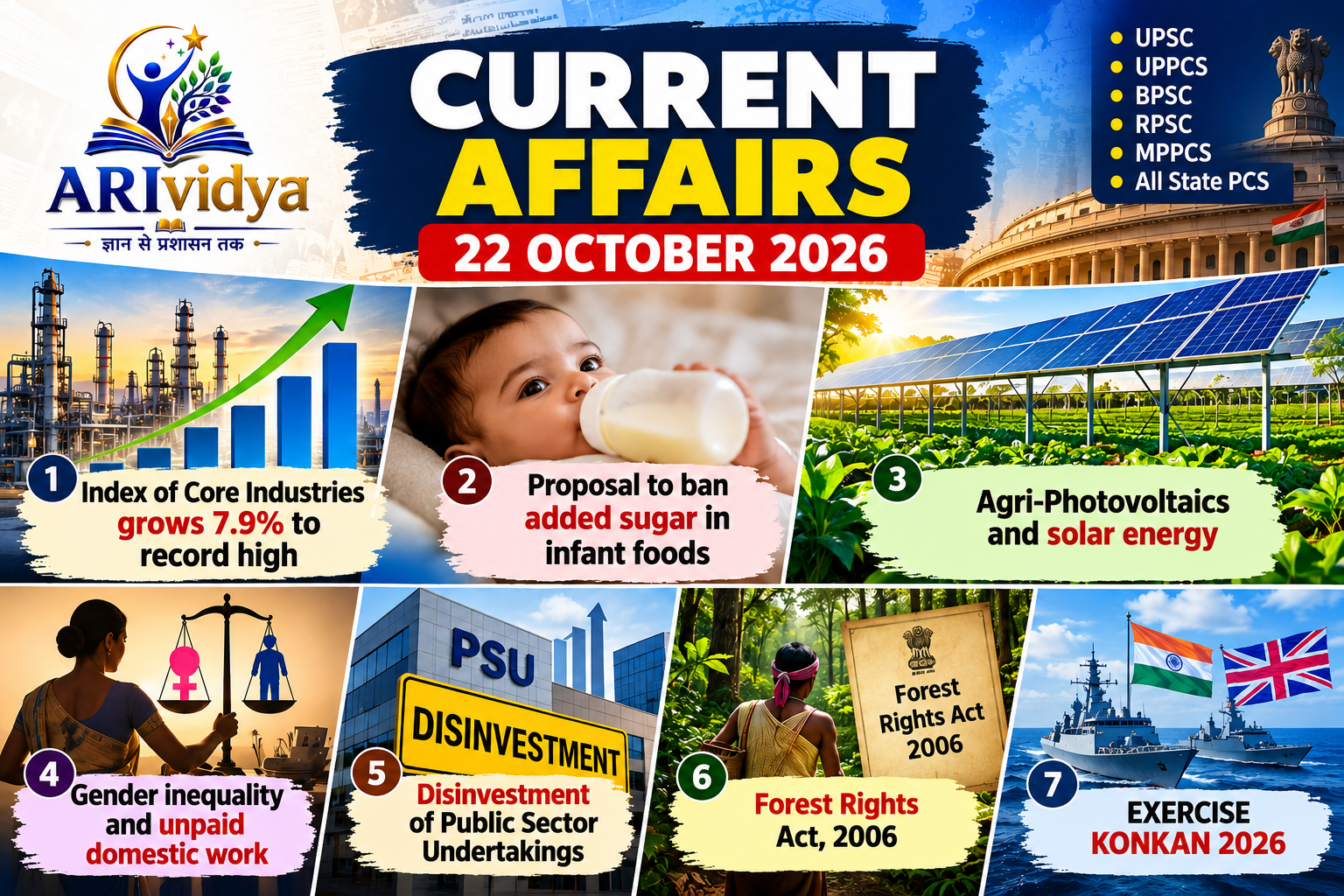
Current Affairs | 22 October 2026
UPSC • UPPCS • BPSC | Prelims and Mains preparation
1. Index of Core Industries: Growth of 7.9% in September
India’s core industries recorded growth of 7.9% in September 2026. The improvement in coal, refinery products and iron ore activity contributed to this rise. Under the revised series with base year 2022–23, the number of core industries has increased from eight to nine with the inclusion of iron ore.
Nine core industries: Coal, crude oil, natural gas, refinery products, fertilisers, steel, cement, electricity and iron ore. Electricity has the highest weight at 30.93%, followed by refinery products (22.57%) and steel (17.58%).
Syllabus: GS-III — Indian Economy and industrial development.
Prelims MCQ
Question: Which sector was added to the revised Index of Core Industries, increasing the number of sectors from eight to nine?
(A) Textiles (B) Iron ore (C) Information technology (D) Pharmaceuticals
Answer and explanation
Answer: (B) Iron ore. The revised index includes iron ore as the ninth core industry.
Mains Practice | GS-III | 150 words
Explain the significance of the Index of Core Industries in assessing industrial performance. What is the importance of including iron ore in the revised index?
2. Proposed Restrictions on Added Sugar in Infant Foods
The Food Safety and Standards Authority of India has proposed removing the existing allowance for adding sucrose and fructose to infant foods. Under current rules, their combined amount may be up to 20% of carbohydrates in products intended for infants aged 0–6 months.
The World Health Organization recommends exclusive breastfeeding for the first six months and avoiding added sugars in complementary foods up to 24 months. Regulation should consider not only sucrose but also substitute sweeteners and the nutritional profile of the finished product.
Syllabus: GS-II — Health and governance; GS-III — Food safety.
Prelims MCQ
Question: Which approach is consistent with the WHO recommendations described in the current-affairs material?
(A) Exclusive breastfeeding for six months and avoiding added sugars up to 24 months
(B) Exclusive breastfeeding for three months followed by sweetened drinks
(C) Adding sugar to all infant foods after six months
(D) Treating added sugar as unrelated to infant nutrition
Answer and explanation
Answer: (A). The recommendation is exclusive breastfeeding during the first six months and avoiding added sugars up to 24 months.
Mains Practice | GS-II | 150 words
Why is regulating added sugar in infant foods important for public health? Suggest key measures for effective food regulation.
3. Agrivoltaics: Combining Farming with Solar Energy
Agrivoltaics involves installing solar panels in a way that allows farming to continue beneath or around them. The material cites India’s capacity in this area at 161 GW and notes a 14 GW contribution from off-grid solar installations in agricultural and rural areas under the PM-KUSUM scheme.
This approach can support irrigation and household electricity needs, supplement farmers’ incomes, improve local energy self-reliance and expand clean power generation. Successful implementation requires suitable crop selection, locally adapted panel structures, sound farm management and protection of land rights. Tenant farmers and women farmers should also share in the benefits.
Syllabus: GS-III — Renewable energy, agriculture and climate-resilient development.
Prelims MCQ
Question: Which statement best describes agrivoltaics?
(A) Using only wind energy for irrigation
(B) Combining crop cultivation and solar power generation on the same land
(C) Converting all farmland into industrial land
(D) Using only hydropower for agriculture
Answer and explanation
Answer: (B). Agrivoltaics integrates agricultural activity with solar electricity generation.
Mains Practice | GS-III | 250 words
Agrivoltaics can increase farmers’ incomes and accelerate India’s clean-energy transition. Analyse its opportunities, challenges and the policy measures needed for wider adoption.
4. Gender Inequality and Unpaid Domestic Work
Women’s economic participation cannot be assessed only by counting their participation in paid employment. An unequal burden of domestic work and care reduces the time available for employment, education, skills development and rest.
The 2026 Global Gender Gap assessment cited in the material puts India’s economic participation and opportunity score at 41.2%. According to the August 2026 Periodic Labour Force Survey figures cited, the labour-force participation rate for women aged 15 and above was 34.8%—39.4% in rural areas and 25.4% in urban areas.
Way forward: Safe workplaces and transport, equal pay for equal work, skills development, care services, shared domestic responsibilities and better leadership opportunities.
Syllabus: GS-I — Society; GS-II — Social justice.
Prelims MCQ
Question: What is a major way in which unpaid domestic work can affect women’s economic participation?
(A) It may reduce time available for employment and skills development
(B) It automatically increases women’s income
(C) It eliminates gender gaps in the labour market
(D) It removes the need for care work
Answer and explanation
Answer: (A). An unequal domestic and care workload can limit time for paid work and skill development.
Mains Practice | GS-I/II | 250 words
Creating employment opportunities alone is not sufficient to increase women’s economic participation. Examine this statement in the context of unpaid domestic work and care responsibilities.
5. Disinvestment, Privatisation and Public Sector Enterprises
The government has approved a proposal to sell more than 30% of its stake in IDBI Bank. The expected disinvestment proceeds for the current financial year are around ₹26,500 crore. The government also plans to list India Infrastructure Finance Company Ltd, Mahanadi Coalfields Ltd and South Eastern Coalfields Ltd on the stock exchanges.
Disinvestment may involve selling government equity; privatisation involves transferring ownership or management to private hands; and asset monetisation mobilises resources through the use or transfer of assets such as land and buildings. These concepts should not be treated as interchangeable.
Syllabus: GS-III — Public sector, fiscal management and economic reforms.
Prelims MCQ
Question: Which statement best distinguishes disinvestment from asset monetisation?
(A) Both mean printing new currency
(B) Disinvestment may involve selling government equity, while asset monetisation mobilises resources through assets
(C) Disinvestment never generates revenue
(D) Asset monetisation only means raising tax rates
Answer and explanation
Answer: (B). These are distinct approaches to mobilising resources and should not be treated as identical.
Mains Practice | GS-III | 250 words
How can India’s disinvestment policy balance revenue generation, efficiency, strategic interests and the need to obtain fair value for public assets? Discuss.
6. Forest Rights Act and Tribal Livelihoods
The Forest Rights Act, 2006 has strengthened the livelihood rights of tribal and forest-dwelling communities. The next step is to complement recognised land rights with sustainable agriculture. Cultivating pulses and oilseeds in suitable areas can raise farm incomes, improve nutrition and domestic supply, and reduce import dependence.
Interventions should be tailored to local soil, rainfall, cropping patterns and livelihood conditions. Access to quality seeds, soil-moisture management and scientific agricultural support is important, while the land and livelihood security of tribal communities must remain central.
Syllabus: GS-II — Tribal rights and legislation; GS-III — Agriculture and food security.
Prelims MCQ
Question: In which year was the Forest Rights Act enacted?
(A) 1992 (B) 2001 (C) 2006 (D) 2013
Answer and explanation
Answer: (C) 2006. The Act concerns the recognition of forest rights of eligible forest-dwelling communities.
Mains Practice | GS-II/III | 250 words
How can promoting sustainable pulses and oilseeds on land recognised under the Forest Rights Act strengthen tribal livelihoods and food security? Discuss the measures required.
7. Exercise KONKAN-2026
Indian Navy guided-missile stealth frigate INS Trishul arrived at Plymouth, United Kingdom, to participate in the bilateral maritime exercise KONKAN-2026 with the Royal Navy. The annual exercise was institutionalised in 2004. It aims to strengthen tactical interoperability, joint operational capability and maritime security cooperation between the two navies.
Syllabus: Prelims — Defence exercises; GS-II — India–UK relations; GS-III — Maritime security.
Prelims MCQ
Question: Exercise KONKAN-2026 is conducted between which two navies?
(A) Indian and French navies
(B) Indian Navy and the British Royal Navy
(C) Indian and Japanese navies
(D) Indian and Australian navies
Answer and explanation
Answer: (B). KONKAN is a bilateral maritime exercise between the Indian Navy and the British Royal Navy.
Mains Practice | GS-II/III | 150 words
Explain the strategic importance of joint maritime exercises between India and the United Kingdom. How do such exercises contribute to maritime security and operational capability?
ARIvidya — From Knowledge to Administration