
24 September 2026 Current Affairs
UPSC & PCS | Facts • Analysis • Prelims • Mains
Thank you for reading this post, don't forget to subscribe!
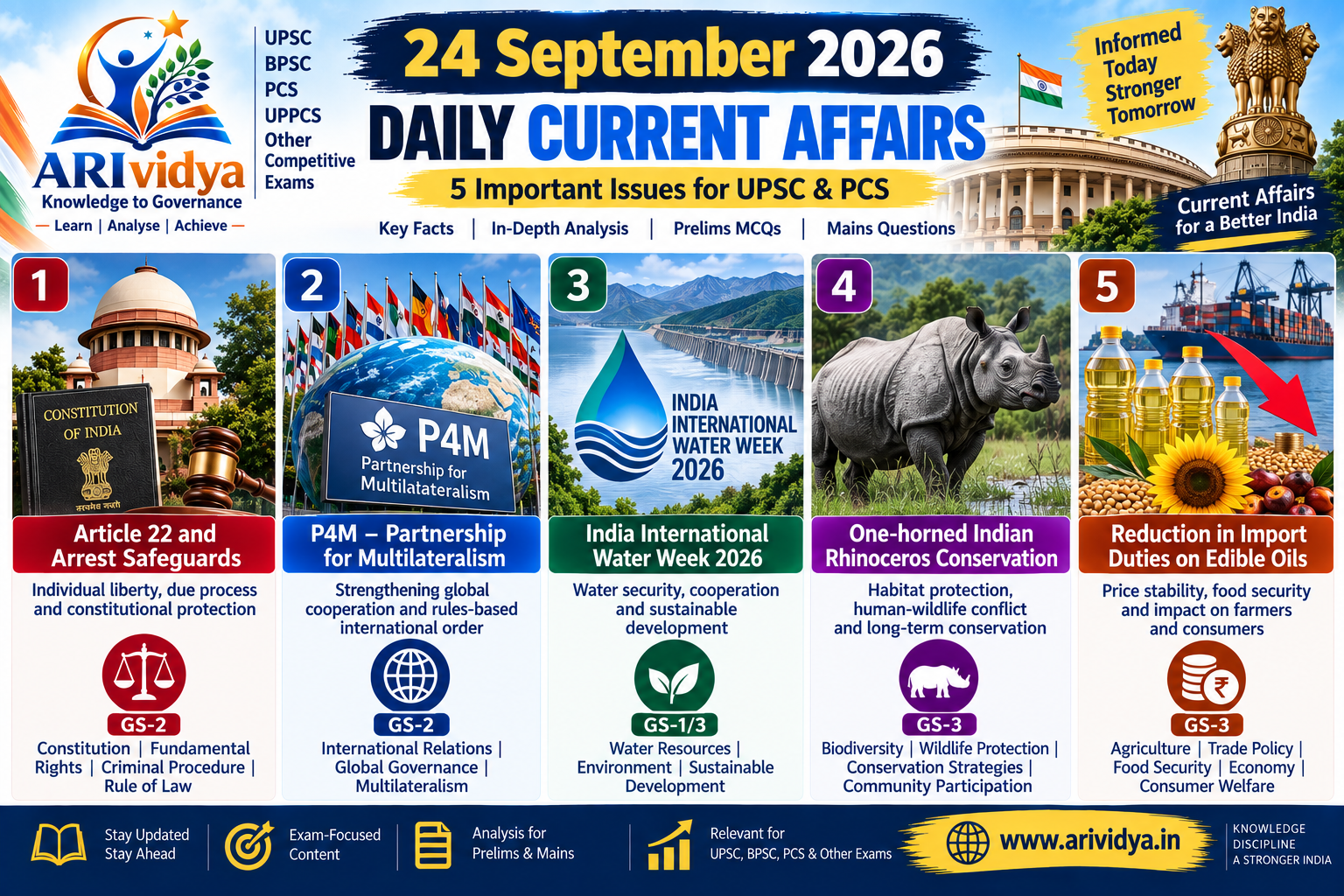
1. Constitutional Safeguards on Arrest under Article 22
What happened?
The Supreme Court emphasised constitutional safeguards relating to arrest, including the requirement that an arrested person should be informed in writing of the grounds of arrest in a language they understand. A later filing of a chargesheet does not, by itself, cure an arrest that violated Article 22(1).
Key facts
- Article 22(1) protects the right of an arrested person to be informed of the grounds of arrest.
- The Court treated written communication of the grounds of arrest as an important procedural safeguard.
- If an arrest violates Article 22(1), the investigating agency cannot simply validate it later by filing a chargesheet.
- Any fresh arrest in such circumstances would require judicial permission.
- Article 22(2) requires an arrested person to be produced before the nearest magistrate within 24 hours, excluding necessary travel time.
A. Right to property B. Right to be informed of grounds of arrest C. Freedom of religion D. Right to equality
Answer: B
Explanation: Article 22(1) provides safeguards to an arrested person, including being informed of the grounds of arrest and access to legal consultation.
Mains Question — GS II: “Constitutional safeguards during arrest are essential for protecting individual liberty.” Discuss in the light of the Supreme Court’s recent interpretation. (150 words)
2. Partners for Multilateralism: Strengthening Multilateral Cooperation
What happened?
India joined the European Union, Australia, Brazil, Canada, Barbados and Kenya in the “Partners for Multilateralism” initiative, launched during the high-level week of the United Nations General Assembly on 21 September 2026.
Key facts
- The initiative seeks to strengthen the multilateral system, international law, peace and inclusive development.
- The participating countries reaffirmed the importance of a multilateral order based on the UN Charter.
- The initiative supports making multilateral institutions more effective, representative, inclusive and accountable.
- Areas of cooperation include resilient global supply chains, trade, financial architecture, artificial intelligence, climate change and global health.
A. Create a military alliance B. Strengthen multilateralism and international cooperation C. Fix regional trade tariffs only D. Manage climate finance only
Answer: B
Explanation: The initiative has a broad focus on multilateral cooperation, international law, peace and shared prosperity.
Mains Question — GS II: Examine the need to reform and strengthen multilateral institutions in a changing global order. Discuss India’s role. (150 words)
3. India International Water Week 2026: Climate-Resilient Water Management
What happened?
The 9th India International Water Week 2026 is being held at Bharat Mandapam, New Delhi, from 22 to 26 September. The central theme this year is “Climate-Resilient Water Management”.
Why is it important?
- Climate change is intensifying challenges such as floods, droughts, groundwater depletion and regional inequalities in water availability.
- Integrated water management requires river-basin planning, groundwater recharge, rainwater harvesting and efficient irrigation.
- Water security is closely connected with food security, public health, energy security and national security.
- The event brings policymakers, researchers, experts, industry and other stakeholders together to discuss policy, innovation and sustainable water management.
A. Water and Industrial Revolution B. Climate-Resilient Water Management C. Urban Water Supply Only D. Expansion of Inland Waterways
Answer: B
Mains Question — GS III: Why should water security in India be treated as a multisectoral policy challenge in the context of climate change? Suggest measures. (150 words)
4. Indian One-Horned Rhinoceros: New Conservation Focus
What happened?
On World Rhino Day, attention was drawn to the conservation of the Indian one-horned rhinoceros and its habitats. The government has highlighted a “Project Rhino” initiative aimed at providing financial and technical support to rhino-bearing states.
Key facts
- The Indian one-horned rhinoceros is mainly found in India and Nepal.
- Assam holds a major share of the world’s population of the species.
- Kaziranga National Park is a major rhino conservation landscape.
- Dudhwa in Uttar Pradesh is also important for rhino reintroduction and habitat management.
- Protection of grasslands and wetlands is crucial for the long-term survival of the species.
- Project Rhino focuses on conservation, habitat management, genetic improvement and understanding population dynamics.
A. India and Nepal B. India and Bhutan C. India and Bangladesh D. India and Sri Lanka
Answer: A
Explanation: The species is associated mainly with the Terai and related grassland-wetland ecosystems of India and Nepal.
Mains Question — GS III: Why should species conservation be integrated with habitat and ecosystem conservation? Discuss with reference to the Indian one-horned rhinoceros. (150 words)
5. Reduction in Import Duties on Edible Oils
What happened?
The Union government announced a reduction in import duties on major edible oils with the stated objective of providing relief to consumers. The move affects the import-tax framework governing domestic availability and prices of edible oils.
Economic significance
- India relies significantly on imports to meet domestic edible-oil demand.
- Lower import duties can put downward pressure on the landed cost of imported edible oils.
- The extent to which lower duties translate into retail price relief depends on market competition and price transmission.
- Import-duty policy can also affect domestic oilseed prices and production incentives for farmers.
- Edible-oil policy therefore involves balancing consumer interests, farmer incomes, domestic production and import dependence.
A. Higher landed cost of imports B. Downward pressure on the landed cost of imported oils C. Complete stoppage of imports D. Automatic doubling of domestic production
Answer: B
Explanation: A lower import duty reduces the tax burden on imported products, although final retail prices depend on several market factors.
Mains Question — GS III: How can India balance consumer interests and oilseed farmers’ interests in its edible-oil policy? Discuss. (150 words)
ARIvidya Exam Takeaway
For Prelims, remember the factual anchors related to Article 22, multilateralism, water management, rhinoceros conservation and edible-oil imports. For Mains, connect these issues with constitutional governance, international relations, climate resilience, biodiversity and agricultural economics.
ARIvidya — Knowledge to Governance