

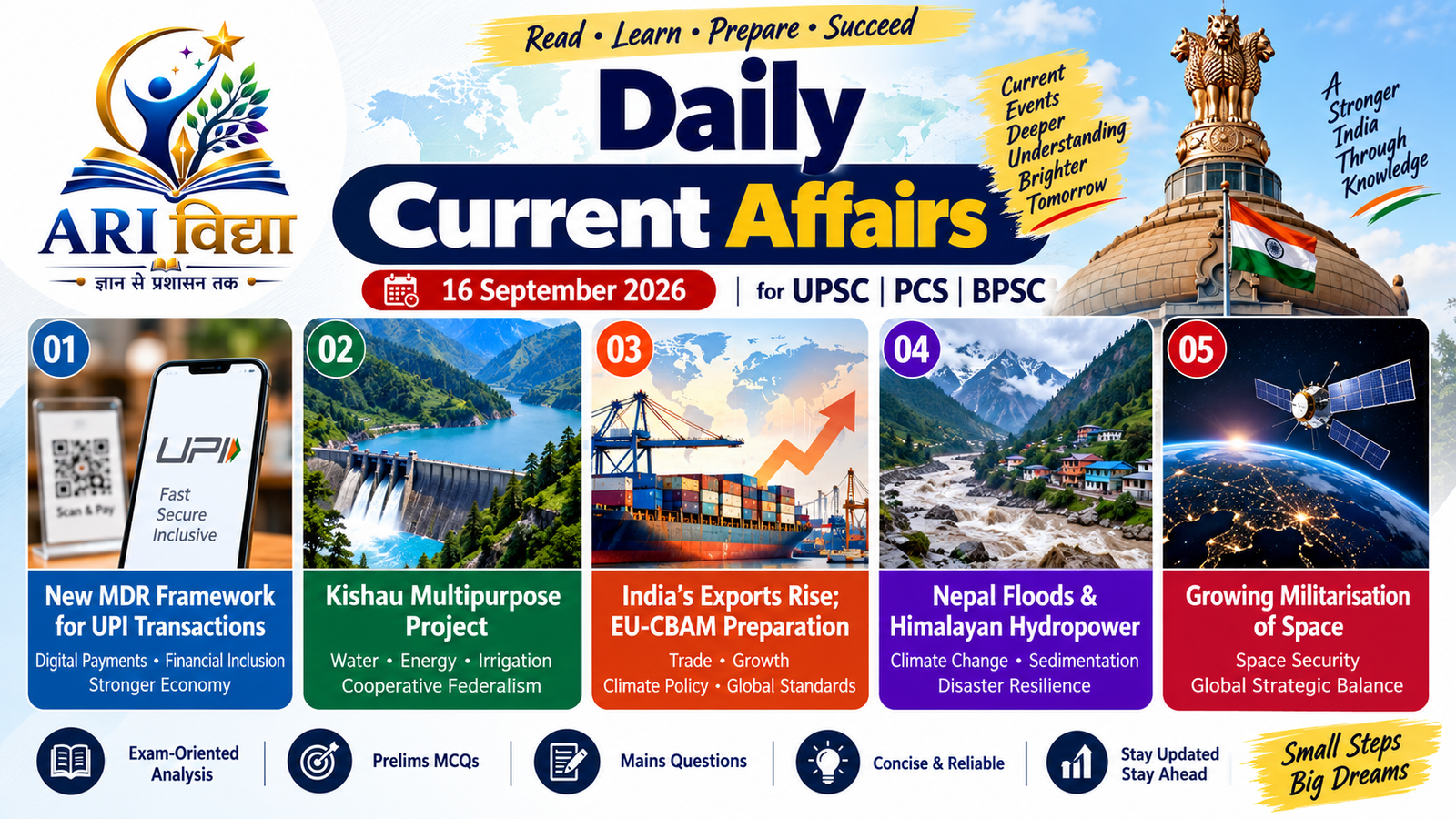
ARIvidya Current Affairs
UPSC • PCS • BPSC | Daily Current Affairs
Thank you for reading this post, don't forget to subscribe!
New MDR Framework for UPI Transactions Above ₹2,000
The government has introduced a new Merchant Discount Rate (MDR) framework for eligible UPI merchant transactions above ₹2,000.
The new framework is scheduled to come into effect from 15 October 2026.
Transactions in essential sectors such as railways, telecom, insurance, fuel and agricultural inputs will attract a flat MDR of ₹5 for transactions above ₹2,000.
Payments related to mutual funds, securities, stock brokers and dealers will attract an MDR of 0.02%, capped at ₹300.
Digital public infrastructure, financial inclusion, digital payments and the sustainability of India’s payment ecosystem.
GS Paper III — Indian Economy
Consider the following statements about the new UPI MDR framework:
- A. All UPI transactions will attract 0.4% MDR.
- B. Person-to-person UPI transactions will attract MDR.
- C. Eligible merchant transactions above ₹2,000 may attract 0.4% MDR.
- D. MDR will necessarily be charged directly to every customer.
The new framework concerns eligible merchant transactions above ₹2,000. The government has stated that consumers will not be directly charged.
“UPI has transformed India’s digital payment ecosystem.” Discuss the need to balance affordability of digital payments with the financial sustainability of the payment ecosystem in the context of the new MDR framework.
150 Words | GS Paper IIISix States Sign Agreement on Kishau Multipurpose Project
Himachal Pradesh, Uttarakhand, Uttar Pradesh, Haryana, Rajasthan and Delhi have signed an agreement for the implementation of the long-pending Kishau Multipurpose Project.
The project is designed as a multipurpose initiative combining hydropower generation with irrigation and water supply objectives.
The Centre is expected to bear around 90% of the financial burden.
Inter-state river management, cooperative federalism, hydropower, irrigation and urban water security.
GS Paper I + GS Paper II + GS Paper III
Which of the following correctly describes the Kishau Multipurpose Project?
- A. It is exclusively a solar energy project.
- B. It combines hydropower with water-related objectives.
- C. It involves only one State.
- D. It is exclusively an irrigation project.
Kishau is a multipurpose project involving hydropower along with irrigation and water-supply objectives.
“Cooperative federalism is essential for effective inter-state river water management in India.” Discuss with reference to the Kishau Multipurpose Project.
150 Words | GS Paper IIIndia’s Exports Rise; EU-CBAM Preparation Intensifies
India’s total exports rose by 25.4% in August 2026 to $82.7 billion.
Imports rose by 18.7% to $92.1 billion, while the overall trade deficit declined to $9.4 billion.
Merchandise exports grew by 26.1% to $43.8 billion.
The Commerce Ministry has constituted the Committee on Export Preparedness for EU CBAM to help Indian exporters prepare for the European Union’s Carbon Border Adjustment Mechanism.
The committee brings together representatives from key ministries, departments, regulators and industry bodies.
External sector, exports, trade competitiveness, climate policy and the changing relationship between environmental regulation and international trade.
GS Paper III — Economy & Environment
The European Union’s CBAM is primarily associated with which of the following?
- A. Agricultural subsidies
- B. Carbon-related adjustment on certain imports
- C. Foreign exchange management
- D. Global food distribution
CBAM links the carbon content of certain imported goods with a border adjustment mechanism.
“Climate policy is increasingly becoming a component of international trade policy.” Examine the implications of the EU-CBAM for India’s export competitiveness.
150 Words | GS Paper IIINepal Floods Highlight Climate Risks to Himalayan Hydropower
The August 26 floods in Nepal caused extensive damage across the Himalayan region and affected several hydropower projects.
At least 13 hydropower projects along the Bhotekoshi and Trishuli river corridors and one solar power plant were extensively damaged.
According to UNDP, around 15 power projects under construction, with a planned capacity of 470 MW, were also damaged.
Himalayan rivers carry exceptionally high sediment loads during the monsoon. Rising sediment can reduce reservoir storage and affect the performance of turbines.
According to an ICIMOD report, suspended sediment loads from Hindu Kush Himalayan headwaters have increased by around 80% over the last six decades, associated with heavier rainfall, accelerating glacier melt and thawing permafrost.
Himalayan geography, climate change, hydropower, disaster management, sedimentation and sustainable infrastructure.
GS Paper I + GS Paper III
Which of the following can increase risks to Himalayan hydropower infrastructure?
- 1. Extreme rainfall
- 2. Accelerating glacier melt
- 3. Rising sediment load
- 4. Thawing permafrost
A. 1 and 2 only
B. 2 and 3 only
C. 1, 2 and 3 only
D. 1, 2, 3 and 4
All these factors can contribute to climate and disaster risks affecting Himalayan infrastructure.
“Himalayan hydropower development needs to be reoriented towards climate resilience and disaster risk reduction.” Discuss in the context of the recent floods in Nepal.
250 Words | GS Paper IIIGrowing Militarisation of Space: Space-Control Weapons
The U.S. Space Force publicly confirmed for the first time that the United States has space-control weapons deployed in orbit.
The Space Force did not disclose the specific types or number of weapons.
According to the U.S. Space Force, space control involves missions aimed at contesting and controlling the space domain through both kinetic and non-kinetic means.
These capabilities can be used for both offensive and defensive purposes.
Modern military and civilian systems increasingly depend on satellites for communication, navigation, surveillance, timing and other critical services.
The development of counter-space capabilities therefore creates new challenges for international security and strategic stability.
Space security, satellite technology, strategic competition, defence technology and international security.
GS Paper II + GS Paper III
Which of the following best describes “Space Control”?
- A. Space tourism activities
- B. Contesting and controlling the space domain using kinetic and non-kinetic means
- C. Only weather satellite operations
- D. Only civilian space research
Space control includes capabilities intended to contest and control the space domain and can have both offensive and defensive applications.
“The militarisation of outer space is creating new challenges for global strategic stability.” Discuss the opportunities and challenges for India in this emerging domain.
250 Words | GS Paper IIIKnowledge to Administration
Daily Current Affairs • UPSC • PCS • BPSC
very nice