
5 October 2026 Current Affairs: 6 Important Issues for UPSC & PCS
360° Analysis | Prelims Facts | Mains Perspective | MCQs | Mains Questions
Thank you for reading this post, don't forget to subscribe!
ARIvidya — Knowledge to Administration
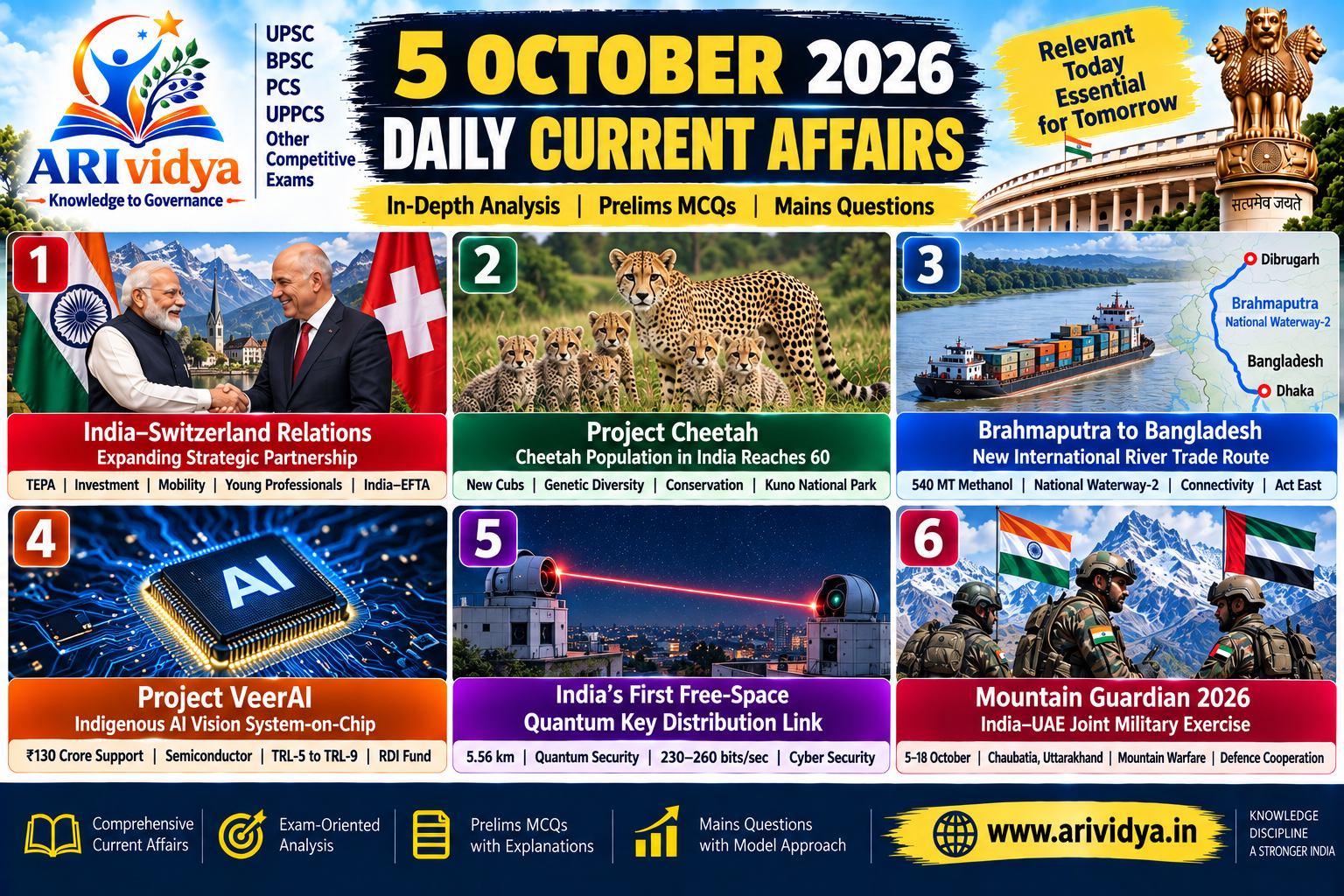
5 October 2026 brings important developments across international relations, environment, Northeast connectivity, artificial intelligence, quantum technology and defence cooperation. This edition focuses on six issues that can be studied from both Prelims and Mains perspectives.
1. India–Switzerland Relations: Expanding the Strategic Partnership
Swiss President Guy Parmelin is visiting India from 5 to 7 October 2026. The visit comes around the first anniversary of the India–European Free Trade Association (EFTA) Trade and Economic Partnership Agreement (TEPA), which entered into force on 1 October 2025.
Key developments
- Migration and Mobility Partnership: aims to facilitate regular and safe mobility, address irregular migration and human trafficking, and improve mobility of students and professionals.
- Young Professionals Exchange: initially allows 300 young professionals from each country annually, with scope to increase the number to 500.
- The EFTA members are Switzerland, Norway, Iceland and Liechtenstein.
Why is it important for India?
The partnership goes beyond tariff reduction. It links trade with investment, employment, technology, skills and professional mobility. Switzerland and other EFTA economies have strengths in advanced manufacturing, pharmaceuticals, finance, research and high-value services.
2. Project Cheetah: India’s Cheetah Population Reaches 60
In Kuno National Park, India-born female cheetah KJP21 gave birth to five healthy cubs. With this, India’s total cheetah population reached 60, including 41 cheetahs born in India.
The development is particularly significant because the father of the five cubs is a Botswana-origin male cheetah, adding a new genetic lineage to India’s population.
Project Cheetah
- Launched on 17 September 2022.
- Initial reintroduction involved cheetahs from Namibia and South Africa, followed later by cheetahs from Botswana.
- Kuno National Park is the principal initial site.
- Gandhi Sagar Wildlife Sanctuary is being developed as another important landscape.
Why does genetic diversity matter?
A small isolated population can face risks from inbreeding and reduced genetic variability. Introducing and maintaining genetically diverse lineages is therefore important for building a viable long-term population.
Major challenges
- Maintaining adequate genetic diversity
- Ensuring a sustainable prey base
- Managing human–wildlife interaction
- Disease surveillance and veterinary care
- Climate and habitat pressures
3. Brahmaputra–Bangladesh Trade Route: A New International River Cargo Link
On 5 October 2026, a barge carrying 540 metric tonnes of methanol departed from the Bogibeel terminal in Dibrugarh, Assam, for Dhaka, Bangladesh.
The cargo is travelling through National Waterway-2 on the Brahmaputra and the India–Bangladesh Protocol Route. The movement is significant for Northeast connectivity and cross-border inland water transport.
What is National Waterway-2?
National Waterway-2 covers the Brahmaputra river system in Assam. The Indian Inland Waterways Authority is involved in developing navigation infrastructure and supporting navigability along the route.
Why is the route strategically important?
- Provides an alternative logistics route for the Northeast.
- Can reduce dependence on a single land-based connectivity corridor.
- Supports lower-cost movement of bulk cargo where waterways are viable.
- Strengthens India–Bangladesh economic connectivity.
- Supports the broader Act East approach and multimodal connectivity.
4. Project VeerAI: Indigenous AI Vision System-on-Chip
The Technology Development Board and BigEndian Semiconductors have entered into an agreement for ₹130 crore of support for Project VeerAI. The total project cost is about ₹260 crore.
The project aims to develop a camera-centric AI Vision System-on-Chip (SoC) and take the technology from Technology Readiness Level 5 to Level 9.
What is a System-on-Chip?
An SoC integrates multiple computing and electronic functions into a single chip. In an AI vision application, it can process visual information from cameras and perform AI-based analysis close to the point where data is generated.
Why is it important?
- Strengthens indigenous semiconductor design capability.
- Can support applications in defence, surveillance, robotics, smart infrastructure and industrial automation.
- Can reduce strategic dependence on imported technologies.
- Can strengthen the domestic research-to-market pipeline.
5. India’s First 5.56-km Free-Space Quantum Key Distribution Link
India has demonstrated a 5.56-km free-space Quantum Key Distribution (QKD) link. The demonstration involved QNu Labs, BISAG-N and IIT Gandhinagar.
The test achieved a quantum bit error rate below 5% and a secure key generation rate of roughly 230–260 bits per second. The generated keys were integrated with a post-quantum cryptography-based platform for secure communication.
What is Quantum Key Distribution?
QKD uses quantum states of light, such as photons, to establish cryptographic keys. A fundamental feature of quantum mechanics is that measuring an unknown quantum state can disturb it. This makes attempts at interception potentially detectable.
Free-space QKD
Unlike fibre-based QKD, free-space QKD sends quantum signals through an open optical path. This makes the technology relevant to possible future links between buildings, ground stations and satellites.
Strategic significance
- Strengthens future quantum-secure communication capabilities.
- Has potential relevance for defence and strategic communications.
- Can be relevant to highly sensitive financial and institutional networks.
- Contributes to the development of future quantum communication networks.
6. India–UAE ‘Mountain Guardian 2026’ Exercise
The India–UAE joint military exercise Mountain Guardian 2026 began on 5 October 2026 at Chaubattia in Uttarakhand and will continue until 18 October.
A total of 92 military personnel from the two countries are participating, with equal representation.
Focus areas
- Mountain warfare
- Joint planning and tactical operations
- Drone operations
- Surveillance
- Firing and field training
- Rock climbing and obstacle training
- Interoperability between the two forces
Why is mountain warfare significant for India?
Large portions of India’s northern frontier consist of high-altitude and mountainous terrain. Operations in such areas are complicated by altitude, low oxygen levels, weather, difficult terrain, limited infrastructure and demanding logistics.
UPSC/PCS Integrated Takeaway
| Current Affair | Core UPSC Theme |
|---|---|
| India–Switzerland | Economic diplomacy, investment and global value chains |
| Project Cheetah | Biodiversity, genetic diversity and ecosystem restoration |
| Brahmaputra–Bangladesh route | Northeast connectivity, inland waterways and Act East |
| Project VeerAI | AI, semiconductors and technological self-reliance |
| Free-space QKD | Quantum technology and cybersecurity |
| Mountain Guardian | Defence diplomacy and mountain warfare |
Prelims Practice
Q1. Which of the following countries are members of EFTA?
- Switzerland, Norway, Iceland and Liechtenstein
- Switzerland, Sweden, Norway and Finland
- France, Switzerland, Norway and Iceland
- Germany, Norway, Iceland and Liechtenstein
Q2. With reference to Project Cheetah, consider the following statements:
- It was launched in 2022.
- Kuno National Park is a major site.
- Genetic diversity is relevant to long-term population viability.
Which of the statements given above are correct?
- 1 only
- 1 and 2 only
- 2 and 3 only
- 1, 2 and 3
Q3. National Waterway-2 is associated primarily with which river?
- Ganga
- Brahmaputra
- Godavari
- Narmada
Q4. Project VeerAI is primarily associated with:
- Marine biodiversity
- AI Vision System-on-Chip
- Satellite launch vehicles
- Quantum computers
Q5. Quantum Key Distribution is based on the use of:
- Only conventional passwords
- Quantum states for secure key establishment
- Only biometric authentication
- Only blockchain ledgers
Q6. Mountain Guardian 2026 is a joint exercise between:
- India and Japan
- India and UAE
- India and France
- India and Australia
Model Mains Questions
- How can India’s partnerships with European economic groupings strengthen its economic diplomacy and global value-chain integration?
- Why should the success of Project Cheetah be assessed through ecological, genetic and social indicators rather than population numbers alone?
- Examine the role of inland waterways in the economic integration of Northeast India, with reference to the India–Bangladesh Protocol Route.
- Why is indigenous semiconductor design capability important for India’s strategic technological autonomy?
- Discuss the strategic significance and practical limitations of Quantum Key Distribution for India’s cybersecurity architecture.
- How do joint military exercises contribute to India’s defence diplomacy? Discuss with reference to India–UAE cooperation.
Final Takeaway
The six developments of 5 October 2026 collectively show that India’s strategic capacity is expanding across multiple dimensions: economic diplomacy, biodiversity conservation, regional connectivity, semiconductor and AI capability, quantum-secure communication, and defence cooperation.
For UPSC and PCS preparation, these should be linked respectively with GS-II, GS-III, Geography, Environment, Science & Technology and International Relations, rather than memorised as isolated news events.