

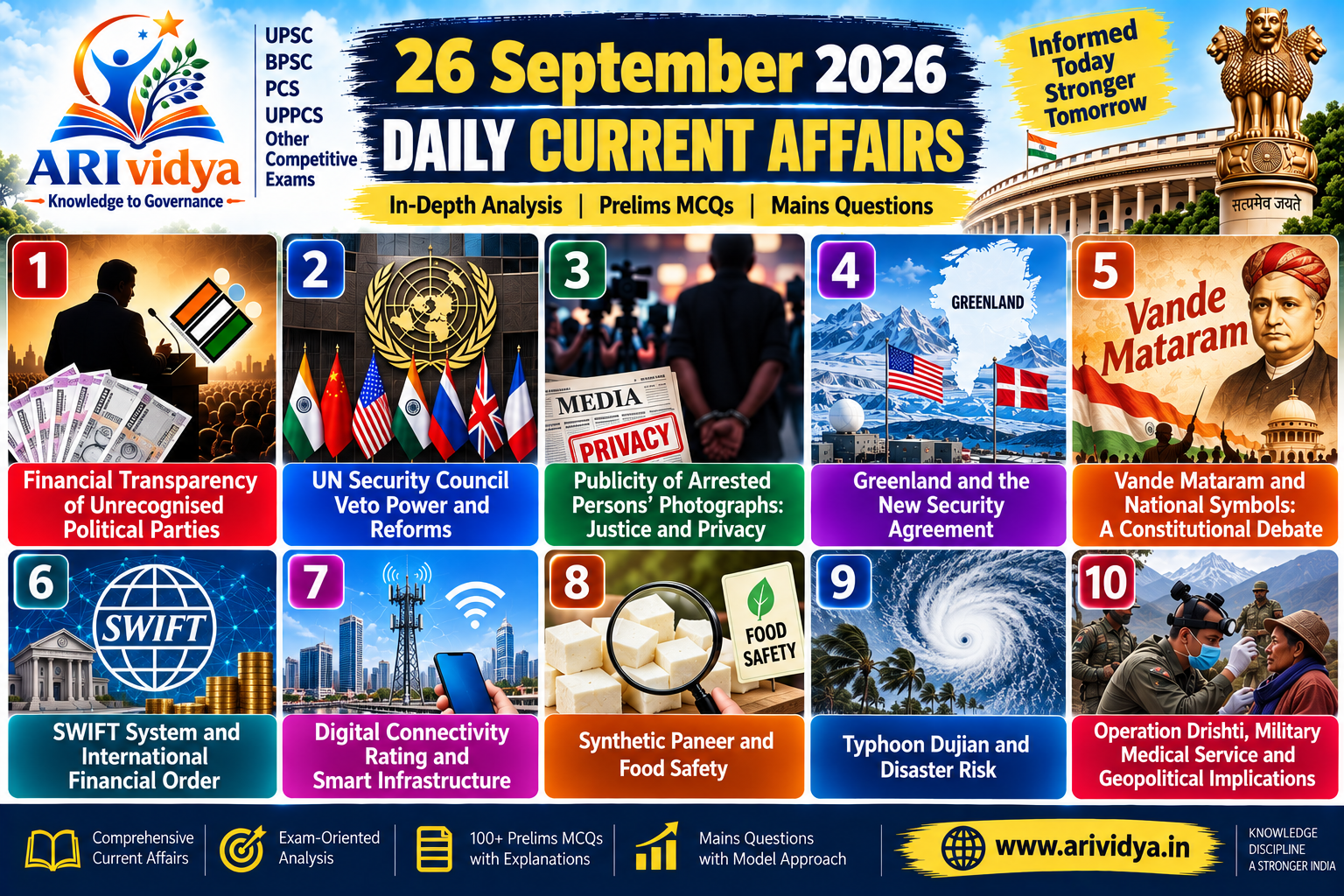
26 September 2026 Current Affairs
Detailed UPSC & PCS Study Material
Thank you for reading this post, don't forget to subscribe!
News • Analysis • Prelims • Mains
1. Financial Transparency of Registered Unrecognised Political Parties
What is the issue?
The financial transparency of registered unrecognised political parties has been an important subject of discussion. The issue is linked with political finance, disclosure of income and expenditure, electoral transparency and regulatory oversight.
Why does it matter?
Transparency in political finance is important for public confidence in elections. Unclear financial transactions can raise questions about the influence of money in elections and the effectiveness of regulatory monitoring.
Key points
- Registration and recognition of political parties are distinct concepts.
- Political-finance transparency is an important part of electoral reform.
- Financial oversight is intended to strengthen the credibility of the electoral process.
- Donations, expenditure, tax treatment and public disclosure are key dimensions of the issue.
The issue of financial transparency of political parties is most directly associated with:
(A) Electoral finance and regulatory oversight
(B) Foreign policy alone
(C) Local administration alone
(D) Judicial appointments alone
Answer: (A)
Explanation: Political donations, expenditure and financial disclosure are directly linked with electoral finance and regulatory oversight.
Mains Question — GS II: Why is financial transparency of political parties important for the credibility of a democratic system? Discuss. (150 words)
2. Debate on Veto Reform in the UN Security Council
What happened?
The debate on making the use of the veto in the UN Security Council more accountable and improving the Council’s representativeness has remained significant. The question of limiting veto use in situations involving humanitarian crises and genocide has also received attention.
Key facts
- The UN Security Council was established in 1945 under the UN Charter.
- It has 15 members.
- The five permanent members are the United States, United Kingdom, France, China and Russia.
- The five permanent members possess veto power.
- The ten non-permanent members serve two-year terms.
- India is part of the G4 with Brazil, Germany and Japan.
- India has served as an elected member of the Security Council in several terms, including 2021–22.
Consider the following statements about the UN Security Council:
1. It has 15 members.
2. The five permanent members possess veto power.
3. The ten non-permanent members have two-year terms.
4. India is a member of the G4.
How many statements given above are correct?
(A) Only one (B) Only two (C) Only three (D) All four
Answer: (D) All four
Explanation: All four statements are correct.
Mains Question — GS II: Discuss the need for reform of the UN Security Council and examine the major grounds of India’s claim for permanent membership. (250 words)
3. Public Circulation of Photographs of Arrested Persons
What is the issue?
The circulation of photographs and police information about accused persons soon after arrest raises questions concerning transparency, privacy, dignity and the presumption of innocence.
Key facts
- Section 84 of the Bharatiya Nagarik Suraksha Sanhita, 2023 concerns proclamation and publication relating to persons absconding.
- It is not, by itself, a general basis for publishing photographs of every arrested person at the early stage of investigation.
- The Criminal Procedure (Identification) Act, 2022 deals with the collection, storage and use of identification-related measurements and information.
- Article 21 protects personal liberty and dignity.
- Presenting an accused person as a criminal before conviction can have lasting reputational consequences.
Section 84 of the Bharatiya Nagarik Suraksha Sanhita, 2023 primarily relates to:
(A) Publication of photographs of every arrested person
(B) Proclamation and publication relating to absconding persons
(C) Regulation of news media
(D) Sentencing of convicted persons
Answer: (B)
Explanation: Section 84 concerns proclamation and publication relating to persons absconding.
Mains Question — GS II: “Transparency in criminal justice must be balanced with individual dignity.” Discuss in the context of public identification of arrested persons. (150 words)
4. Greenland and the New Arctic Security Arrangement
What happened?
Information concerning a new security arrangement involving the United States, Denmark and Greenland has brought renewed attention to the strategic importance of the Arctic region.
Key facts
- Greenland is an autonomous territory within the Kingdom of Denmark.
- The United States operates the Pituffik Space Base in Greenland.
- The source material notes an existing US military presence of around 150 personnel there.
- Plans concerning military facilities at Narsarsuaq in southern Greenland and Mestersvig in eastern Greenland have been discussed.
- The 1951 US–Denmark defence agreement forms part of the historical framework for the US military presence in Greenland.
- Greenland’s significance is linked to Arctic security, maritime routes, natural resources and the North Atlantic strategic environment.
Consider the following statements about Greenland:
1. Greenland is an autonomous territory within the Kingdom of Denmark.
2. The Pituffik Space Base is located in Greenland.
3. The 1951 US–Denmark defence agreement is connected with the US military presence in Greenland.
Which of the statements given above are correct?
(A) 1 and 2 only (B) 2 and 3 only (C) 1 and 3 only (D) 1, 2 and 3
Answer: (D)
Explanation: All three statements are supported by the source material.
Mains Question — GS II: Analyse the growing strategic significance of the Arctic region for global geopolitics and India’s interests. (150 words)
5. Vande Mataram and the Constitutional Debate on National Symbols
What happened?
The public singing of Vande Mataram, the use of its different stanzas and the constitutional questions surrounding respect for national symbols have remained subjects of debate. The core issue involves balancing respect for national symbols with freedom of conscience.
Historical and constitutional facts
- Vande Mataram was composed by Bankim Chandra Chattopadhyay.
- In 1937, the Congress Working Committee decided on the use of its first two stanzas at national gatherings.
- On 24 January 1950, Rajendra Prasad stated that Vande Mataram should receive equal honour.
- The Constitution does not contain a separate explicit constitutional provision for a “National Song”.
- The 1986 Bijoe Emmanuel case is relevant to the balance between respect for national symbols and freedom of conscience.
- The issue connects fundamental rights, fundamental duties and respect for national symbols.
Consider the following statements regarding Vande Mataram:
1. It was composed by Bankim Chandra Chattopadhyay.
2. In 1937, its first two stanzas were selected for use at national gatherings.
3. The Constitution contains a separate explicit provision for the “National Song”.
4. On 24 January 1950, Rajendra Prasad referred to Vande Mataram as deserving equal honour.
Which of the statements given above are correct?
(A) 1 and 2 only (B) 1, 2 and 4 only (C) 2, 3 and 4 only (D) 1, 2, 3 and 4
Answer: (B) 1, 2 and 4 only
Explanation: Statements 1, 2 and 4 are correct according to the source material; there is no separate explicit constitutional provision for the National Song.
Mains Question — GS I/II: Discuss the constitutional balance between respect for national symbols and an individual’s freedom of conscience. (150 words)
6. SWIFT and the International Financial System
What is SWIFT?
SWIFT is a secure system for exchanging financial messages between banks and financial institutions. It is not itself a bank or a currency; rather, it facilitates secure communication relating to international payments.
Why does it matter?
- It plays an important role in cross-border banking communication.
- It is widely used in international trade and financial transactions.
- Its role becomes particularly important when geopolitical sanctions affect international financial connectivity.
Which one of the following correctly describes SWIFT?
(A) A central bank
(B) A system for secure exchange of international financial messages
(C) A domestic-only payment system
(D) A national currency
Answer: (B)
Explanation: SWIFT facilitates secure financial messaging between banks and financial institutions.
Mains Question — GS III: Discuss the role of financial messaging systems such as SWIFT in the international financial system and the implications of geopolitical sanctions. (150 words)
7. Digital Connectivity and Smart Infrastructure
What happened?
A telecom-regulatory initiative concerning the assessment of digital connectivity at the building and property level has drawn attention. It reflects the growing importance of digital infrastructure as a component of modern physical infrastructure.
Why does it matter?
- Reliable digital connectivity is essential for remote work, online education, telemedicine and e-commerce.
- Digital readiness can become an important component of future smart cities.
- Standardisation can help consumers and property developers assess connectivity quality.
Assessment of digital connectivity at the building level is primarily intended to evaluate:
(A) Building height alone
(B) Digital infrastructure and connectivity capability
(C) Electricity consumption alone
(D) Land value alone
Answer: (B)
Mains Question — GS III: Why is it necessary to develop digital infrastructure alongside physical infrastructure in India’s digital transformation? (150 words)
8. Artificial Cheese and Food Safety
Why is it important?
The issue of artificial cheese and milk-substitute products is connected with food safety, standardisation, labelling and consumer rights. Consumers should have clear information about the nature of the products they purchase.
Key points
- Clear food labelling is essential for informed consumer choice.
- Dairy-based products and dairy substitutes need to be clearly distinguished.
- Standardisation can help control adulteration and misleading commercial practices.
- Food safety is directly connected with public health and consumer protection.
Regulation of artificial cheese is most directly related to:
(A) Food safety and consumer protection
(B) Space research
(C) Monetary policy
(D) Maritime security
Answer: (A)
Explanation: Product composition, quality and labelling are directly linked with food safety and consumer rights.
Mains Question — GS III: Explain the role of standardisation, labelling and regulatory oversight in ensuring food safety. (150 words)
9. Typhoon Dujuan and Disaster Risk Reduction
Why is it important?
Typhoon Dujuan is relevant for understanding tropical cyclones and disaster risks. Such systems can bring intense rainfall, strong winds, coastal flooding and damage to life and property.
Key points
- Tropical cyclones derive energy from warm ocean surfaces and favourable atmospheric conditions.
- Coastal regions can face particularly severe impacts.
- Early warning, evacuation, coastal protection and preparedness are central to disaster-risk reduction.
- India’s long coastline makes cyclone preparedness an important part of disaster management.
Which of the following conditions is favourable for the formation of tropical cyclones?
(A) Very cold ocean water
(B) Warm ocean surface and adequate moisture
(C) Extremely dry atmosphere
(D) Snowfall alone
Answer: (B)
Mains Question — GS III: Analyse the role of early warning systems and local preparedness in reducing cyclone-related losses in India. (150 words)
10. Military Medical Services and Healthcare in Remote Areas
Why is it important?
Providing specialised medical services to personnel and communities in remote, mountainous and border areas is relevant both to national security and humanitarian assistance.
Key points
- High-altitude regions can pose health challenges such as low oxygen levels and extreme cold.
- Special medical camps and health missions can provide preventive and immediate medical support.
- Such initiatives can strengthen civil-military cooperation in border regions.
What can be a major objective of specialised military medical missions in remote border areas?
(A) Military training alone
(B) Providing essential medical support to personnel and local communities
(C) Economic surveys alone
(D) Road construction alone
Answer: (B)
Mains Question — GS II: Discuss the need to integrate healthcare delivery in border areas with national security and civil-military cooperation. (150 words)
ARIvidya Exam Takeaway
Today’s current affairs connect democratic transparency, global governance, individual liberty, Arctic geopolitics, international finance, digital infrastructure, food safety and disaster management. For Prelims, revise the factual anchors; for Mains, focus on causes, impacts and policy dimensions.
ARIvidya — Knowledge to Governance