
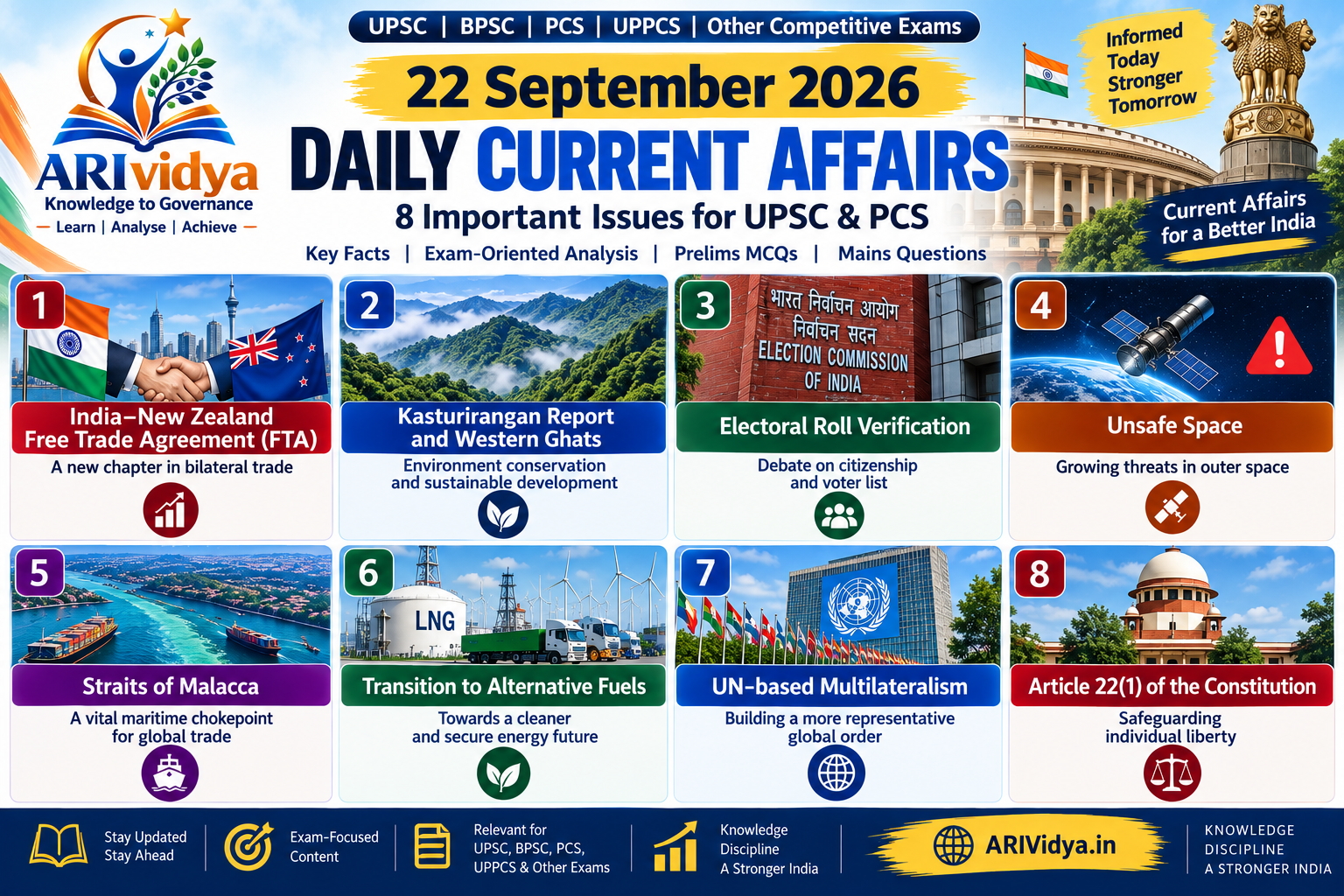
22 September 2026 Current Affairs
8 Important Issues for UPSC, PCS & Other Competitive Exams
Thank you for reading this post, don't forget to subscribe!
Facts • Analysis • Prelims • Mains
1. India–New Zealand Free Trade Agreement
What happened?
The India–New Zealand Free Trade Agreement (FTA) has been ratified and is scheduled to enter into force on October 20, 2026. The stated target is to double bilateral trade to ₹35,000 crore over the next four to five years.
Key Facts
- New Zealand’s foreign trade office said the agreement will remove import levies on Indian goods.
- 95% of New Zealand’s exports to India will be tariff-free or face sharply reduced levies.
- India has retained safeguards for sensitive sectors including dairy and several agricultural products.
- The source mentions a $20 billion foreign direct investment commitment by Wellington into India.
When is the India–New Zealand FTA scheduled to enter into force?
(A) October 1, 2026
(B) October 20, 2026
(C) November 1, 2026
(D) January 26, 2027
Discuss the potential impact of free trade agreements on India’s trade, agriculture and MSME sectors.
2. Kasturirangan Committee and the Western Ghats
What happened?
The recommendations of the Kasturirangan Committee on ecological protection of the Western Ghats are again in focus. The source reports concerns from the Karnataka government about possible livelihood implications.
Key Facts
- About 37% of the Western Ghats was proposed to be brought under the Ecologically Sensitive Area framework.
- A complete ban on mining, quarrying and sand mining in ESAs was proposed.
- No thermal power projects were proposed in ESAs; hydropower projects would require detailed study.
- Highly polluting Red-category industries were proposed to be strictly banned.
- Inhabited regions and plantations were proposed to be excluded from the ESA framework.
Comparison: The 2011 Gadgil panel proposed a wider ecological framework, graded ESAs and a bottom-up governance approach.
The Kasturirangan Committee is primarily associated with:
(A) Himalayan ecology
(B) Western Ghats ecology
(C) Coastal zone management
(D) Ganga conservation
Discuss the challenges of balancing ecological protection and local livelihoods in the Western Ghats.
3. Electoral Roll Verification and ‘Presumed Ineligible’ Voters
What happened?
During the Special Intensive Revision process in Delhi, questions have been raised about voter verification, matching with older electoral records and alleged discrepancies. The source also notes that the Supreme Court is hearing petitions related to the process.
Key Facts
- Verification is central to preparing and revising electoral rolls.
- The source analyses differences between draft-roll elector numbers in some Delhi constituencies and those who voted in the February 2025 Assembly election.
- It mentions notices linked to “mapping” and “logical discrepancies”.
- The Supreme Court has heard issues concerning protection of eligible voters during the revision process.
Source note: The numerical claims are presented as source analysis and should not be treated as final conclusions of the Election Commission.
Which constitutional provision is primarily associated with the superintendence, direction and control of elections in India?
(A) Article 324
(B) Article 326
(C) Article 368
(D) Article 280
Why must electoral-roll accuracy be balanced with protection of the rights of eligible voters in a democracy?
4. Growing Security Challenges in Outer Space
What happened?
The United States has confirmed the deployment of on-orbit space-control weapons, renewing debate over weaponisation, satellite security and the need for stronger multilateral governance of outer space.
Key Facts
- Satellites increasingly support civilian and military communications, energy and financial networks.
- The source notes that the U.S., Russia, China and India, among others, have developed counter-space capabilities.
- Article IV of the 1967 Outer Space Treaty prohibits placing nuclear weapons and other weapons of mass destruction in orbit.
- The treaty does not comprehensively prohibit conventional weapons, electronic jamming or directed-energy systems in orbit.
What is a key provision of Article IV of the 1967 Outer Space Treaty?
(A) Ban on all satellites
(B) Prohibition of nuclear weapons and WMDs in orbit
(C) Ban on all military satellites
(D) Ban on space tourism
Examine the need to strengthen global governance of outer space amid growing military and counter-space capabilities.
5. Strait of Malacca and Global Maritime Trade
Why is it in the news?
The Strait of Malacca is highlighted as a critical maritime route for global trade, particularly energy flows. The source also discusses a Malacca–Singapore model in the context of possible approaches to the Strait of Hormuz.
Key Facts
- The Strait of Malacca is a major maritime link between the Indian Ocean and the South China Sea.
- It is strategically important for Asian energy and commercial shipping.
- Security of major sea lanes is closely linked with energy security and global supply chains.
The Strait of Malacca is a major sea route linking the:
(A) Indian Ocean and South China Sea
(B) Mediterranean Sea and Black Sea
(C) Red Sea and Atlantic Ocean
(D) Arabian Sea and Mediterranean Sea
Explain the importance of secure maritime chokepoints for India’s energy and economic security.
6. Transition from Fossil Fuels to Alternative Fuels
What happened?
In August 2026, alternative-fuel vehicles accounted for 41.95% of new passenger-vehicle registrations, exceeding petrol vehicles at 40.85%. The source describes this as a notable fuel crossover.
Key Facts
- The alternative-fuel category combines CNG, hybrid and electric vehicles.
- Petrol and diesel together still accounted for 83.5% of total vehicle registrations in January–March 2026.
- EVs accounted for 10.6% of total registrations.
- EV adoption in two- and three-wheelers contributed significantly to the growth.
Which options were combined in the source’s “alternative fuels” category?
(A) Only electric vehicles
(B) CNG, hybrid and electric vehicles
(C) Only CNG and LPG
(D) Petrol, diesel and electric vehicles
Discuss the role of infrastructure, technology and policy in accelerating India’s transition towards cleaner transport.
7. UN-Based Multilateralism
What happened?
India is set to participate in the “Partners for Multilateralism” meeting at the United Nations. The initiative seeks support for making multilateral institutions more representative, legitimate, effective and trusted.
Key Facts
- The initiative was founded by leaders of the European Union, Brazil, Kenya and Canada.
- Its agenda includes artificial intelligence, climate change, health security and digital transformation.
- India is already part of platforms including the Non-Aligned Movement, BRICS, G20 and G4.
What is a central objective of the “Partners for Multilateralism” initiative?
(A) Create only a military alliance
(B) Support reform and cooperation in multilateral institutions
(C) Increase global trade tariffs
(D) Create only a regional currency
“The credibility of the United Nations increasingly depends on its ability to reflect contemporary geopolitical realities.” Discuss the need for UN reforms, with special reference to the Security Council.
8. Article 22(1): Constitutional Safeguards on Arrest
What happened?
The Supreme Court held that an arrested person must be informed of the grounds of arrest and must have access to a lawyer of choice under Article 22(1). The source states that violation of this safeguard can make the detention unconstitutional.
Key safeguards under Article 22(1) and 22(2)
- Right to be informed of the grounds of arrest as soon as possible.
- Right to consult and be defended by a legal practitioner of choice.
- Right to be produced before a magistrate within 24 hours.
- No detention beyond 24 hours without a magistrate’s order.
- Article 22(3) provides exceptions for enemy aliens and persons detained under preventive-detention laws.
Which right is directly associated with Article 22(1) of the Constitution?
(A) Right to consult a lawyer of one’s choice
(B) Fundamental right to property
(C) Right to vote
(D) Right to information
Discuss the constitutional safeguards available to arrested persons under Article 22.
Read • Understand • Practise • Prepare
Source basis: topics and facts provided in the 22 September 2026 current-affairs source.