

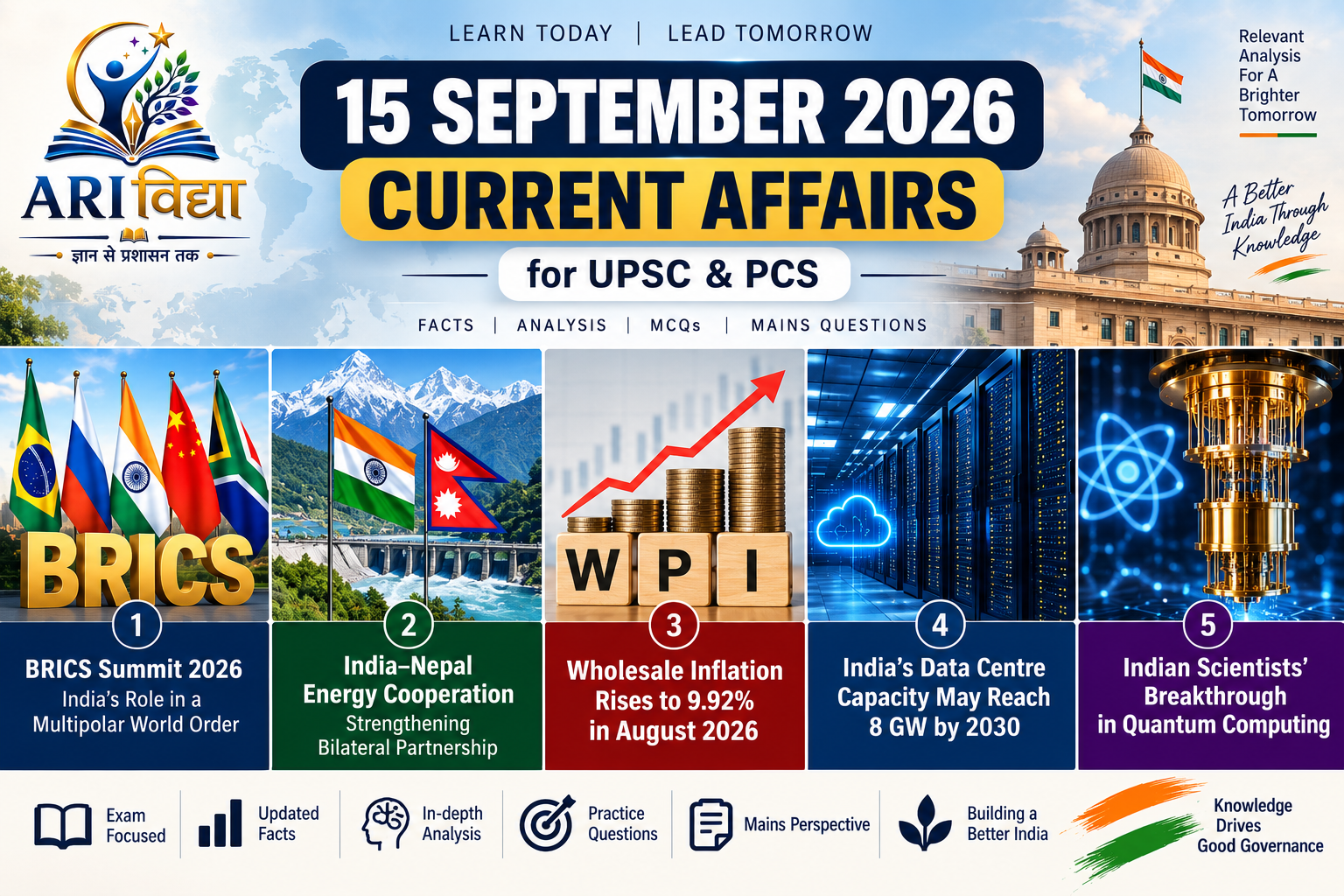
1. BRICS Summit 2026: India’s Role in a Multipolar World Order
What Happened?
The BRICS Summit 2026 has brought renewed focus on India’s role in shaping a more multipolar global order. Discussions have focused on strengthening cooperation among BRICS members, increasing intra-BRICS trade, promoting transactions in local currencies and supporting reforms in global institutions.
Thank you for reading this post, don't forget to subscribe!
Background & Context
BRICS has emerged as an important platform for cooperation among major emerging economies and countries of the Global South. India has consistently advocated greater representation of developing countries in global decision-making institutions, including the United Nations Security Council.
Important Facts
- BRICS is an important platform for cooperation among emerging economies.
- India is seeking stronger representation for the Global South.
- Local-currency trade can reduce excessive dependence on major international currencies.
- UN Security Council reform remains an important issue for India.
- BRICS cooperation covers economic as well as strategic and diplomatic issues.
Why is it Important for UPSC/PCS?
This topic is important for International Relations and Global Governance. It can be linked with India’s foreign policy, Global South, multipolarity, economic diplomacy, BRICS and reforms of international institutions.
Prelims MCQ
Q. Consider the following statements regarding BRICS:
- It provides a platform for cooperation among emerging economies.
- India supports reforms in global institutions including the UN Security Council.
- BRICS cooperation is limited only to trade and economic issues.
Which of the statements given above is/are correct?
A. 1 and 2 only
B. 2 and 3 only
C. 1 and 3 only
D. 1, 2 and 3
Correct Answer: A. 1 and 2 only
Explanation: BRICS cooperation extends beyond economics to strategic, diplomatic and global governance issues. Therefore, statement 3 is incorrect.
Mains Question
Q. Discuss the significance of BRICS in promoting a multipolar world order and examine India’s role in strengthening the voice of the Global South.
Word Limit: 250 words | GS Paper II
Key Takeaway
BRICS provides India with an important platform to promote multipolarity, strengthen the Global South and seek reforms in global institutions.
2. India–Nepal Energy Cooperation: Strengthening Bilateral Partnership
What Happened?
India has strengthened its support for Nepal following severe floods while continuing to deepen bilateral energy cooperation. India sent more than 130 tonnes of relief material to Nepal through eight Indian Air Force special flights from 26 August 2026.
Background & Context
India and Nepal share close geographical, cultural and economic ties. Hydropower and electricity cooperation have become increasingly important areas of bilateral engagement. Cross-border electricity trade can help Nepal meet its growing power demand while strengthening regional energy connectivity.
Important Facts
- India provided more than 130 tonnes of relief material to Nepal.
- Relief supplies included tents, blankets, sanitation kits and medicines.
- Solar lamps and generators were also included in the relief assistance.
- Energy cooperation is an important pillar of India–Nepal relations.
- Cross-border electricity cooperation can support regional energy security.
Why is it Important for UPSC/PCS?
The topic is important for India’s Neighbourhood First Policy, India–Nepal relations, hydropower, regional connectivity and disaster diplomacy. It can be connected with India’s approach towards its immediate neighbours.
Prelims MCQ
Q. Which of the following is/are important areas of India–Nepal cooperation?
- Hydropower and electricity trade
- Disaster relief and humanitarian assistance
- Regional energy connectivity
A. 1 only
B. 1 and 2 only
C. 2 and 3 only
D. 1, 2 and 3
Correct Answer: D. 1, 2 and 3
Explanation: Energy cooperation, humanitarian assistance and regional connectivity are all significant dimensions of India–Nepal relations.
Mains Question
Q. India–Nepal energy cooperation can become an important instrument of regional development. Discuss the opportunities and challenges involved.
Word Limit: 150 words | GS Paper II
Key Takeaway
Energy cooperation combined with humanitarian assistance can strengthen India’s neighbourhood diplomacy and regional connectivity.
3. Wholesale Inflation Rises to 9.92% in August 2026
What Happened?
India’s Wholesale Price Index (WPI)-based inflation increased to 9.92% in August 2026, compared with 9.78% in July 2026.
Background & Context
The Wholesale Price Index measures changes in prices at the wholesale level. Movement in wholesale prices is important for understanding inflationary pressures in the economy and can influence production costs and retail prices.
Important Facts
- WPI inflation in August 2026: 9.92%.
- WPI inflation in July 2026: 9.78%.
- Food inflation increased to 7.05% from 6.65%.
- Inflation in manufactured products stood at 8.37%.
- WPI is an important indicator of wholesale-level price movements.
Why is it Important for UPSC/PCS?
This is important for Indian Economy, Inflation, WPI, monetary policy, price stability and economic growth. Questions can also involve the difference between WPI and CPI.
Prelims MCQ
Q. Consider the following statements about the Wholesale Price Index (WPI):
- It measures price movements at the wholesale level.
- It is an important indicator of inflationary trends.
- It is identical to the Consumer Price Index (CPI).
A. 1 and 2 only
B. 2 and 3 only
C. 1 and 3 only
D. 1, 2 and 3
Correct Answer: A. 1 and 2 only
Explanation: WPI tracks wholesale-level prices, whereas CPI measures changes in prices faced by consumers. Therefore, they are not identical.
Mains Question
Q. Rising wholesale inflation can affect production costs, investment and consumer prices. Discuss its implications for India’s economic growth.
Word Limit: 150 words | GS Paper III
Key Takeaway
The rise in WPI inflation highlights continuing price pressures and the importance of balancing price stability with economic growth.
4. India’s Data Centre Capacity May Reach 8 GW by 2030
What Happened?
India’s data-centre capacity has reached around 1.57 GW as of August 2026 and is projected to increase to approximately 8 GW by 2030.
Background & Context
Rapid digitalisation, cloud computing, artificial intelligence, digital public infrastructure and increasing data consumption are driving demand for data centres in India.
Important Facts
- India’s data-centre capacity as of August 2026: 1.57 GW.
- Projected capacity by 2030: approximately 8 GW.
- Demand is being driven by digitalisation and emerging technologies.
- Data centres require reliable electricity, cooling systems and connectivity.
- The sector has implications for India’s digital economy and infrastructure.
Why is it Important for UPSC/PCS?
The issue is relevant to Science & Technology, Digital Economy, Artificial Intelligence, Data Governance, Infrastructure and Energy Security. It also raises questions about the environmental footprint of digital infrastructure.
Prelims MCQ
Q. Which of the following factors can increase the demand for data-centre capacity?
- Cloud computing
- Artificial Intelligence
- Digitalisation
- Growth in data consumption
A. 1 and 2 only
B. 1, 2 and 3 only
C. 2, 3 and 4 only
D. 1, 2, 3 and 4
Correct Answer: D. 1, 2, 3 and 4
Explanation: All these factors contribute to increasing demand for digital infrastructure and data-centre capacity.
Mains Question
Q. India’s expanding data-centre ecosystem is both an opportunity for digital growth and a challenge for energy and environmental sustainability. Discuss.
Word Limit: 250 words | GS Paper III
Key Takeaway
India’s data-centre expansion can strengthen the digital economy, but reliable power, green energy, cybersecurity and sustainable infrastructure will be crucial.
5. Indian Scientists Make a New Breakthrough in Quantum Computing
What Happened?
Scientists at the Raman Research Institute (RRI) have demonstrated a novel approach to addressing an important challenge in quantum computing, with the potential to improve the reliability and integrity of quantum calculations.
Background & Context
Quantum computers use quantum-mechanical principles to perform certain computations in ways fundamentally different from conventional computers. However, quantum systems are highly sensitive to errors and disturbances, making reliability a major challenge for practical quantum computing.
Important Facts
- The work was carried out by scientists at the Raman Research Institute.
- It addresses a significant challenge associated with quantum computing.
- The approach aims to improve the reliability of quantum calculations.
- Quantum computing is an emerging area of advanced science and technology.
- India is developing capabilities in quantum technologies under its broader quantum mission.
Why is it Important for UPSC/PCS?
The topic is important for Science & Technology, particularly quantum computing, quantum technologies, emerging technologies and India’s technological capabilities.
Prelims MCQ
Q. Consider the following statements about quantum computing:
- Quantum computers exploit principles of quantum mechanics.
- Quantum systems can be highly sensitive to errors and disturbances.
- Improving computational reliability is an important challenge in quantum computing.
A. 1 only
B. 1 and 2 only
C. 2 and 3 only
D. 1, 2 and 3
Correct Answer: D. 1, 2 and 3
Explanation: Quantum computing relies on quantum-mechanical principles, while controlling errors and maintaining reliable calculations remain major technological challenges.
Mains Question
Q. What are the major challenges in achieving reliable quantum computing? Discuss the significance of Indian research in strengthening the country’s quantum technology ecosystem.
Word Limit: 250 words | GS Paper III
Key Takeaway
Improvements in quantum reliability can accelerate the transition of quantum computing from experimental research towards practical applications.