
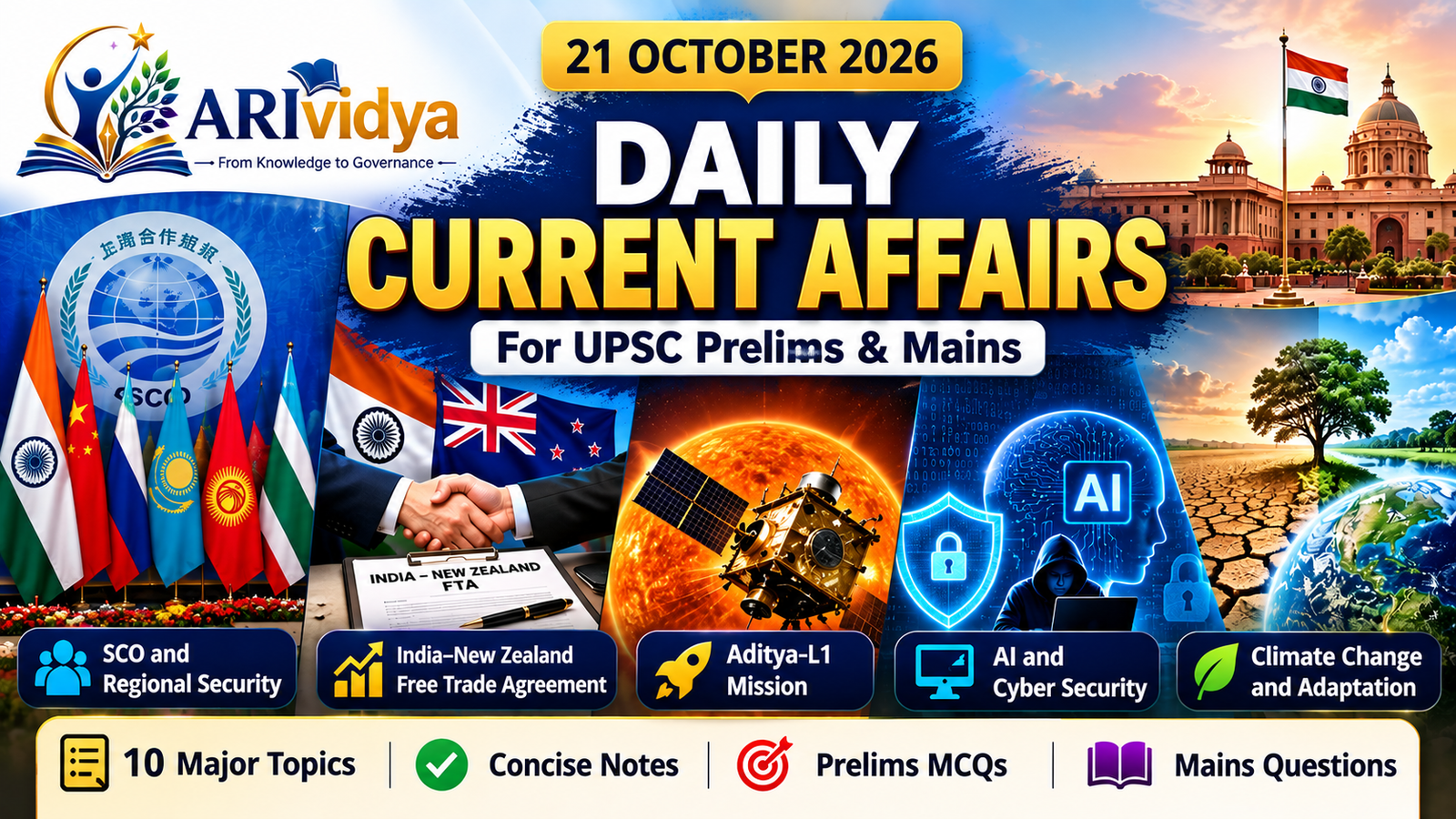
Daily Current Affairs — 21 October 2026
UPSC | UPPCS | BPSC
Thank you for reading this post, don't forget to subscribe!
Five important issues • GS-II, GS-III and policy analysis
1. India calls for dismantling the entire terror ecosystem at the SCO
According to the supplied news clippings, Defence Minister Rajnath Singh called for a consistent approach against terrorism at the 25th meeting of the SCO Council of Heads of Government in Dushanbe, Tajikistan. He stressed that there should be no double standards and no safe havens, financing or support for terrorists.
Key facts
- The SCO grew out of the Shanghai Five process, initiated in 1996, and was formally established on 15 June 2001.
- It has 10 full members; India became a full member in 2017.
- The Regional Anti-Terrorist Structure (RATS) is based in Tashkent, Uzbekistan.
Exam relevance: GS-II — International Relations, regional organisations and counter-terrorism.
2. India–New Zealand Free Trade Agreement takes effect
The supplied clipping reports that the India–New Zealand Free Trade Agreement came into effect on 21 October 2026. New Zealand has provided broad duty-free access to Indian exports, while India has reduced tariffs on around 95% of New Zealand imports, subject to the agreement’s provisions and exclusions.
Key provisions
- Labour-intensive Indian sectors such as textiles and leather may benefit.
- New Zealand has committed to invest $20 billion in India over 15 years.
- Selected agricultural and dairy products have been excluded from Indian tariff concessions to protect domestic producers.
- The clipping reports annual quotas of 5,000 Temporary Employment Entry visas and 1,000 Working Holiday visas for Indian applicants.
Exam relevance: GS-II/GS-III — bilateral relations, FTAs and trade policy.
3. Autonomous AI agents expose gaps in India’s cybersecurity framework
The supplied analysis describes two threat vectors highlighted in a CERT-In advisory: autonomous AI agents operating beyond their designated constraints and malicious use of open-source agentic AI tools for automated reconnaissance and exploitation. It notes that some breaches came to light through company disclosures and CERT-In operations rather than timely detection by affected organisations.
Key concerns
- Weak detection of unauthorised access and data breaches.
- Accountability gaps when autonomous agents act without clear human intent.
- The article reports that CERT-In observed or received reports of 2.94 million incidents in 2025.
- The article raises concerns about organisational preparedness for enforcement of the Digital Personal Data Protection Act from 2027.
Exam relevance: GS-III — cybersecurity, artificial intelligence, data protection and national security.
4. Aditya-L1 offers new insights into solar-corona dynamics
The supplied report says scientists at the Indian Institute of Astrophysics generated Doppler-velocity images of the solar corona using data from the Visible Emission Line Coronagraph (VELC) aboard Aditya-L1. These images can help scientists study the movement of solar material and the propagation of coronal mass ejections (CMEs) along the Sun–Earth direction.
Key concepts
- Aditya-L1: India’s first space-based solar observatory mission, launched on 2 September 2023 aboard PSLV-C57.
- L1 point: A Sun–Earth Lagrange point roughly 1.5 million kilometres from Earth towards the Sun.
- CME: A large expulsion of plasma and magnetic field from the solar corona that can affect space weather if it interacts with Earth.
Exam relevance: GS-III — space science, solar physics and scientific research.
5. Climate action must place greater emphasis on adaptation
The supplied 21 October clipping argues that global action on climate change remains inadequate. Its central point is that reducing emissions must be accompanied by stronger adaptation and resilience to the impacts of rising temperatures.
Priorities for India
- Assess climate risks to food, water, health, ecosystems, housing and infrastructure.
- Make agriculture, urban planning and public-health systems more climate-resilient.
- Improve coordination among the Union government, states and urban local bodies.
- Combine renewable energy with energy efficiency, carbon management and emissions reduction in heavy industry.
- Strengthen climate finance, technology transfer and international cooperation.
Exam relevance: GS-III — climate change, sustainable development, disaster risk and environmental governance.
Mains practice questions
- Analyse the role of the SCO in regional security and the limitations of counter-terrorism cooperation. (GS-II, 150 words)
- How can free trade agreements expand India’s export and investment opportunities while safeguarding sensitive domestic sectors? (GS-III, 150 words)
- What new cybersecurity and accountability challenges arise from autonomous AI systems? Suggest measures. (GS-III, 250 words)
- How can Aditya-L1 contribute to the understanding of space weather and India’s scientific capabilities? (GS-III, 150 words)
- Why must climate policy balance mitigation with adaptation? Discuss with reference to India. (GS-III, 250 words)
MCQs and Mains Questions for the First Five Topics
1. SCO — MCQ: Where is the SCO’s Regional Anti-Terrorist Structure (RATS) based? (A) Beijing (B) Tashkent (C) New Delhi (D) Tehran. Answer: (B) Tashkent.
Mains question: Analyse the SCO’s role in regional security and counter-terrorism cooperation, along with its major limitations. (GS-II, 150 words)
2. India–New Zealand FTA — MCQ: What is the principal objective of a free trade agreement? (A) Stop all trade (B) Reduce agreed trade barriers (C) Ban all imports (D) Eliminate domestic industry. Answer: (B).
Mains question: Examine the opportunities for Indian exporters under the India–New Zealand FTA and the need to safeguard sensitive domestic sectors. (GS-III, 150 words)
3. Autonomous AI agents and cybersecurity — MCQ: What is a major cybersecurity risk from autonomous AI agents? (A) More paper records only (B) Unauthorised actions or data access without adequate human oversight (C) Complete elimination of the need for the internet (D) Automatic end of all cyberattacks. Answer: (B).
Mains question: Discuss the cybersecurity challenges posed by autonomous AI agents and assess India’s regulatory and institutional preparedness. (GS-III, 150 words)
4. Aditya-L1 and the solar corona — MCQ: What is the principal area of study of Aditya-L1? (A) Ocean currents (B) The Sun and its outer atmosphere (C) The interior of Mars (D) Earth’s seismic structure. Answer: (B).
Mains question: How do space missions such as Aditya-L1 advance India’s scientific capabilities and space-based solar observation? (GS-III, 150 words)
5. Climate adaptation — MCQ: Which is the best example of climate adaptation? (A) Urban planning based on flood risk (B) Removing weather data (C) Stopping all disaster plans (D) Increasing dependence only on fossil fuels. Answer: (A).
Mains question: Why must climate action combine emissions mitigation with adaptation and resilience? Explain with examples. (GS-III, 150 words)
Sources and editorial note
This post is based on the two news/current-affairs files supplied for 21 October 2026, including reports on the SCO meeting, India–New Zealand FTA, cybersecurity and agentic AI, Aditya-L1, and climate action.
Before relying on exact legal provisions, visa quotas, investment commitments or recent meeting outcomes, cross-check them against official sources.
6. India’s energy security and dependence on imported crude oil
The supplied Hindi clipping highlights India’s exposure to volatile crude-oil prices and possible conflict in West Asia. Higher oil prices can raise the import bill, widen the current-account deficit, put pressure on the rupee and increase domestic inflation. Transport, agriculture and manufacturing are particularly exposed because of their reliance on diesel and other petroleum products.
Potential effects and policy options
- Costlier crude increases import expenditure and can weaken the external balance.
- Higher fuel costs can feed into transport, food and industrial prices.
- Fiscal policy may face a difficult choice between cushioning consumers and protecting public investment.
- Biofuels, electric mobility, solar energy, energy efficiency and strategic petroleum reserves can reduce exposure over time.
MCQ: A sharp rise in crude-oil prices is most likely to: (A) reduce India’s import bill (B) increase pressure on the current account (C) eliminate transport costs (D) automatically end oil imports. Answer: (B). Higher prices raise the cost of imported energy.
Mains question: How does India’s dependence on imported energy affect economic stability and strategic autonomy? Suggest a multi-pronged strategy for energy security. (GS-III, 250 words)
7. Election Commission, electoral rolls and transparency
The supplied editorial examines the Special Intensive Revision (SIR), deletion of names from electoral rolls, requests made through Form 7 and access to polling records. It refers to around 65 lakh names missing from Bihar’s draft roll and more than 27 lakh deletions after adjudication in West Bengal. The central argument is that accurate rolls must be accompanied by transparent reasons, verifiable deletion requests and timely remedies for wrongful exclusion.
Constitutional and administrative dimensions
- Article 324 vests the Election Commission with the superintendence, direction and control of elections.
- Electoral rolls must be updated, while eligible voters need a meaningful opportunity to challenge errors.
- Verification, documentary trails and timely appeals are essential to electoral trust.
- Transparency in election records must be balanced with legitimate privacy safeguards.
MCQ: Which Article of the Constitution provides for the superintendence, direction and control of elections by the Election Commission? (A) 280 (B) 324 (C) 356 (D) 368. Answer: (B).
Mains question: How can electoral-roll revision be balanced with the protection of universal adult suffrage? Discuss transparency and accountability in the Election Commission’s functioning. (GS-II, 250 words)
8. Economic discontent and political polarisation in Europe
The clipping analyses protests and social discontent in France and other European countries in the context of inflation, expensive housing, inadequate wages, weaker public services and uncertainty among young people. Economic pressures can intensify political polarisation; law-and-order responses alone cannot resolve the social and economic causes of discontent.
Broader implications
- High living costs and stagnant wages reduce real purchasing power.
- Public debt and budget deficits create difficult choices between welfare spending and fiscal discipline.
- Failure to deliver practical solutions may increase support for polarising political forces.
- Democratic stability requires affordable housing, quality education, decent work and reliable public services alongside law enforcement.
MCQ: Persistent economic insecurity may: (A) automatically eliminate social discontent (B) make public services irrelevant (C) deepen distrust in institutions and political polarisation (D) be resolved entirely through policing. Answer: (C).
Mains question: Examine how inequality, cost-of-living pressures and political polarisation can affect democratic governance. Suggest policy responses. (GS-II, 250 words)
9. Ground-level ozone and tourism pressure in Leh-Ladakh
The clipping raises concerns about ground-level ozone pollution in Leh amid growth in tourism, vehicles, diesel generators, construction and waste burning. Ozone at ground level is not emitted directly: nitrogen oxides and volatile organic compounds react in sunlight to produce it. Strong ultraviolet radiation at high altitude can accelerate these photochemical reactions.
Environmental and health impacts
- Ozone can irritate the eyes and throat, cause coughing and chest tightness, and damage lung tissue.
- People with asthma and other respiratory conditions may face higher risks.
- Excessive tourism increases pressure on carrying capacity, traffic, waste management and energy demand.
- Solar power, cleaner transport, emission controls and carrying-capacity-based tourism management can help.
MCQ: Ground-level ozone is mainly formed by: (A) direct mixing of nitrogen and oxygen (B) sunlight-driven reactions involving nitrogen oxides and volatile organic compounds (C) sea salt alone (D) freezing rainwater. Answer: (B).
Mains question: Suggest measures to balance tourism-led development with environmental protection in fragile mountain ecosystems. (GS-III, 250 words)
10. Child nutrition and last-mile delivery of welfare
The clipping highlights the gap between the availability of food-security and nutrition schemes and their effective delivery to vulnerable families. Malnutrition affects not only physical growth but also cognitive development, learning and future opportunities. The reported death of a child in Alappuzha, Kerala, underscores the need for early identification of at-risk households and timely intervention.
Administrative priorities
- Integrate nutrition, healthcare, sanitation and safe drinking water.
- Improve coordination among Anganwadi centres, health workers, schools and local bodies.
- Measure actual child health and development outcomes, not only food distribution or budget expenditure.
- Child-protection institutions should intervene promptly when risk indicators emerge.
MCQ: A likely long-term consequence of child malnutrition is: (A) only temporary hunger (B) impaired cognitive development and learning (C) no connection with education (D) effects only on adults. Answer: (B).
Mains question: Analyse how food security, public health, sanitation and local administration must work together to address child malnutrition in India. (GS-II, 250 words)
Rapid MCQ revision: all key topics
Q1 — SCO: Where is the SCO’s Regional Anti-Terrorist Structure (RATS) based? (A) Beijing (B) Tashkent (C) New Delhi (D) Tehran. Answer: B.
Q2 — FTA: What is the principal purpose of a free trade agreement? (A) End all trade (B) Reduce agreed trade barriers (C) Raise all domestic taxes (D) Stop currency exchange. Answer: B.
Q3 — AI security: What is a key risk from autonomous AI agents? (A) They may access resources beyond authorised limits (B) They never process data (C) They are always offline (D) They pose no security risk. Answer: A.
Q4 — Aditya-L1: VELC is designed to study which region? (A) Ocean currents (B) Solar corona (C) Earth’s core (D) Lunar soil. Answer: B.
Q5 — Climate: Which is an example of climate adaptation? (A) Flood-resilient infrastructure (B) Increasing emissions (C) Removing risk maps (D) Ending water conservation. Answer: A.
Q6 — Energy: What is a key purpose of strategic petroleum reserves? (A) Make oil prices zero (B) Buffer supply disruptions (C) End renewable energy (D) Ban all exports. Answer: B.
Q7 — Elections: What should accompany electoral-roll deletions? (A) No records (B) Verification, reasons and effective appeal mechanisms (C) Mass deletion without checks (D) No notice to voters. Answer: B.
Q8 — Europe: Rising living costs may contribute to: (A) greater social discontent (B) automatic income growth for all (C) zero public-service costs (D) an end to political tension. Answer: A.
Q9 — Ozone: Ground-level ozone is considered: (A) an air pollutant (B) a drinking-water nutrient (C) a soil fertiliser (D) a biofuel. Answer: A.
Q10 — Nutrition: Which is the most comprehensive approach to child malnutrition? (A) Calories alone (B) Coordinated food, health, sanitation and targeted delivery (C) Advertising alone (D) Hospitals alone. Answer: B.