
Date: 12 October 2026 | Examinations: UPSC, UPPCS and BPSC | Subjects: Polity, Economy, International Relations, Science & Technology, and Social Justice
Thank you for reading this post, don't forget to subscribe!
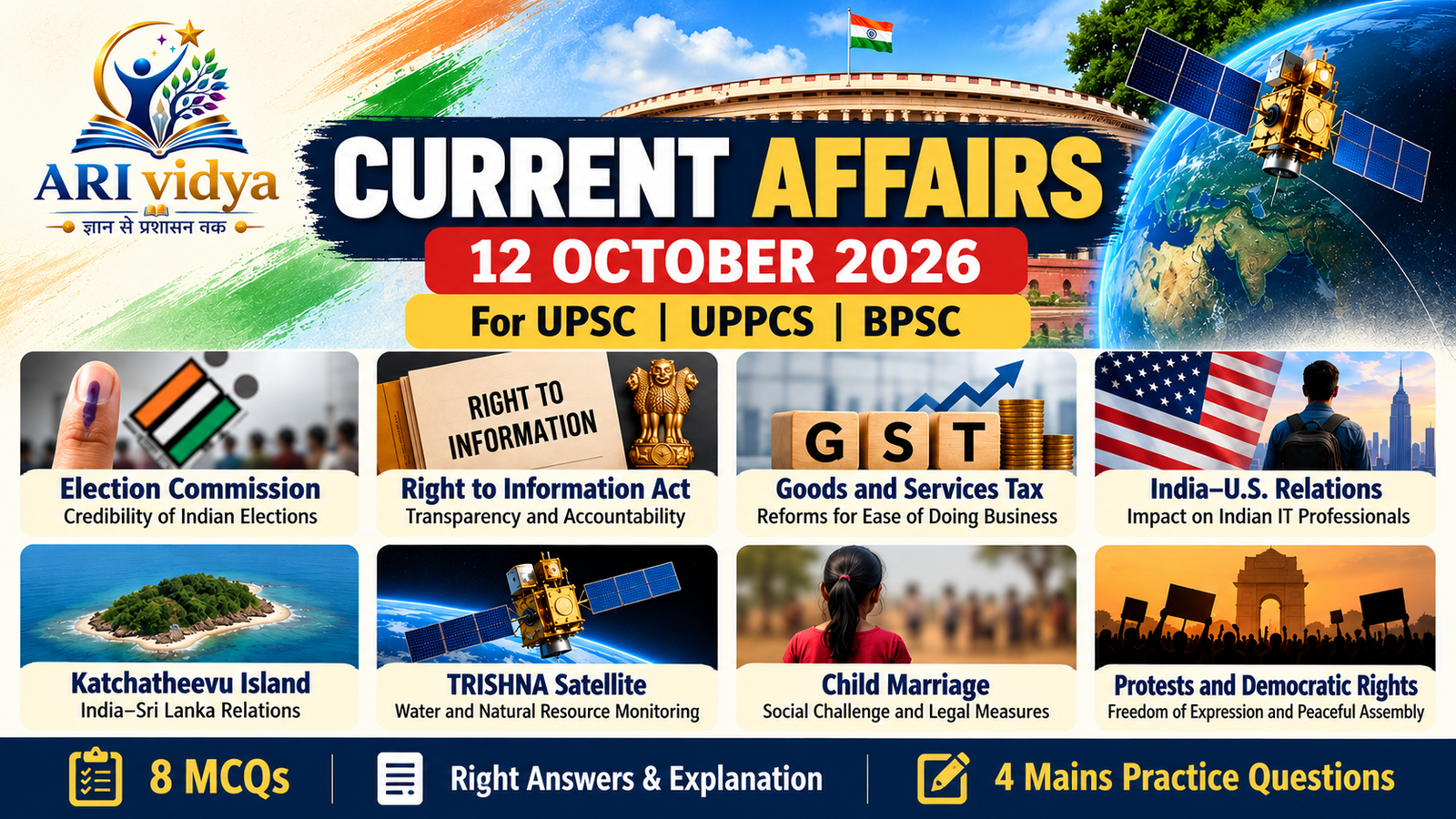
Today’s current affairs cover the credibility of the Election Commission, the Right to Information Act, GST reforms, the impact of US immigration policy on Indian IT professionals, Katchatheevu Island, the TRISHNA satellite mission, child marriage, and peaceful protests. Each topic includes one Prelims practice MCQ, followed by four Mains practice questions.
1. Credibility of Indian Elections and the Election Commission
Syllabus: General Studies II | Constitution, electoral reforms and democracy
Why in the news?
Discussions have focused on the Special Intensive Revision (SIR) of electoral rolls, the impartiality of the Election Commission, and public confidence in the electoral process.
Key facts
- The Election Commission of India is a constitutional body established under Article 324 of the Constitution.
- Electoral-roll accuracy, election financing, the use of money power and defections are important issues concerning electoral fairness.
- AI-generated misleading content and deepfakes are emerging challenges for elections.
- India had approximately 98 crore electors during the 2024 general election.
Challenges
- Questions about the impartiality of the electoral process.
- Money power and inducements during elections.
- Risk of wrongful inclusion or deletion of voters from electoral rolls.
- Misleading digital content and post-election defections.
Way forward
Greater transparency in electoral-roll revision, better regulation of political financing, institutional independence of the Election Commission, timely action against digital misinformation, and faster resolution of electoral disputes are essential.
Conclusion: Free and fair elections are the foundation of democracy. Transparency, accountability and public trust must be strengthened.
Prelims MCQ 1
Question: Consider the following statements regarding the credibility of Indian elections:
- Special Intensive Revision of electoral rolls is related to the accuracy of the electoral process.
- AI-generated misleading content can pose a challenge to electoral fairness.
- The Election Commission is a statutory body that is not mentioned in the Constitution.
(A) 1 and 2 only
(B) 2 and 3 only
(C) 1 and 3 only
(D) 1, 2 and 3
View answer and explanation
Correct answer: (A) 1 and 2 only. The Election Commission is a constitutional body provided for under Article 324.
2. Right to Information Act, 2005
Syllabus: General Studies II | Good governance, transparency and accountability
Why in the news?
On the completion of 21 years of the Act, questions have been raised about proactive disclosure of information by government departments and compliance with transparency audits.
Key facts
- The Right to Information Act was enacted in 2005.
- Section 4(1)(b) requires public authorities to proactively disclose specified information.
- Section 8 provides exemptions from disclosure for certain categories of information.
- Section 8(2) permits disclosure in certain circumstances where public interest outweighs the harm from disclosure.
- According to figures cited in the source material from the Central Information Commission’s 2024–25 report, 1,446 of 2,303 registered public authorities submitted third-party transparency audit reports—about 62.7%.
Key challenges and the way forward
Major challenges include inadequate proactive disclosure, pending appeals and outdated information on official websites. Effective compliance with Section 4, regular audits and reduction of the backlog in Information Commissions are important priorities.
Conclusion: RTI can be effective when public authorities develop an administrative culture of making essential information available proactively.
Prelims MCQ 2
Question: Section 4(1)(b) of the Right to Information Act, 2005, primarily deals with:
(A) The judicial jurisdiction of Information Commissions
(B) Proactive disclosure of information by public authorities
(C) Fixing the minimum age of citizens who can seek information
(D) The procedure for abolishing the right to information
View answer and explanation
Correct answer: (B). Section 4 requires public authorities to publish specified information proactively and periodically.
3. Reforms in Goods and Services Tax (GST)
Syllabus: General Studies III | Indian economy, tax reforms and MSMEs
Why in the news?
The source material discusses procedural reforms associated with GST registration, returns, refunds, input tax credit and ease of doing business.
Key areas of reform
- Simplifying tax registration and return-filing procedures.
- Making refunds and input tax credit faster and more transparent.
- Reducing compliance costs for small traders and micro, small and medium enterprises.
- Making it easier for small sellers to participate through e-commerce platforms.
Potential impact and challenges
Simplified procedures can improve working capital, encourage participation in the formal economy and provide relief to exporters. However, complexity in tax administration, disputes relating to input tax credit and the need for consistent implementation across states remain important concerns.
Conclusion: Tax reforms should be simple, transparent and predictable. Proposals mentioned in news reports should not be treated as rules already implemented.
Prelims MCQ 3
Question: What is the primary purpose of input tax credit under the GST system?
(A) To impose the same tax rate on every product
(B) To reduce the cascading effect of taxes by allowing eligible tax credit through the supply chain
(C) To tax exports in every circumstance
(D) To completely exempt all small traders from tax
View answer and explanation
Correct answer: (B). Subject to prescribed conditions, GST paid on eligible purchases can be credited against GST payable on sales.
4. India–US Relations and Indian IT Professionals
Syllabus: General Studies II and III | International relations, migration and the services sector
Why in the news?
The source material refers to an announcement by the United States to suspend eight major technology companies from the permanent labour certification programme. The possible implications for skilled Indian professionals have consequently come into focus.
H-1B visa and Green Card: the difference
- H-1B visa: Allows temporary employment in the United States subject to specified conditions.
- Green Card: Provides a route to permanent residence in the United States.
- Permanent labour certification: A process associated with certain employment-based permanent-residence applications.
Significance for India and the way forward
Changes in visa policy can affect professionals’ long-term plans and companies’ recruitment decisions. India should focus on diplomatic engagement, protection of professionals’ interests, domestic research and innovation, and technological cooperation with alternative markets.
Conclusion: A long-term response should include expanding opportunities for knowledge, technology and quality employment within India.
Prelims MCQ 4
Question: Consider the following statements about the H-1B visa and Green Card:
- The H-1B visa permits temporary employment in the United States subject to specified conditions.
- A Green Card relates to permanent residence in the United States.
- Suspension from the permanent labour certification programme automatically cancels all Indian H-1B visas.
(A) 1 only
(B) 1 and 2 only
(C) 2 and 3 only
(D) 1, 2 and 3
View answer and explanation
Correct answer: (B). H-1B visas and Green Cards are distinct immigration arrangements. Action concerning labour certification does not automatically cancel all H-1B visas.
5. Katchatheevu Island: India–Sri Lanka Relations
Syllabus: Prelims and General Studies II | Neighbourhood relations and maritime issues
Geographical location and background
- Katchatheevu is a small, uninhabited island in the Palk Strait.
- St Anthony’s Church is located on the island, and devotees from India and Sri Lanka participate in an annual religious event there.
- Under the 1974 India–Sri Lanka maritime agreement, the island was transferred to Sri Lanka.
- A supplementary agreement in 1976 defined limits relating to fishing rights in the maritime zones of the two countries.
Significance for India
Fisherfolk livelihoods and safety, maritime boundaries, concerns of coastal communities and India–Sri Lanka relations are central dimensions of this issue. Dialogue, joint mechanisms and alternative livelihood opportunities can help address concerns.
Prelims MCQ 5
Question: Consider the following statements about Katchatheevu Island:
- It is located in the Palk Strait.
- It was transferred to Sri Lanka under the 1974 India–Sri Lanka maritime agreement.
- The 1976 agreement dealt with fishing rights in the maritime zones of the two countries.
(A) 1 and 2 only
(B) 2 and 3 only
(C) 1 and 3 only
(D) 1, 2 and 3
View answer and explanation
Correct answer: (D). Katchatheevu is a sensitive issue in India–Sri Lanka maritime relations and is closely linked to the rights of fisherfolk.
6. TRISHNA Satellite Mission: Water and Natural Resources
Syllabus: General Studies III | Space technology and environment
Why in the news?
Preparations for the upcoming TRISHNA mission, a joint effort of ISRO and France’s space agency CNES, have been in focus. The source material mentions a possible launch window within the next 12–16 months.
Key facts and applications
- TRISHNA stands for Thermal Infra-Red Imaging Satellite for High-resolution Natural Resource Assessment.
- It is a joint satellite mission of India and France.
- Potential applications include studying land-surface temperature, agriculture, irrigation, water resources and indicators associated with drought.
- Megha-Tropiques and SARAL are among the earlier satellite missions involving India–France cooperation.
Conclusion: Thermal infrared observations can provide a scientific basis for policies relating to climate, agriculture and water management.
Prelims MCQ 6
Question: Consider the following statements about the TRISHNA satellite mission:
- It is a joint mission of India and France.
- ISRO and CNES are collaborating on it.
- It focuses on natural-resource assessment using thermal infrared observations.
(A) 1 and 2 only
(B) 2 and 3 only
(C) 1 and 3 only
(D) 1, 2 and 3
View answer and explanation
Correct answer: (D). TRISHNA focuses on high-resolution thermal infrared observations for natural-resource assessment.
7. Child Marriage: Social Change Beyond Legislation
Syllabus: General Studies I and II | Women’s empowerment, social justice and child rights
Why in the news?
Despite action to prevent child marriages in Telangana, problems such as poverty, school dropout and social pressure continue to pose challenges.
Figures cited in the source material
- The source material cites 20.1% as the proportion of women aged 20–24 who were married before 18, attributed to NFHS-6 (2023–24).
- It mentions that 1,245 child marriages were prevented in Telangana during 2025–26 and 825 between April and August 2026.
- It also reports that 777 children identified in this context had dropped out of school.
Causes and legal measures
Poverty, lack of access to education, patriarchal norms, illness or loss of income in the family, and exploitation of vulnerable households are among the major causes. The Prohibition of Child Marriage Act, 2006, the Protection of Children from Sexual Offences Act, 2012, Child Helpline 1098 and One Stop Centres are important mechanisms in this area.
Way forward
Keeping girls in education, providing economic support to families, raising social awareness, taking timely legal action and ensuring rehabilitation must be pursued together.
Prelims MCQ 7
Question: Consider the following statements about the prevention of child marriage in India:
- The Prohibition of Child Marriage Act, 2006 provides a legal framework to prevent child marriage.
- Preventing a marriage alone is sufficient; education and economic security have no role to play.
- Child Helpline 1098 is important for assisting children in distress.
(A) 1 and 2 only
(B) 1 and 3 only
(C) 2 and 3 only
(D) 1, 2 and 3
View answer and explanation
Correct answer: (B). Ending child marriage requires not only law enforcement but also education, economic security, social awareness and child-protection services.
8. Democratic Rights and Peaceful Protests
Syllabus: General Studies II | Fundamental rights, civil liberties and rule of law
Constitutional basis
- Article 19(1)(a): Freedom of speech and expression.
- Article 19(1)(b): Right to assemble peaceably and without arms.
- Article 19(1)(c): Right to form associations or unions.
These rights are subject to reasonable restrictions prescribed by the Constitution. The administration must protect civil liberties while maintaining public order. Arrest and detention must comply with legal requirements, and police action must be accountable.
Conclusion: Respect for dissent and impartial enforcement of the law are complementary to democratic governance. Administrative action should be lawful, necessary and proportionate.
Prelims MCQ 8
Question: Under which provision of the Indian Constitution is the right to assemble peaceably and without arms guaranteed?
(A) Article 14
(B) Article 19(1)(a)
(C) Article 19(1)(b)
(D) Article 21
View answer and explanation
Correct answer: (C) Article 19(1)(b). Reasonable restrictions on this right may be imposed on the grounds specified under Article 19(3).
Mains Practice Questions
Question 1 — General Studies II | 15 marks | 250 words
Analyse the major challenges affecting the credibility of Indian elections. Suggest measures to strengthen the independence of the Election Commission and public trust in the electoral process.
Question 2 — General Studies II | 10 marks | 150 words
The Right to Information Act, 2005 has played an important role in promoting good governance. Examine the challenges in its effective implementation.
Question 3 — General Studies III | 10 marks | 150 words
How can procedural simplification under the Goods and Services Tax promote small enterprises, investment and ease of doing business? Discuss the associated challenges.
Question 4 — General Studies I and II | 15 marks | 250 words
Child marriage persists in India despite legislative measures. Examine its underlying causes and suggest a multi-dimensional strategy for its elimination.
Quick Revision
- Election Commission: Article 324, electoral rolls, election financing.
- Right to Information: Section 4, proactive disclosure, Information Commissions.
- GST: Tax compliance, input tax credit, MSMEs.
- India–US relations: H-1B visa, Green Card, skilled professionals.
- Katchatheevu: Palk Strait, 1974 and 1976 agreements.
- TRISHNA: ISRO–CNES, thermal infrared, water resources.
- Child marriage: 2006 Act, education, social justice.
- Protests: Article 19, civil liberties, rule of law.
ARIvidya message: Do not merely memorise current affairs. Connect every news item with the Constitution, governance, the economy, society and India’s international relations.