

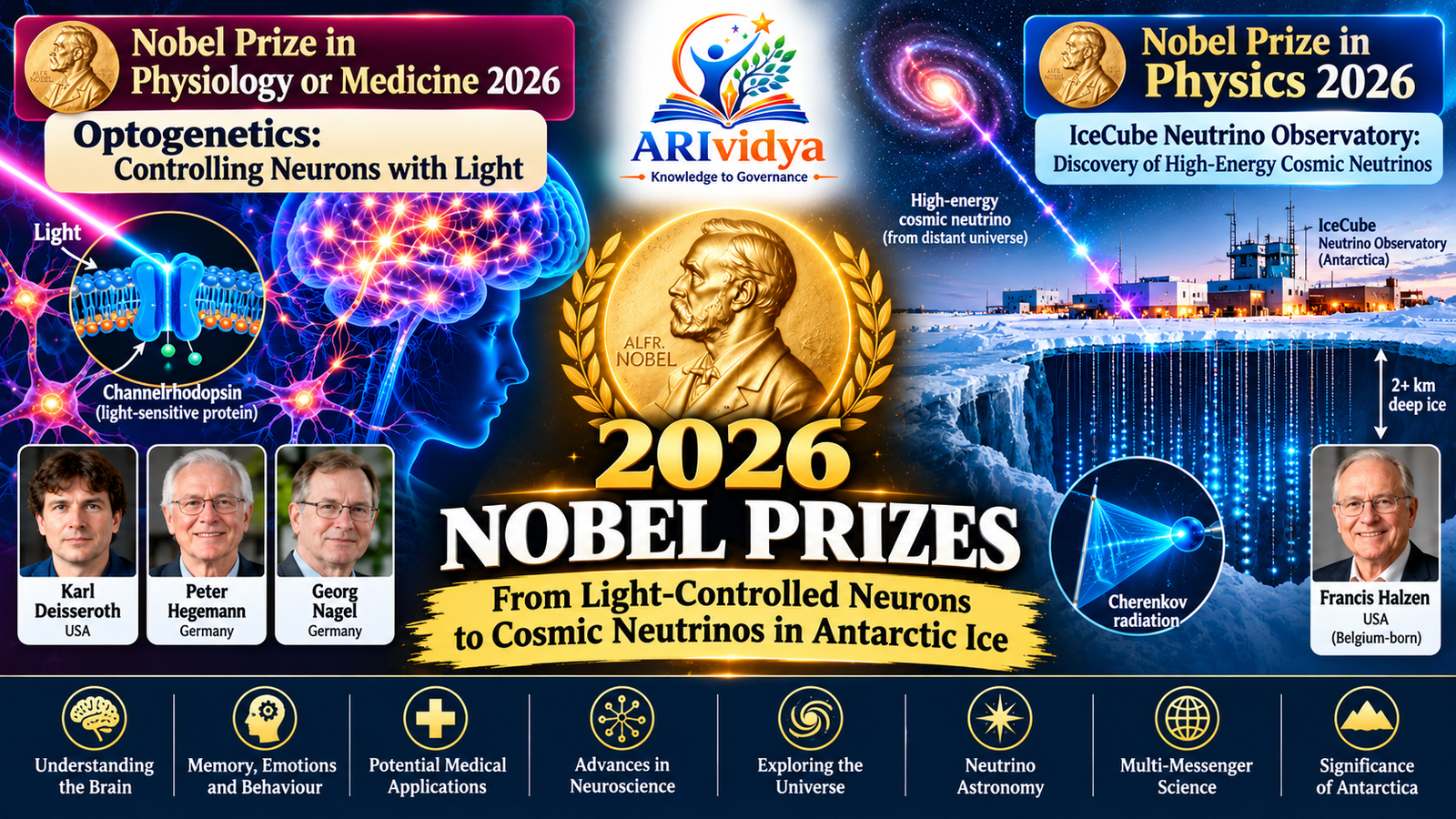
2026 Nobel Prizes: From Using Light to Understand the Brain to Detecting Cosmic Particles in Antarctic Ice
An easy-to-understand guide to the 2026 Nobel Prizes in Physiology or Medicine and Physics, designed for non-science backgrounds and competitive-exam preparation.
Thank you for reading this post, don't forget to subscribe!
At a Glance
The 2026 Nobel Prizes in Medicine and Physics highlight two very different scientific achievements. One uses light to control selected nerve cells; the other uses the deep Antarctic ice at the South Pole to detect extremely elusive neutrinos.
The common thread is simple: modern science is developing new ways to observe, measure and control phenomena that were previously very difficult to study.
1. Nobel Prize in Physiology or Medicine 2026 — Optogenetics
Recognised work: Discoveries leading to optogenetics and the use of light-sensitive ion channels to control neural activity.
What was the problem?
The human brain contains billions of nerve cells, or neurons. They communicate through electrical and chemical signals. When we remember something, feel fear, make a decision or move our body, different neural circuits become active.
The major scientific challenge was this: how can researchers switch a specific neuron or a small group of neurons on or off at a precise moment and determine what that activity actually does?
What is optogenetics?
Optogenetics combines genetics with light. Scientists use genetic methods to make selected cells sensitive to light. They can then use light to influence the activity of those cells.
The name itself is useful: opto refers to light, while genetics refers to genes and genetic techniques.
Why is channelrhodopsin important?
Peter Hegemann and Georg Nagel played a key role in understanding channelrhodopsin, a light-sensitive ion channel. In simple terms, it can be thought of as a tiny molecular door that responds to light and changes the movement of ions across a cell membrane. This can alter the electrical activity of the cell.
Karl Deisseroth’s contribution
Karl Deisseroth and his colleagues helped transform these discoveries into a powerful tool for neuroscience. By combining genetic targeting with light, researchers could control selected neurons with exceptional timing and spatial precision.
1. Select the target neurons.
2. Introduce genetic instructions related to a light-sensitive protein.
3. Allow the protein to be expressed in the selected cells.
4. Deliver suitable light to influence the cells’ activity.
Why is this a major breakthrough?
It is not enough to observe which neurons become active during a behaviour. A deeper question is: if we activate or silence those neurons, does the behaviour change?
Optogenetics gave researchers a powerful way to study such cause-and-effect relationships in neural circuits. That is why it has become a transformative method in modern neuroscience.
Where can it be useful?
- Understanding memory and learning.
- Studying neural circuits involved in emotions and behaviour.
- Investigating how different brain circuits function.
- Research into neurological and psychiatric disorders such as Parkinson’s disease, epilepsy and Alzheimer’s disease.
- Exploring possible approaches to vision restoration and other neurological applications.
Important caution: Many therapeutic applications remain experimental or under development. They should not be presented as routine medical treatments.
Limitations and ethical questions
- Delivering genetic changes safely and precisely into the human brain is difficult.
- Delivering light to deep brain regions presents technical challenges.
- Results from animal studies cannot automatically be transferred to humans.
- Technologies capable of influencing brain activity raise questions about consent, autonomy and privacy.
2. Nobel Prize in Physics 2026 — IceCube and Neutrinos
Recognised work: Decisive contributions to the IceCube Neutrino Observatory and the discovery of high-energy neutrinos of astrophysical origin.
First, what is a neutrino?
A neutrino is an extremely small, electrically neutral particle that interacts only very weakly with matter. Huge numbers of neutrinos pass through Earth and our bodies, yet most are extremely difficult to detect.
What is IceCube?
The IceCube Neutrino Observatory uses the enormous volume of Antarctic ice beneath the South Pole as a natural particle detector. Thousands of light-sensitive sensors are embedded more than two kilometres deep in the ice.
When a high-energy neutrino very rarely interacts with matter in the ice, it can produce charged particles that generate a characteristic flash of light. IceCube’s sensors record this light, allowing scientists to reconstruct information about the neutrino.
Francis Halzen’s contribution
Francis Halzen advanced the idea that the clear, immense ice at the South Pole could serve as the detection medium for high-energy astrophysical neutrinos. He played a decisive role in developing IceCube and building the international scientific collaboration behind it.
How did this change our understanding of the Universe?
Astronomers have traditionally studied the Universe mainly through electromagnetic radiation, or light. Neutrinos provide a different messenger from extreme cosmic environments.
Because neutrinos carry no electric charge, they are not deflected by magnetic fields in the same way charged particles are. They can therefore preserve valuable directional information about their sources.
Why is neutrino astronomy important?
- It opens a new way to study the most energetic sources in the Universe.
- It helps scientists investigate distant galaxies and extreme cosmic events.
- It strengthens multi-messenger astronomy, where different kinds of cosmic signals are studied together.
- It connects particle physics with astrophysics and cosmology.
Why are neutrinos so difficult to detect?
They interact very weakly with matter, so most pass through without producing a detectable signal. This is why scientists need a detector of enormous scale. IceCube turns a vast natural resource—the Antarctic ice—into a giant detection medium.
What comes next?
IceCube has helped establish neutrino astronomy as a major field. Future, larger and more sensitive observatories are expected to improve the identification of neutrino sources and deepen our understanding of high-energy processes in the Universe.
3. The Common Thread Between the Two Nobel Prizes
The subjects are different, but there is a fascinating connection.
Light is used to control selected nerve cells.
Light produced by rare particle interactions is used to detect neutrinos.
Light becomes a tool for studying phenomena that are otherwise difficult to observe or control.
One opens new experimental possibilities in brain science; the other opens a new window on the Universe.
4. Key Scientific Terms for Competitive Exams
A method that combines genetic techniques with light to control cellular activity.
A light-sensitive protein forming an ion channel that can alter cellular electrical activity.
A nerve cell that communicates information through electrical and chemical signals.
An electrically neutral particle that interacts very weakly with matter.
A characteristic light produced when a charged particle moves very rapidly through a medium; it can be used for particle detection.
The study of cosmic sources and events through neutrinos.
5. Why This Matters for India and UPSC
- Neuroscience: new methods for understanding brain function.
- Biotechnology: gene-based techniques and light-sensitive proteins.
- Medical research: understanding neurological disorders and exploring possible therapies.
- Particle physics: fundamental particles and their interactions.
- Space and astronomy: studying the high-energy Universe through neutrinos.
- Antarctic research: building and operating large scientific facilities in extreme environments.
- Ethics: consent, autonomy and privacy in technologies that can influence brain activity.
6. The Whole Story in One Minute
Medicine: Scientists developed ways to make selected nerve cells sensitive to light and then use light to control their activity. This allows researchers to investigate which neural circuits actually cause particular functions or behaviours.
Physics: Scientists turned the enormous Antarctic ice beneath the South Pole into a giant neutrino detector. Rare interactions produce detectable light, allowing researchers to study high-energy neutrinos arriving from distant cosmic sources.
Memory aid: Light to control the brain = Optogenetics; Antarctic ice to detect cosmic neutrinos = IceCube.
Practice Question 1
Which of the following best describes optogenetics?
(a) Using X-rays to produce images of bones.
(b) Using light to control the activity of selected cells after making them light-sensitive through genetic methods.
(c) Trapping neutrinos in Antarctic ice.
(d) Measuring only the number of blood cells.
Practice Question 2
Which statement about the IceCube Neutrino Observatory is correct?
(a) It is a surface telescope designed only to photograph visible stars.
(b) It uses deep Antarctic ice and light-sensitive sensors to detect rare neutrino interactions.
(c) It measures atmospheric oxygen over Antarctica.
(d) It directly captures neutrinos with magnetic fields.
UPSC Mains Practice Question
Question: The 2026 Nobel Prizes in Physiology or Medicine and Physics highlight two very different applications of advanced scientific methods. Explain the scientific significance of optogenetics and neutrino astronomy. How do these technologies expand our ability to understand the human brain and the high-energy Universe? Discuss their major opportunities and limitations.
UPSC Takeaway
The key lesson from these Nobel-winning achievements is that scientific progress is not only about discovering new facts. It is also about developing new ways to observe, measure and control phenomena that were previously difficult to study.
For the examination, do not merely memorise the names of the laureates. Connect the topic with the underlying concept, technology, applications, limitations, ethics and wider scientific significance.
Sources
This study note is based on recent Nobel-related official announcements and material from leading scientific institutions and science publications, including the Nobel Prize, Nature, the American Physiological Society, the IceCube Neutrino Observatory and the U.S. National Science Foundation.