

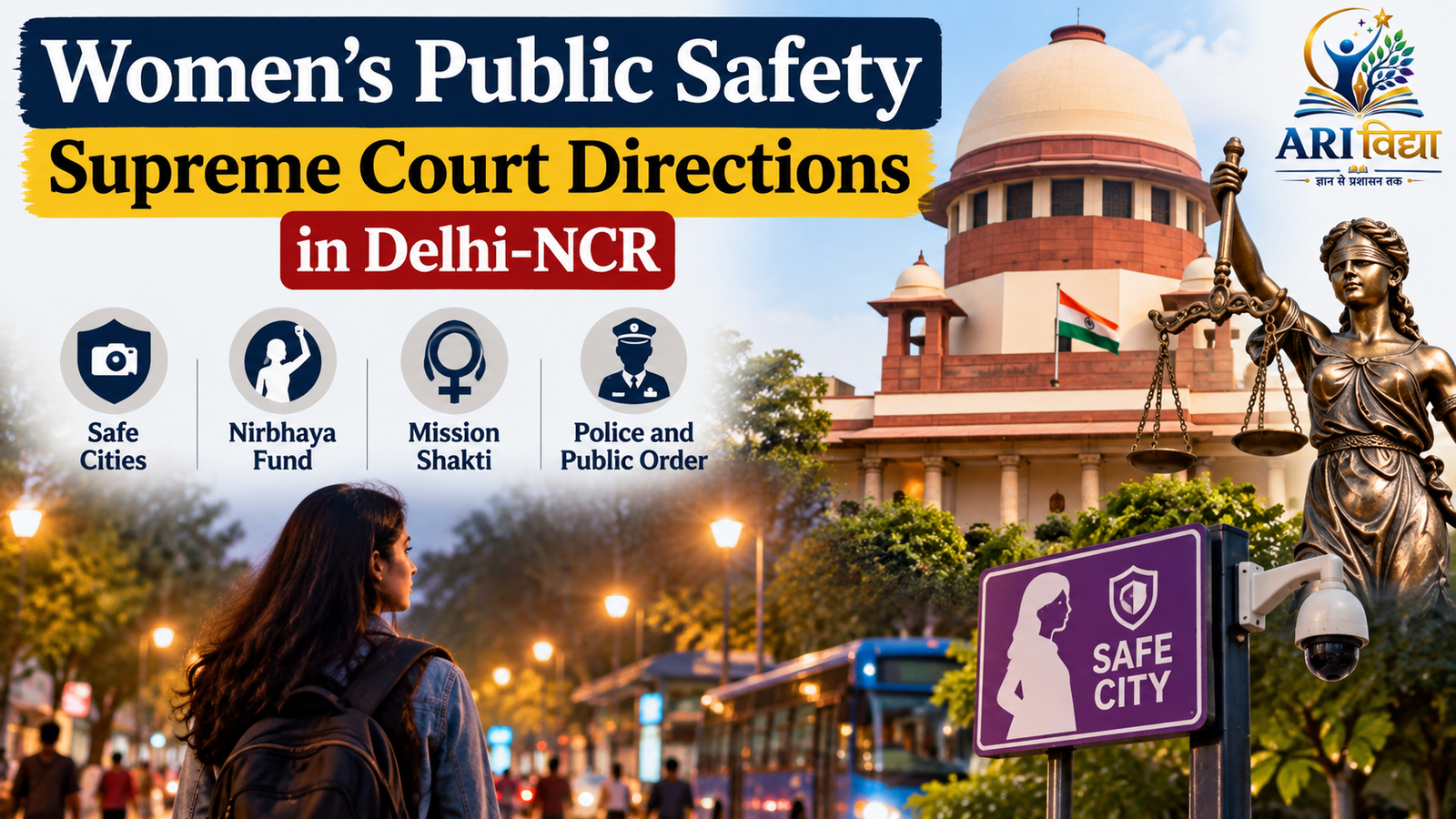
Women’s Public Safety: Why Is It in the News?
Following recent incidents of sexual violence against women and minors in Delhi-NCR, the Supreme Court of India took suo motu cognizance on 28 September 2026 in “In Re: Recent Rape Incidents in Delhi NCR”. The Court directed a comprehensive review of policing, lighting, CCTV, identification of vulnerable areas and the functionality of safety mechanisms to make public spaces safer. [1]
Thank you for reading this post, don't forget to subscribe!
1. Key Directions of the Supreme Court
The Court’s approach was not limited to punitive action after an incident. It also emphasized crime prevention, risk identification, public infrastructure and administrative accountability. Key directions include:
- Constitution of dedicated teams in each police district to survey vulnerable locations.
- Identification of parks, deserted routes, transport hubs, markets and areas around educational institutions.
- Preparation of district-wise vulnerability maps and sharing them among concerned police stations.
- Audit of lighting and CCTV in public parks and vulnerable areas.
- Security review of metro stations, bus stops, bus terminals, railway stations and other public transport locations.
- Enhanced patrolling at identified vulnerable locations, particularly during evening and early morning hours.
- A detailed status report on the actual functioning of available women’s safety mechanisms.
- Information on pendency, disposal and duration of trials in Fast Track Special Courts and Exclusive POCSO Courts.
The Court also sought information on the functioning of mechanisms such as the National Sexual Offenders Database, Sexual Offences Investigation Tracking System, Mission Shakti, emergency response system 112, Women Helpline 181, Safe City Project, Women Help Desks and One Stop Centres. [3]
2. Constitutional Basis
Article 21: Life, Dignity and Personal Liberty
The most important constitutional basis of the issue is Article 21. The Supreme Court linked the right to live with dignity and free from the fear of violence with the constitutional guarantee of life and personal liberty. [1][4]
Its broader meaning is that for a woman, access to roads, parks, markets, public transport and other public spaces is not merely physical access. If a location presents persistent and serious safety risks, her actual freedom, mobility and opportunities can be affected.
Articles 14 and 15
Article 14 provides the constitutional basis of equality. Article 15(1) prohibits discrimination on the ground of sex, while Article 15(3) permits the State to make special provisions for women and children. [5]
Therefore, targeted schemes and special institutional arrangements for women’s safety can be understood as constitutional efforts towards substantive equality.
Responsibility of the State
Women’s safety must also be linked with the broader responsibilities of governance. Public-space safety involves the police, urban local bodies, transport institutions, the judicial system and social welfare institutions. For UPSC, it can be presented as an integrated issue of constitutional rights + good governance + social justice.
3. Major Legal Framework
India has several legal mechanisms for the protection of women and children. Under the current criminal law framework, the Bharatiya Nyaya Sanhita, 2023 incorporates offences against women and children in a separate chapter and came into force on 1 July 2024. [6]
For children, the Protection of Children from Sexual Offences Act, 2012 (POCSO) provides a specialised legal framework. It covers different categories of sexual offences, mandatory reporting, child-friendly procedures and special courts. [7]
For UPSC, merely remembering the names of laws is not sufficient. The entire chain of law → police investigation → forensics → prosecution → courts → victim support should be understood as an integrated justice process.
4. Role of Police and Administration
In India, Police and Public Order are subjects in the State List. Therefore, State Governments and Union Territories have the primary responsibility for crime prevention and maintenance of law and order. The Union Government can support them through schemes, financial assistance, capacity building and coordination. [8]
Modern women’s safety policy cannot rely only on increasing police strength. Data-based patrolling, identification of crime-prone areas, Women Help Desks, emergency response, speedy grievance redressal and coordination between police and civil administration are also important.
5. Safe City Approach
According to the Ministry of Home Affairs, the Safe City Project aims to address critical safety gaps and create a safer environment for women in metropolitan cities. Its framework includes civic facilities in public spaces, easier access to law enforcement, technology-based surveillance in hotspots, tracking of offenders and community sensitisation. [9]
In the Delhi-NCR matter, the Supreme Court’s emphasis on lighting, CCTV, vulnerability mapping and patrolling is connected with this broader preventive urban safety approach.
6. Nirbhaya Fund and Mission Shakti
The Nirbhaya Fund was created after 2012 to provide financial support for projects related to women’s safety. It is a non-lapsable corpus. The Ministry of Women and Child Development has a nodal role in the appraisal and recommendation of proposals, while administration of the fund is associated with the Department of Economic Affairs. [10]
Mission Shakti is an important framework for government interventions relating to women’s safety, protection and empowerment. Its Sambal component includes safety and support mechanisms such as One Stop Centres. [8][11]
One Stop Centres
The One Stop Centre scheme was launched in 2015. Its objective is to connect women affected by violence with medical assistance, police assistance, legal aid, psychosocial counselling and temporary shelter at a single location. [11]
7. Technology: Along with Solutions, Accountability Too
CCTV, smart lighting, emergency response systems, crime data and digital complaint systems can strengthen safety. However, technology is not a substitute for policing. Installing a camera and ensuring that it is functional, monitored and useful for investigation are different things.
The expansion of technology-based surveillance also raises questions of privacy, data protection, proportionality and accountability. Therefore, for UPSC it can be linked with security versus privacy and technology-enabled governance.
8. Judicial System and Pendency
An important dimension of women’s safety is the criminal justice system. Delays in investigation, weaknesses in prosecution or a high number of pending cases in courts can weaken the expected deterrent effect of law. For this reason, the Supreme Court sought information on the functioning, pendency and disposal of cases in Fast Track Special Courts and Exclusive POCSO Courts in Delhi. [3]
The key governance principle for UPSC is: making a law and ensuring its effective implementation are two different stages.
9. Urban Planning and Women’s Safety
Women’s safety cannot be viewed separately from urban planning. Poor lighting, deserted routes, unsafe access to public transport and inadequate surveillance can increase risks. Therefore, safer cities require proper street lighting, safe public transport, secure pedestrian routes, regular safety audits, citizen grievance mechanisms and coordination between urban local bodies and police.
This can be connected with the broader idea of gender-responsive urban planning.
10. Major Challenges
- Gap between laws and schemes and their effective implementation.
- Limited coordination among police, urban local bodies and transport agencies.
- Maintenance problems related to CCTV and lighting infrastructure.
- Need for updated data on crime-prone areas and its shared use.
- Delays in investigation and judicial processes.
- Access to medical, legal and psychosocial support for victims.
- Balancing privacy and data security with technology-based surveillance.
11. Way Forward
- Preventive policing: Identify vulnerable locations before incidents rather than relying only on post-incident response.
- Measurable accountability: Assign responsible officials and timelines for each safety mechanism.
- Integrated data: Coordinate the use of police, urban local body, transport and citizen grievance data.
- Functional infrastructure: Ensure regular operation and maintenance rather than merely installing equipment.
- Timely justice: Strengthen the capacity of special courts, investigation and prosecution.
- Victim-centric system: Integrate medical, legal and psychosocial support.
- Community participation: Involve citizens in identifying and improving safe public spaces.
- Privacy safeguards: Establish clear data protection and accountability mechanisms alongside surveillance technology.
12. Important Facts for UPSC Preliminary Examination
- Article 21 — Life and personal liberty.
- Article 15(3) — Special provisions for women and children.
- Police and Public Order — Subjects in the State List.
- Bharatiya Nyaya Sanhita, 2023 — Came into force on 1 July 2024.
- POCSO Act, 2012 — Special legal framework for sexual offences against children.
- Nirbhaya Fund — Non-lapsable corpus for projects related to women’s safety.
- One Stop Centres — Integrated support for women affected by violence.
- Safe City Project — Combines technology, civic facilities and policing for urban women’s safety.
13. How to Use This in UPSC Mains?
This topic can be linked with Governance, Constitution and Social Justice under GS-II and Indian Society under GS-I. Instead of merely describing crimes, build a complete chain: Article 21 → State responsibility → preventive policing → urban infrastructure → technology → criminal justice → victim support → accountability.
Possible Mains Question
“Women’s public safety is not merely a law-and-order issue but a combined question of constitutional rights, urban governance and judicial accountability.” Discuss in the context of recent developments in Delhi-NCR. (250 words, 15 marks)
Conclusion
An effective solution to women’s public safety cannot depend only on harsher punishment. Safe public infrastructure, accountable policing, effective investigation, timely justice, victim support, responsible use of technology and institutional accountability must work together. The Supreme Court’s current proceedings concerning Delhi-NCR bring into focus the broader question of how citizens can experience safe and dignified lives in public spaces.
UPSC Takeaway: Do not restrict this topic merely to “crimes against women”. Prepare it as an integrated issue covering Article 21 + gender justice + good governance + police reforms + urban planning + technology + criminal justice system.
Sources
1. Supreme Court of India, In Re: Recent Rape Incidents in Delhi NCR, 28 September 2026.
2. ARIvidya study material — Women’s Safety, GS-II.
3. Judicial details relating to the Supreme Court proceedings of 28 September 2026.
4. Constitution of India — Article 21.
5. Constitution of India — Article 15.
6. Bharatiya Nyaya Sanhita, 2023.
7. Protection of Children from Sexual Offences Act, 2012.
8. Government of India — Official material relating to women’s and children’s safety.
9. Ministry of Home Affairs — Safe City Project.
10. Ministry of Women and Child Development — Nirbhaya Fund.
11. Ministry of Women and Child Development — One Stop Centres and Mission Shakti.