

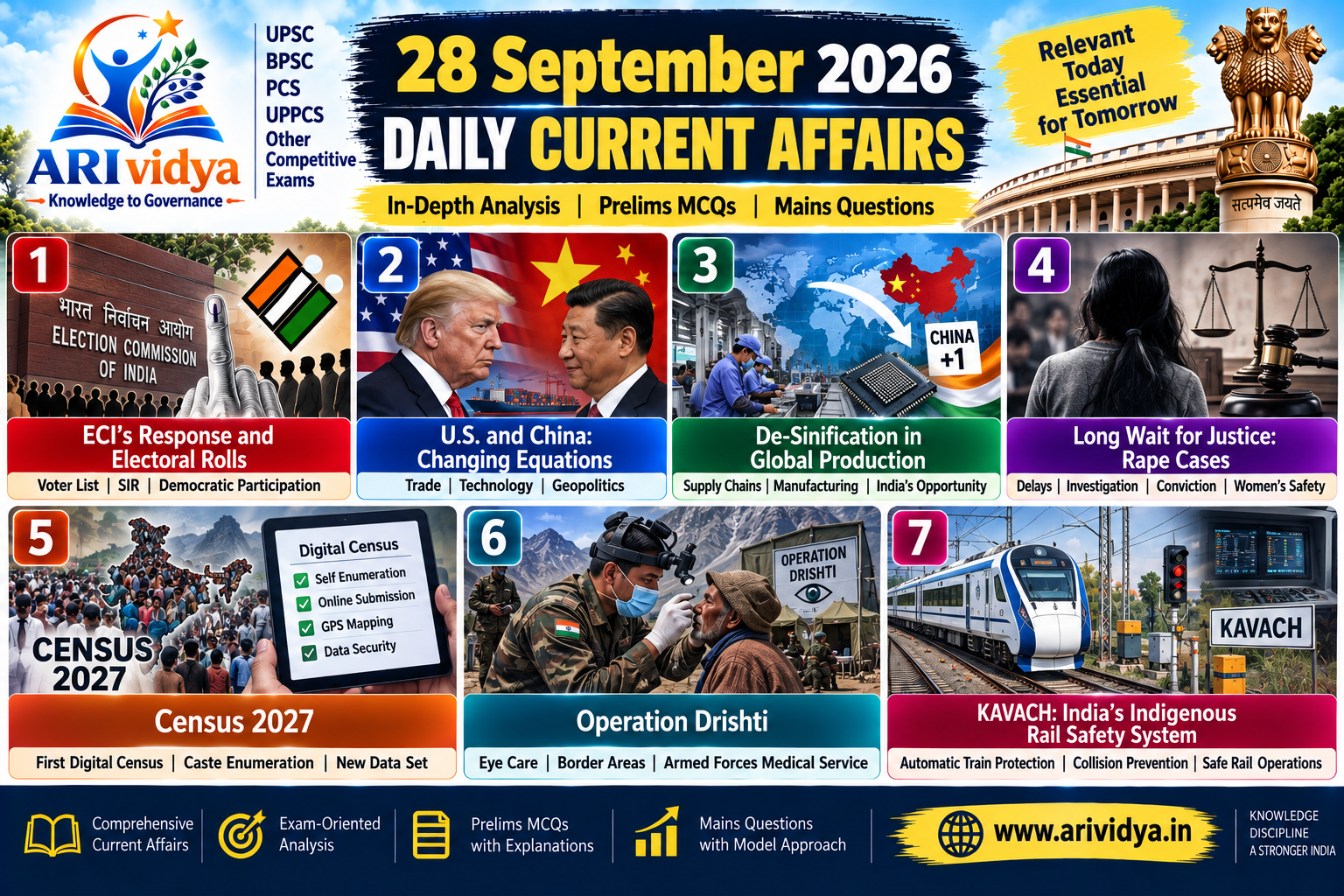
28 September 2026 Current Affairs
7 Important Issues for UPSC & PCS
Thank you for reading this post, don't forget to subscribe!
Prelims MCQs • Mains Analysis • Quick Revision
1. Election Commission and Special Intensive Revision of Electoral Rolls
What is the issue?
The source material places the Election Commission’s role and the Special Intensive Revision (SIR) of electoral rolls among the important polity issues for the day. The discussion focuses on electoral-roll revision, verification, deletion and re-enrolment, and the institutional responsibilities involved in maintaining accurate voter lists.
Prelims MCQ
The constitutional basis for the Election Commission of India is primarily provided under:
(a) Article 280
(b) Article 324
(c) Article 356
(d) Article 368
2. U.S.–China Relations and the Emerging New Equilibrium
What happened?
The source analyses the evolving relationship between the United States and China and its wider implications for the global balance of power. It refers to the Chinese President’s visit to Washington and notes that issues such as semiconductors, rare earths and U.S. arms sales to Taiwan remain strategically important.
Prelims MCQ
Which of the following issues are strategically important in U.S.–China relations?
(a) Semiconductors
(b) Rare earths
(c) Taiwan
(d) All of the above
3. De-Sinification of Global Production
What is changing?
Global production networks are increasingly being reorganised to reduce excessive dependence on China. The source highlights that this is not simply about moving factories; companies also have to identify, replace and verify suppliers embedded deep within complex production ecosystems.
The material refers to reported efforts by SpaceX to remove Chinese-made components from its supply chain and to Japanese company TDK expanding battery production in Haryana as part of a broader China-plus-one strategy.
Prelims MCQ
What is the basic idea behind the “China-plus-one” strategy?
(a) Ending all trade with China
(b) Diversifying production and supply chains across more than one country
(c) Increasing only domestic consumption
(d) Shifting all investment to the services sector
4. Delayed Justice in Rape Cases
What is the concern?
The source examines delays in investigation, filing of charge sheets, trials and final decisions in rape cases. It uses an analysis of National Crime Records Bureau data to highlight the continuing pendency of cases and the limited number of convictions completed within the same year.
Prelims MCQ
Which of the following can contribute to faster disposal of criminal cases?
(a) Strengthening investigation capacity
(b) Adequate judicial manpower
(c) Effective monitoring of time-bound trials
(d) All of the above
5. Census 2027: Digital Census and Caste Enumeration
What is important?
The source describes Census 2027 as a major national exercise with extensive public participation. It will make significant use of digital tools and provide households with a self-enumeration facility.
The source also states that the exercise will include the first nationwide caste enumeration since 1931, beyond the existing enumeration of Scheduled Castes and Scheduled Tribes, and that the data will have significance for future delimitation after the constitutional freeze is lifted.
Prelims MCQ
Which statement about Census 2027 is correct according to the source?
(a) It will use only paper-based enumeration
(b) It provides a digital self-enumeration facility
(c) It will cover only urban households
(d) It introduces no new household data points
6. Operation Drishti: Military Medical Outreach in Border Areas
What happened?
Under Operation Drishti, Armed Forces Medical Services surgeons performed 220 sight-restoring surgeries at an underground surgical centre in Tangdhar, Kupwara, along the Line of Control.
Prelims MCQ
Operation Drishti, as described in the source, is associated with:
(a) A military training exercise
(b) Ophthalmic medical outreach in border areas
(c) Railway safety
(d) Maritime security
7. KAVACH: India’s Automatic Train Protection System
What is KAVACH?
KAVACH is India’s indigenous advanced Automatic Train Protection system, developed by the Research Design and Standards Organisation in collaboration with Indian industry. Its purpose is to reduce train-collision risks and automatically activate braking in critical situations.
Prelims MCQ
What is the primary purpose of KAVACH?
(a) Fixing railway ticket prices
(b) Providing automatic train protection and collision-avoidance support
(c) Electrifying railway stations
(d) Reducing freight tariffs
UPSC/PCS Quick Revision
- Polity: Election Commission and electoral rolls
- International Relations: U.S.–China relations and implications for India
- Economy: Diversification of global manufacturing supply chains
- Social Justice: Timely justice in sexual-offence cases
- Governance: Census 2027 and digital self-enumeration
- Security & Health: Operation Drishti
- Science & Technology: KAVACH automatic train protection
ARIvidya — Knowledge to Governance