
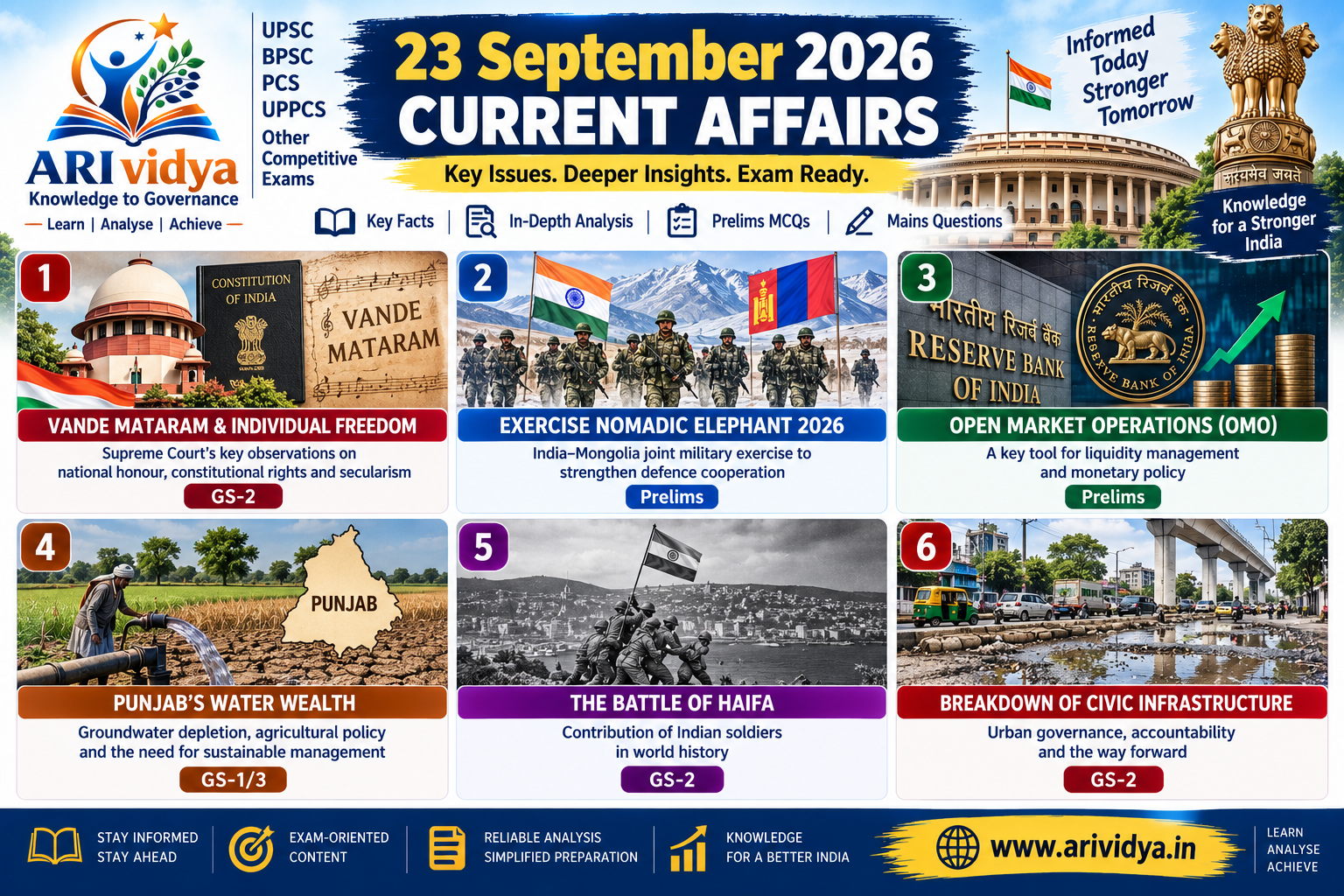
23 September 2026 Current Affairs
UPSC & PCS | Key Facts • Analysis • Prelims MCQs • Mains Questions
Thank you for reading this post, don't forget to subscribe!
1. Vande Mataram and Individual Freedom: Supreme Court’s Observations
What happened?
The Supreme Court considered the legal issue of whether a person can face penal consequences for consciously choosing not to sing the National Song, particularly when the objection is based on conscience or religious belief. The Court referred to the principle recognised in the 1986 Bijoe Emmanuel judgment and indicated that government regulation cannot disregard constitutional freedoms.
Background and key facts
- Vande Mataram was composed by Bankim Chandra Chattopadhyay in Sanskritised Bengali.
- It was first published in Bangadarshan in 1875 and later included in Anandamath (1882).
- Rabindranath Tagore set it to music, and the first two stanzas were adopted as the National Song by the Congress Working Committee in 1937.
- On 24 January 1950, Rajendra Prasad affirmed its equal honour alongside Jana Gana Mana.
- The Constitution does not expressly create a separate constitutional status for the National Song, while Article 51A(a) asks citizens to respect the Constitution, the National Flag and the National Anthem.
- The Supreme Court’s discussion also highlights the balance between public symbols, national honour and individual freedom of conscience.
Options: A. 1 and 2 only B. 2 and 3 only C. 1 and 3 only D. 1, 2 and 3
Answer: A
Explanation: Statements 1 and 2 are correct. Article 51A(a) refers to the National Anthem, not the National Song.
Mains Question — GS II: “National symbols strengthen civic identity, but their regulation must remain consistent with constitutional freedoms.” Discuss in the context of individual conscience and freedom of religion. (150 words)
2. Exercise Nomadic Elephant 2026: India–Mongolia Defence Cooperation
What happened?
The 18th edition of the India–Mongolia Joint Military Exercise Nomadic Elephant commenced at the Foreign Training Node in Pithoragarh, Uttarakhand. The exercise is conducted annually and alternates between India and Mongolia.
Key facts
- 18th edition: 2026.
- Venue: Pithoragarh, Uttarakhand.
- Participating countries: India and Mongolia.
- The previous edition was held in Ulaanbaatar in 2025.
- The exercise focuses on strengthening interoperability, joint training and military cooperation, including operations in challenging terrain.
- The 2026 exercise is scheduled from 21 September to 3 October, with personnel from both sides participating.
Options: A. Kazakhstan B. Mongolia C. Uzbekistan D. Kyrgyzstan
Answer: B. Mongolia
Explanation: Nomadic Elephant is an annual bilateral military exercise between India and Mongolia.
Mains Question — GS II: Examine the significance of India–Mongolia defence cooperation for India’s wider engagement with Central and Inner Asia. (150 words)
3. RBI Open Market Operations: Managing Durable Liquidity
What happened?
The Reserve Bank of India conducted an Open Market Operation (OMO) sale auction involving Government of India securities to absorb durable surplus rupee liquidity from the financial system.
Concept and significance
- OMO refers to the RBI’s purchase or sale of government securities in the open market.
- When the RBI buys government securities, it injects liquidity into the banking system; when it sells them, liquidity is absorbed.
- OMO is a quantitative monetary-policy instrument used to manage system liquidity and influence monetary conditions.
- The source material notes a ₹25,000 crore OMO sale auction aimed at draining durable surplus liquidity.
- Operation Twist involves simultaneous purchase of longer-maturity government securities and sale of shorter-maturity securities to influence the maturity structure of yields.
- Treasury Bills have maturities of less than one year, while dated government securities generally have maturities exceeding one year.
Options: A. 1 only B. 1 and 2 only C. 2 and 3 only D. 1, 2 and 3
Answer: B
Explanation: Statements 1 and 2 are correct. OMO is a quantitative monetary-policy instrument.
Mains Question — GS III: Explain how Open Market Operations help the RBI manage liquidity and monetary conditions. Distinguish OMO from Operation Twist. (150 words)
4. Punjab’s Groundwater Crisis: Agriculture, Incentives and Sustainability
What happened?
The latest groundwater assessment highlights the severity of groundwater stress in Punjab. The state’s groundwater extraction rate is reported at about 152%, with a large majority of its assessment blocks falling in the red or over-exploited category.
Why is the crisis deepening?
- The rice–wheat production system has developed around assured procurement, subsidised electricity, groundwater access, high-yielding varieties and intensive irrigation.
- The system has supported food security but has also created strong incentives for water-intensive cultivation.
- Farmers may hesitate to diversify because of uncertainty relating to procurement, prices, processing facilities, storage and supply chains.
- Rice and wheat cultivation together account for roughly 25 billion cubic metres of irrigation water use annually in the source material.
- Groundwater depletion can also have distributional consequences: farmers with greater financial resources can access deeper wells, while smaller farmers may become dependent on purchased water.
Options: A. Assured procurement and subsidised electricity only B. Groundwater access and high-yielding varieties only C. Procurement, electricity, groundwater access and market structures together D. Rain-fed farming and low irrigation demand
Answer: C
Explanation: The crisis is linked to a wider policy and production system rather than a single factor.
Mains Question — GS III: “Unsustainable groundwater extraction in Indian agriculture is as much a consequence of distorted cropping patterns and policy incentives as it is of water scarcity.” Discuss with reference to Punjab. (250 words)
5. Battle of Haifa: India’s Military History in West Asia
Why in news?
23 September marks the anniversary of the 1918 Battle of Haifa, an episode that connects India’s military history with the wider history of West Asia during the First World War.
Historical significance
- More than a million Indian soldiers served overseas during the First World War, with more than 74,000 Indian personnel reported killed.
- Indian cavalry played a major role in the capture of Haifa in 1918.
- The Teen Murti Haifa Chowk in New Delhi commemorates the Indian soldiers associated with the battle.
- The battle is remembered in Israel as a symbol of the contribution of Indian soldiers.
- At the same time, the historical interpretation needs context: Indian soldiers were serving under British colonial command, and the political consequences of the campaign were connected with the wider imperial order in West Asia.
Options: A. First World War B. Second World War C. First Anglo-Afghan War D. Crimean War
Answer: A. First World War
Explanation: The battle took place in 1918 during the First World War.
Mains Question — GS I: Examine the role of Indian soldiers in overseas theatres during the First World War and explain how the Battle of Haifa forms part of this history. (150 words)
6. Breakdown of Civic Infrastructure: A Governance Challenge
Issue in focus
Deaths and accidents linked to unsafe buildings and failing civic infrastructure raise questions beyond individual negligence. The source material frames such incidents as indicators of weaknesses in urban planning, enforcement, monitoring and public accountability.
Governance dimensions
- Weak enforcement of building and safety standards can turn preventable risks into public tragedies.
- Urban expansion without adequate planning can put pressure on drainage, roads, utilities and public spaces.
- Regular inspection and transparent compliance records can improve accountability.
- Public access to information such as safety certificates and violation records can help citizens make informed choices.
- Effective urban governance requires coordination between local bodies, regulators, engineers, emergency services and citizens.
Options: A. Weak enforcement B. Transparent compliance and regular safety inspections C. Unplanned expansion D. Delayed monitoring
Answer: B
Explanation: Transparent compliance systems and regular inspections improve preventive governance and accountability.
Mains Question — GS II: Civic infrastructure failures are often symptoms of governance deficits rather than isolated accidents. Discuss with suitable examples. (150 words)
ARIvidya Exam Takeaway
For Prelims, remember the factual anchors: Vande Mataram, Nomadic Elephant, OMO, Punjab groundwater, Battle of Haifa and key governance concepts. For Mains, connect each issue with constitutional values, international relations, monetary policy, sustainable agriculture, modern history and urban governance.
ARIvidya — Knowledge to Governance