

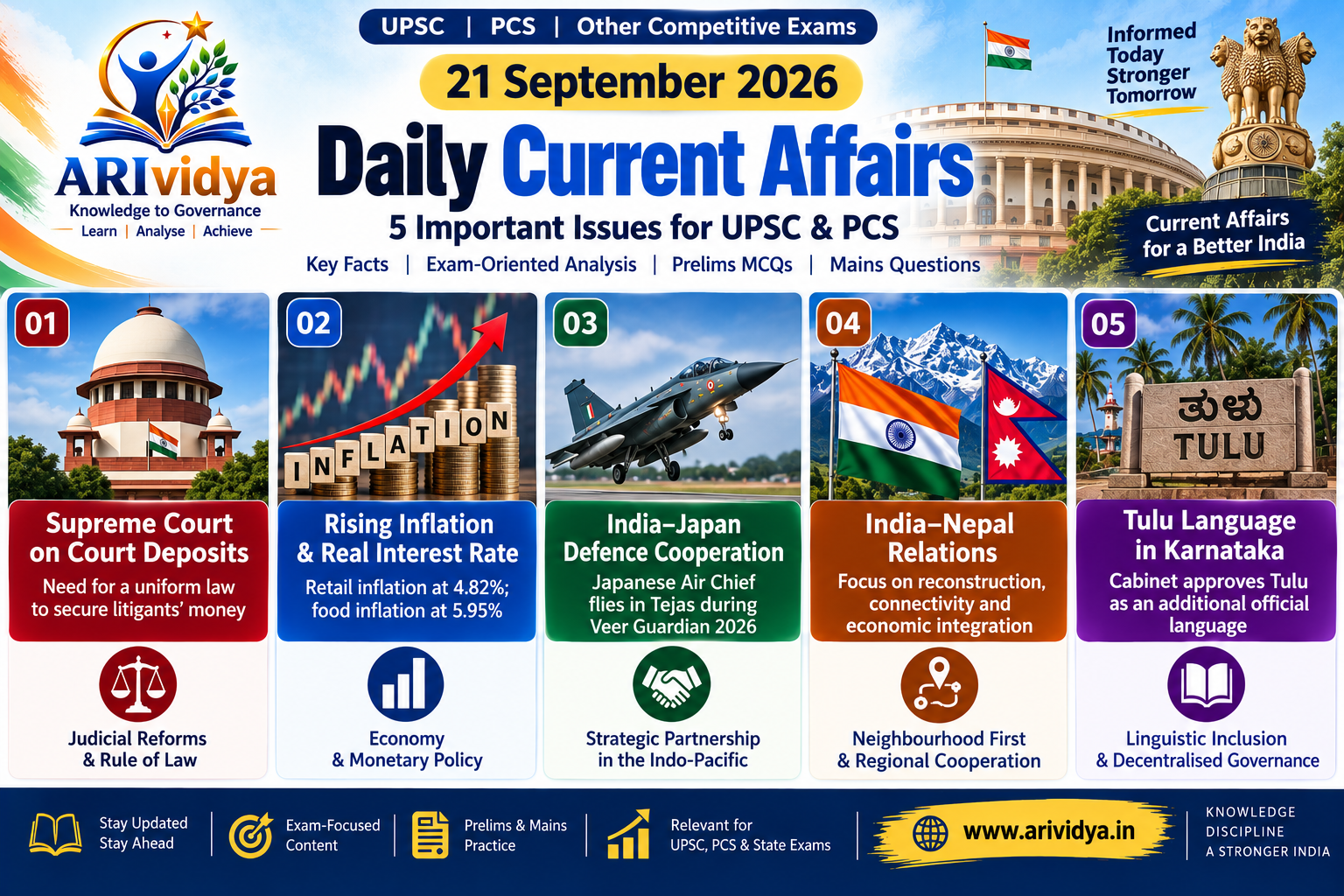
21 September 2026 Current Affairs
5 Important Issues for UPSC & PCS
Thank you for reading this post, don't forget to subscribe!
Facts • Analysis • Prelims Practice • Mains Perspective
1. Supreme Court Seeks Study on Management of Litigants’ Money
What happened?
The Supreme Court has highlighted the need for a uniform national framework for the investment and management of money deposited by litigants in courts and tribunals. The Court asked the Law Commission of India to examine the issue and study the existing practices.
Key Facts
- There is currently no uniform national framework governing the investment and management of litigants’ money deposited with courts and tribunals.
- The issue concerns the administration, investment and handling of funds that remain deposited during judicial proceedings.
- The Law Commission has been asked to study the matter.
Why is it important for UPSC/PCS?
The issue connects judicial administration, financial governance, institutional accountability and the need for uniform standards across the country.
Which institution has been asked by the Supreme Court to study the issue of management of litigants’ money deposited in courts and tribunals?
(A) Finance Commission
(B) Law Commission of India
(C) Election Commission of India
(D) Reserve Bank of India
Discuss the need for uniform standards for the management of litigants’ money deposited with courts and tribunals. What issues of accountability and financial governance arise?
2. Inflation and the Real Interest Rate
What happened?
India’s retail inflation increased to 4.82% in August 2026, while food inflation stood at 5.95%. The inflation data is relevant for monetary policy, household purchasing power and the real return on financial savings.
Key Facts
- Retail inflation: 4.82% in August 2026.
- Food inflation: 5.95%.
- Repo rate: 5.25%.
- Loan growth: 19.1%; deposit growth: 17.8%.
- Loan-deposit ratio: about 80.3%.
Concept for Prelims
The real interest rate broadly reflects the nominal interest rate after accounting for inflation. Persistent inflation can reduce the purchasing power of fixed nominal returns.
Consider the following statements about the real interest rate:
1. It takes inflation into account.
2. Higher inflation, with the nominal interest rate unchanged, generally lowers the real return.
Which of the statements given above is/are correct?
(A) 1 only
(B) 2 only
(C) Both 1 and 2
(D) Neither 1 nor 2
Explain how inflation affects household purchasing power, savings and monetary policy transmission in India.
3. India–Japan Defence Cooperation: Veer Guardian 2026
What happened?
During the Veer Guardian 2026 exercise at Jodhpur, Japan Air Self-Defense Force Chief General Takehiro Morita flew in an Indian Air Force Tejas aircraft with the IAF Chief. The exercise is being conducted from September 9 to 22, 2026.
Key Facts
- India is participating with Tejas, Su-30MKI and Rafale aircraft.
- Japan is participating with F-2A fighter aircraft.
- This is the first time Japanese fighter aircraft have operated from Indian soil in this exercise context.
- The exercise reflects growing operational cooperation between the two air forces.
Why is it important?
India–Japan defence cooperation is part of the broader strategic relationship between the two countries and is relevant to India’s Indo-Pacific engagement, defence interoperability and regional security architecture.
Veer Guardian 2026 is associated with defence cooperation between:
(A) India and France
(B) India and Japan
(C) India and Australia
(D) India and South Korea
Examine the significance of India–Japan defence cooperation for India’s role in the Indo-Pacific.
4. India–Nepal Relations: Connectivity and Economic Integration
What happened?
India and Nepal are focusing on post-flood reconstruction and strengthening connectivity, trade, energy cooperation and supply-chain integration. The broader relationship includes road and rail connectivity, cross-border movement, investment and people-to-people ties.
Key Areas of Cooperation
- Post-flood reconstruction and recovery.
- Road and rail connectivity.
- Cross-border trade and investment.
- Air connectivity and movement of people.
- Energy cooperation and supply-chain integration.
UPSC Perspective
India–Nepal relations are important in the context of neighbourhood-first diplomacy, Himalayan geography, connectivity, energy security, border management and people-to-people relations.
Which of the following areas are relevant to contemporary India–Nepal cooperation?
1. Connectivity
2. Trade and investment
3. Energy cooperation
4. People-to-people relations
(A) 1 and 2 only
(B) 2 and 3 only
(C) 1, 3 and 4 only
(D) 1, 2, 3 and 4
Discuss the importance of connectivity, energy and economic integration in strengthening India–Nepal relations.
5. Tulu Gets Additional Official Administrative Language Status in Karnataka
What happened?
The Karnataka Cabinet decided to grant Tulu the status of an additional official administrative language in the areas where it is widely spoken. The move covers Dakshina Kannada, southern Udupi and the relevant area of Kasaragod mentioned in the report.
Key Facts
- Tulu is widely spoken in the coastal Karnataka region.
- Local body meetings and government circulars/orders can contain Tulu under the decision.
- People can submit applications in Tulu in the relevant administrative context.
- Article 345 of the Constitution deals with the official language or languages adopted by a State.
Why is it important for UPSC/PCS?
The issue links language policy, cultural diversity, cooperative federalism, local administration and constitutional provisions relating to official languages.
Article 345 of the Constitution of India primarily deals with:
(A) Official language or languages adopted by a State
(B) Language of the Supreme Court
(C) Language of international treaties
(D) Language of Union Public Service Commission examinations
Discuss how language recognition can contribute to cultural inclusion and effective local administration in a linguistically diverse country like India.