

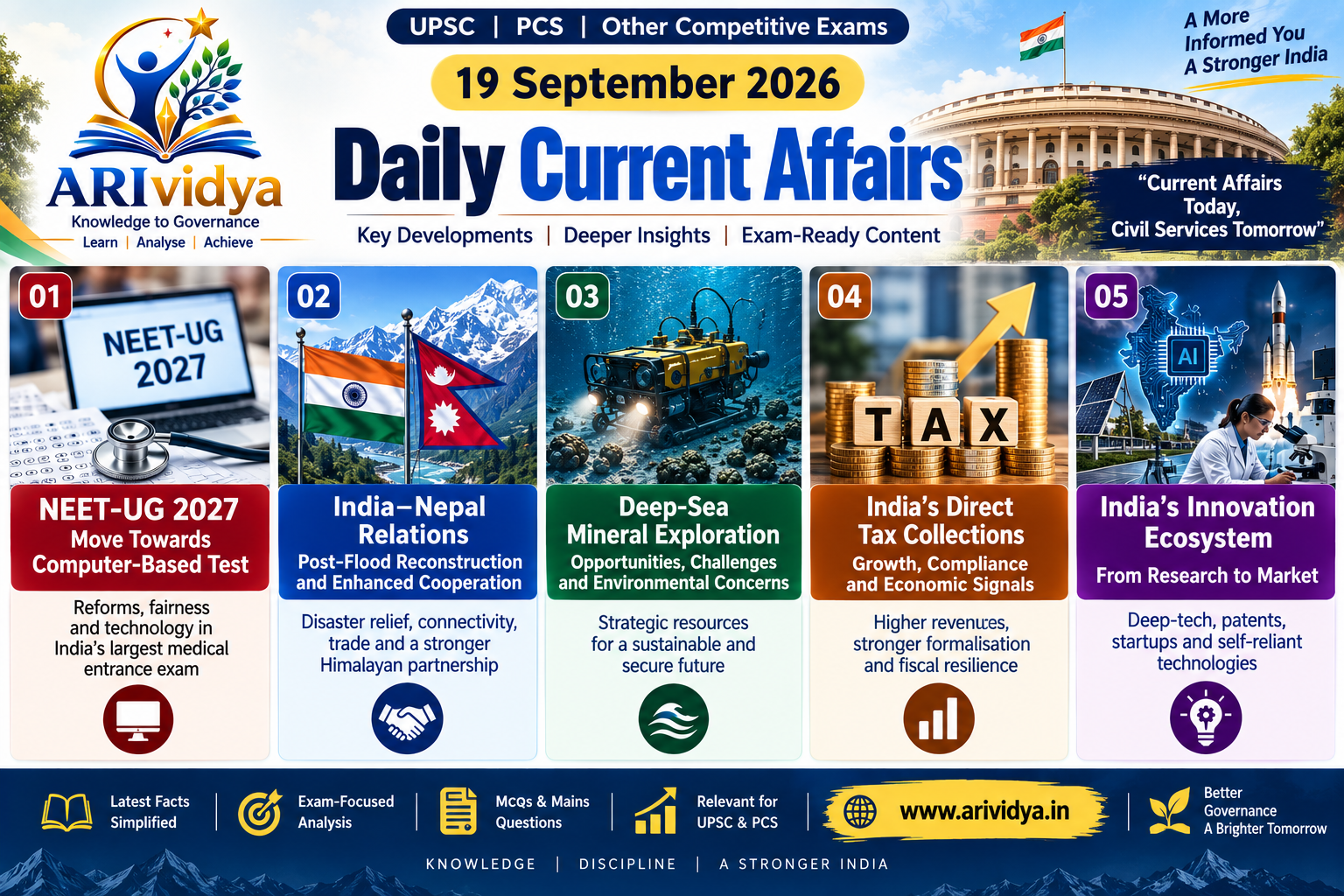
ARIvidya Daily Current Affairs
19 September 2026
Thank you for reading this post, don't forget to subscribe!
Five selected issues for UPSC & PCS preparation
NEET-UG 2027: Computer-Based Examination Under Consideration
What happened?
The Union government told the Supreme Court that shifting NEET-UG 2027 from the existing pen-and-paper format to a computer-based examination remains under active consideration. A high-powered task force chaired by Nandan Nilekani is also examining examination reforms.
Prelims MCQ
Which statement is correct about NEET-UG 2027?
A. It is conducted only by State governments.
B. The Union government is considering a computer-based mode.
C. It is only for postgraduate medical admission.
D. It is conducted by the Reserve Bank of India.
Answer: B
Mains Practice
“Digitisation can improve transparency in large-scale competitive examinations, but it also creates new administrative challenges.” Discuss.
Word limit: 150 words | GS: II
India–Nepal Relations: Post-Flood Recovery and Connectivity
What happened?
India and Nepal discussed post-flood reconstruction support, stronger economic ties and connectivity. Discussions covered roads, railways, trade, investment and people-to-people links.
Prelims MCQ
Which areas are important in India–Nepal relations?
1. Water resources 2. Energy 3. Cross-border connectivity 4. Trade and transit
A. 1 and 2 only
B. 2 and 3 only
C. 1, 2 and 3 only
D. 1, 2, 3 and 4
Answer: D
Mains Practice
“Water resources, disaster management and connectivity infrastructure are interlinked dimensions of India–Nepal relations.” Analyse.
Word limit: 150 words | GS: II
Deep-Sea Mineral Exploration and the Environmental Dilemma
What happened?
India is advancing exploration of deep-sea mineral resources in the international seabed area of the Indian Ocean. India has three exploration contracts covering about 95,000 sq km under the International Seabed Authority framework.
Prelims MCQ
Which minerals may occur in polymetallic nodules?
1. Nickel 2. Copper 3. Cobalt 4. Manganese
Answer: 1, 2, 3 and 4
Mains Practice
“Deep-sea minerals can support India’s strategic requirements, but their exploitation must follow strong ecological safeguards.” Discuss.
Word limit: 250 words | GS: III
Rise in Direct Tax Collections
What happened?
According to the Central Board of Direct Taxes, net direct tax collections crossed ₹12.12 lakh crore up to September 17, 2026. Advance tax collection was around ₹5.22 lakh crore, while gross direct tax collections exceeded ₹14.32 lakh crore.
Prelims MCQ
Which statement is correct about a direct tax?
A. Its entire burden falls on consumers.
B. It is generally levied on income or profits.
C. It is collected only by State governments.
D. GST is a direct tax.
Answer: B
Mains Practice
“Rising direct tax collections may indicate better compliance and formalisation, but they cannot alone measure economic development.” Examine.
Word limit: 150 words | GS: III
India’s Indigenous Innovation Ecosystem: From Research to Market
What happened?
India is seeing stronger collaboration among public research institutions, private R&D and deep-tech enterprises. Members of the India Deep Tech Alliance invested ₹2,170 crore in 56 deep-tech firms over the last year.
Prelims MCQ
Which areas are important to India’s indigenous innovation ecosystem?
1. Deep technology 2. 6G communications 3. Space technology 4. Biomedical innovation
Answer: 1, 2, 3 and 4
Mains Practice
“India must move beyond increasing patent applications and strengthen technology commercialisation and technology transfer.” Comment.
Word limit: 250 words | GS: III
Prepared from the UPSC and PCS examination perspective.