

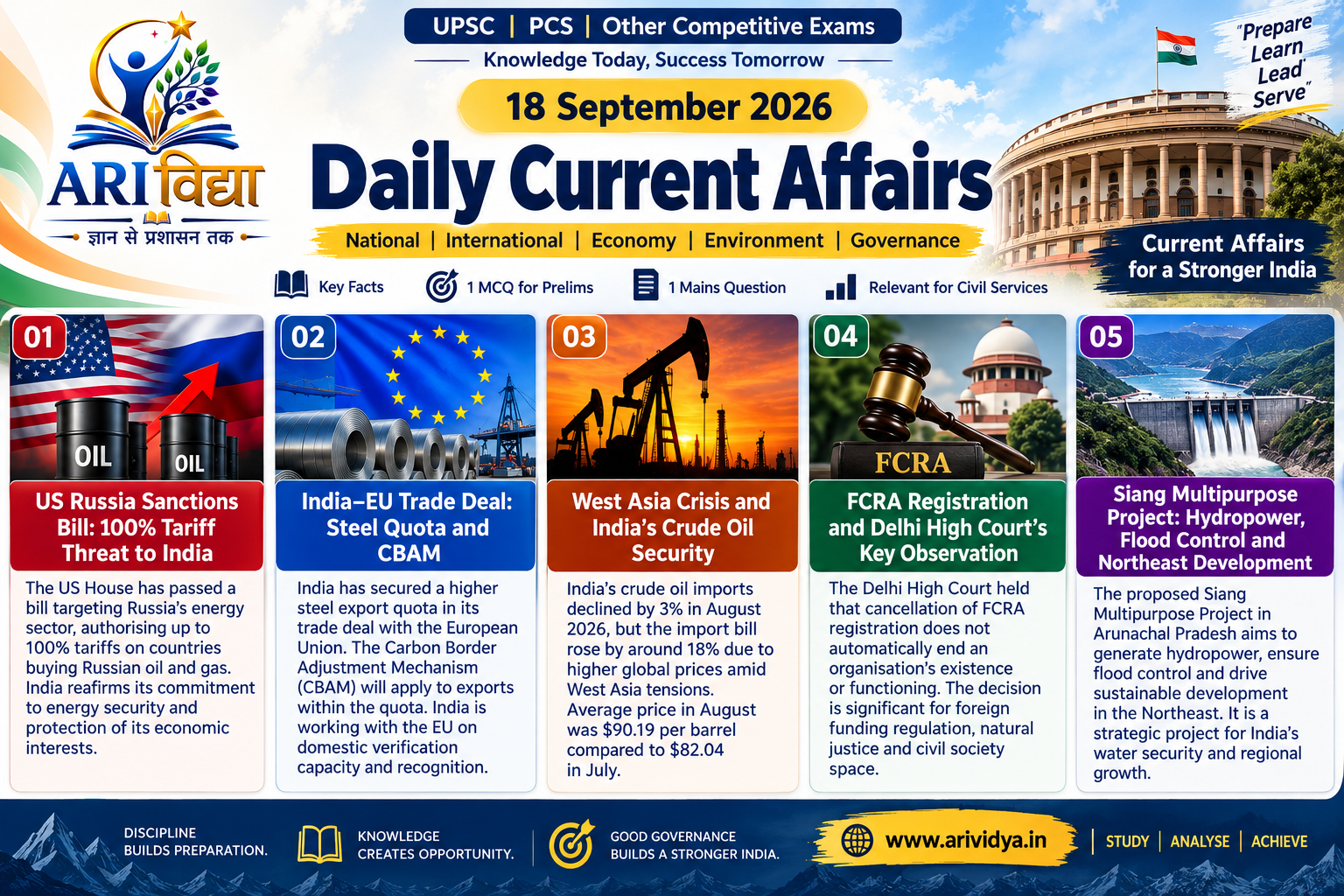
18 September 2026 Current Affairs
Five selected issues for UPSC & PCS preparation
Thank you for reading this post, don't forget to subscribe!
Prelims facts, MCQs and Mains practice in one revision sheet
18 September 2026 • Friday
U.S. Russia-related sanctions bill and a potential tariff of up to 100% for India
The U.S. House of Representatives passed legislation on September 16, 2026 targeting Russia’s energy sector. The bill authorises the U.S. President to impose tariffs of up to 100% on certain countries buying Russian oil and gas. India is directly relevant because Russian crude accounted for more than 51% of India’s oil imports in July 2026.
Key Facts
- India imported about 11.04 million tonnes of Russian oil in July 2026.
- Russian crude accounted for nearly 52% of India’s total oil imports that month, the highest share in the available data.
- India’s July spending on Russian oil was about $7.3 billion.
- India has reiterated that energy security requires diversified sourcing and that it will protect its trade and economic interests.
Prelims MCQ
Which statement correctly describes the U.S. Russia-related bill discussed in the news?
- It automatically imposes a 100% tariff on every country buying Russian oil.
- It authorises the U.S. President to impose tariffs of up to 100% on certain countries for buying Russian oil and gas.
- It applies only to European countries.
- It immediately bans India from importing Russian crude.
Mains Question
Analyse the challenges to India’s energy security and strategic autonomy arising from U.S. pressure over India’s imports of Russian crude oil.
GS Paper II: International Relations | GS Paper III: Energy Security and Economy
India-EU trade deal: steel quota and the Carbon Border Adjustment Mechanism
Amid the European Union’s revised quota regime for certain steel imports from July 2026, India secured front-loaded steel concessions under its trade agreement with the EU. The quota for India increased from 1.65 million tonnes to 1.9 million tonnes, while the potential total quota including residual quotas can reach 2.8 million tonnes.
Key Facts
- India’s quota under the relevant mechanism was initially 1.65 million tonnes.
- The quota was expanded to 1.9 million tonnes when the revised system was implemented in July 2026.
- Including residual quotas, India’s potential total quota can reach 2.8 million tonnes.
- Indian steelmakers will still have to comply with the EU’s Carbon Border Adjustment Mechanism even when exports fall within the quota.
- India is working to build domestic capacity for CBAM verification and recognition of Indian verification agencies.
Prelims MCQ
Which statement about India-EU steel trade is correct?
- Steel within the quota is completely exempt from CBAM.
- India’s potential total steel quota, including residual quotas, can reach 2.8 million tonnes.
- The EU has removed all restrictions on Indian steel imports.
- India will not need domestic capacity for carbon verification.
Mains Question
How can carbon-based trade measures such as CBAM affect India’s export competitiveness? Discuss policy options available to India.
GS Paper II: International Trade | GS Paper III: Industry, Climate and Economy
West Asia tensions and India’s crude oil import security
Amid continuing uncertainty from West Asia tensions, India’s crude oil import volume in August 2026 fell by about 3%, while the import bill rose by around 18.2% year-on-year. India’s crude basket averaged $90.19 per barrel in August, compared with $82.04 in July and $69.11 in August 2025.
Key Facts
- India imported about 19 million metric tonnes of crude oil in August 2026.
- The August crude import bill was about $11.7 billion.
- Import volume was about 3% lower year-on-year.
- Import expenditure was about 18.2% higher year-on-year.
- Shipping routes, oil prices, source diversification and strategic reserves are key components of India’s energy security.
Prelims MCQ
Which statement correctly describes India’s crude oil imports in August 2026?
- Both import volume and import expenditure fell sharply.
- Import volume fell by about 3%, while import expenditure rose by about 18.2%.
- Import volume rose by 18.2%, while expenditure fell by 3%.
- India stopped importing crude oil in August.
Mains Question
How can geopolitical tensions in West Asia affect India’s energy security? Suggest measures to build long-term energy resilience.
GS Paper II: International Relations | GS Paper III: Energy, Inflation and Economy
FCRA registration and the Delhi High Court’s important ruling
The Delhi High Court declined to interfere with an interim order allowing the Commonwealth Human Rights Initiative to withdraw ₹20 lakh from its reserve fund for operational expenses despite cancellation of its Foreign Contribution (Regulation) Act registration. The court observed that cancellation of FCRA registration does not mean that an organisation ceases to function; the effect is that it cannot receive foreign contributions.
Key Facts
- A single judge had permitted withdrawal of ₹20 lakh from the organisation’s reserve fund on May 19, 2026.
- The amount was to be used for recurring operational expenses, subject to certification by a chartered accountant.
- A Division Bench led by Chief Justice D.K. Upadhyaya dismissed the Centre’s appeal.
- The organisation said its FCRA registration was cancelled on September 12, 2024 without an opportunity of hearing.
- Its registration had earlier been suspended in June 2021.
Prelims MCQ
Which statement best reflects the Delhi High Court’s observation?
- Cancellation of FCRA registration automatically dissolves an organisation.
- Cancellation prevents receipt of foreign contributions but does not by itself mean the organisation ceases to exist.
- Cancellation transfers all domestic funds to the government.
- The court abolished FCRA regulation.
Mains Question
Examine the role of natural justice in balancing regulation of foreign contributions with the autonomy of civil-society organisations.
GS Paper II: Governance, Civil Society and Judiciary
Siang Upper Multipurpose Project: water, energy and strategic dimensions
Arunachal Pradesh Chief Minister Pema Khandu said the government remained open to dialogue with villagers and organisations concerned about the proposed Siang Upper Multipurpose Project. The proposed capacity is expected to range between 11,000 MW and 12,500 MW. The Siang flows as the Yarlung Tsangpo in Tibet upstream.
Key Facts
- The project is proposed on the Siang River in Arunachal Pradesh.
- Its proposed capacity is between 11,000 MW and 12,500 MW.
- The pre-feasibility process has been under discussion for about two years, according to the report.
- India has also justified pursuing the project in the context of China’s proposed 60,000 MW Medog hydropower station on the Yarlung Tsangpo.
- Communities in East Siang, Siang, Upper Siang and West Siang have raised concerns over displacement, environmental impacts and seismic risks.
Prelims MCQ
Which statement about the Siang Upper Multipurpose Project is correct?
- It is a solar project in western India.
- It is a proposed 11,000–12,500 MW multipurpose project on the Siang River in Arunachal Pradesh.
- It is designed only for drinking-water supply.
- Its proposed capacity is below 1,000 MW.
Mains Question
Discuss how India can balance water security, hydropower development, transboundary river politics and local community concerns in the context of the Siang Upper Multipurpose Project.
GS Paper II: International Relations and Northeast India | GS Paper III: Water, Energy and Environment
Relevant reports published in The Hindu, 18 September 2026, from the available newspaper material.